
博客
ISO 9001-Oriented Process-Driven Metal Fabrication: A Complete Supplier Qualification Guide for Medical Aesthetic Device OEMs
2026年11月23日
Why ISO 9001 Process Discipline Decides Whether Your Aesthetic Laser Is a Clinical Asset or a Service Liability
In B2B medical aesthetic device procurement, the laser source, handpiece, and cooling design receive all the engineering attention. Yet the enclosure, chassis, waveguide mounts, cooling manifolds, and patient-contact hardware that hold those systems together are produced by metal fabrication suppliers—and the process discipline behind that fabrication is what determines whether a 755nm/808nm/1064nm diode platform maintains calibration after 500,000 pulses or drifts out of tolerance in month three. An ISO 9001-certified, process-driven fabrication partner is not a commodity vendor; it is a regulatory and reliability asset that protects your ISO 13485 quality system, your Medical CE technical file, and your FDA clearance commitments.
This guide is written for OEM procurement engineers, clinic equipment buyers, and quality managers evaluating fabrication partners for medical aesthetic hardware. It explains how ISO 9001 process control translates into measurable device performance—fluence stability, pulse width repeatability, spot size accuracy, and epidermal cooling integrity—and how to audit a supplier before awarding a production contract.
From Shop Floor to Clinical Outcome: How Fabrication Process Control Maps to Laser Performance
Tolerance Stack-Up and Optical Alignment
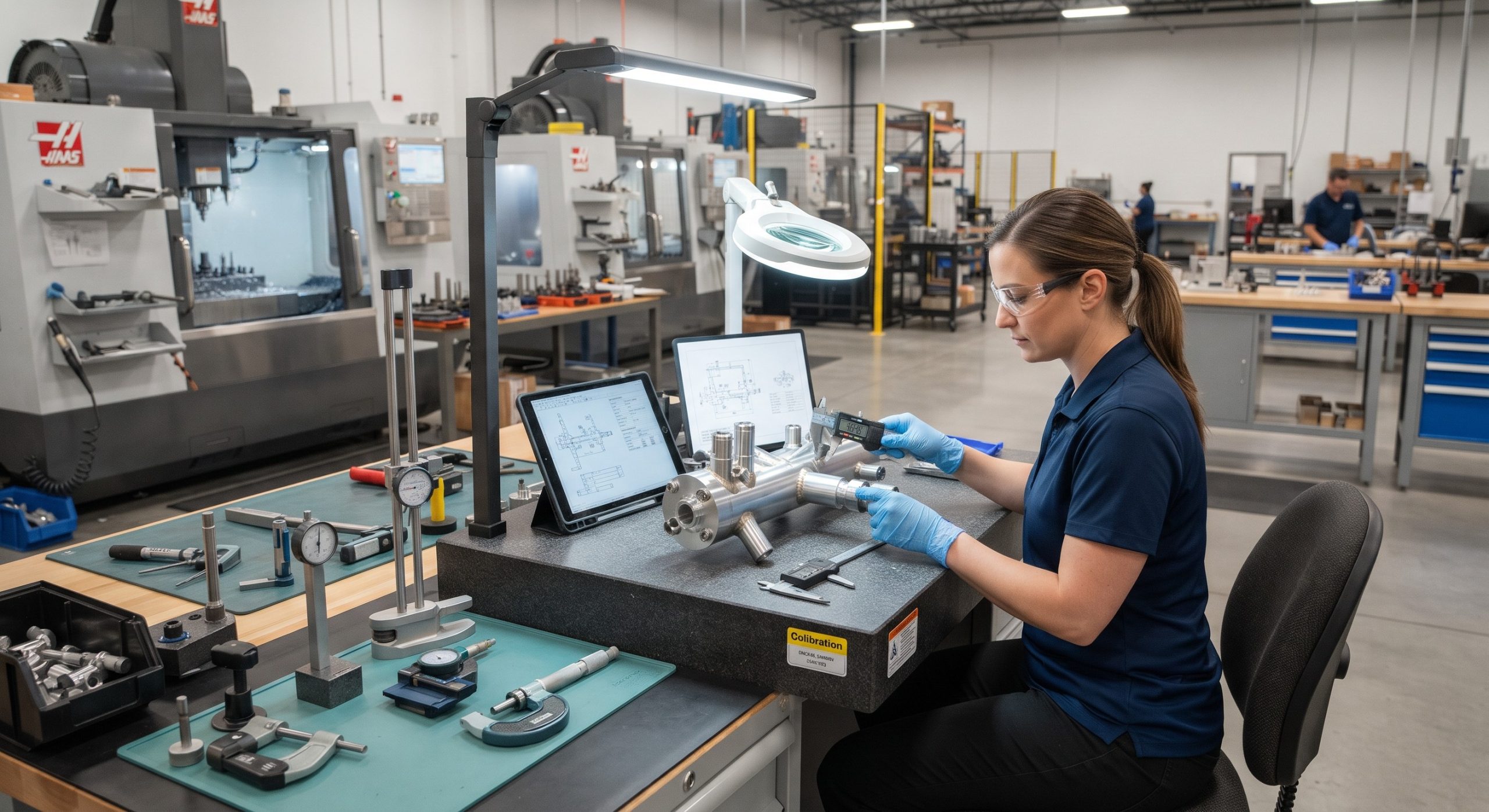
Every aesthetic laser depends on precise optical alignment between the laser bar array, the focusing lens, and the handpiece aperture. The mounting brackets and optical bench that hold these components are fabricated parts. If bracket flatness varies beyond ±0.05mm or mounting hole position drifts across a production lot, spot size uniformity degrades—producing hot spots that increase epidermal injury risk at fixed fluence settings. ISO 9001 clause 8.5.1 (control of production) requires documented parameter control and first-article inspection on every setup; process-driven fabricators apply this to CNC machining, sheet metal forming, and welding fixtures rather than relying on operator judgment.
Thermal Management and Cooling Circuit Integrity
Sapphire contact cooling and TEC-based epidermal protection depend on leak-free coolant manifolds and consistent thermal contact between the cold plate and the handpiece tip. Weld porosity or inconsistent braze coverage in a cooling manifold produces micro-leaks that emerge only under thermal cycling—a failure mode invisible at incoming inspection but catastrophic in the treatment room. Process-driven fabrication enforces welder qualification to ISO 9606, documented weld parameters, and helium leak testing at defined acceptance thresholds, all traceable to serialized work orders under ISO 9001 clause 8.5.2 (identification and traceability).
Surface Finish and Biocompatibility of Patient-Contact Parts
Handpiece housings and spacers that contact intact skin must meet cleanability and biocompatibility expectations consistent with ISO 10993 biological evaluation. Ra surface finish, passivation of stainless components, and elimination of trapped geometries are fabrication-controlled characteristics. A supplier operating under ISO 9001 with documented process validation (clause 8.5.1) can demonstrate finish consistency lot-to-lot rather than certifying it by exception.
Critical Fabrication Output Metrics for Medical Aesthetic OEMs
The following specification table summarizes the fabrication-controlled characteristics that most directly influence aesthetic laser performance and regulatory standing. These are the metrics to request in a supplier capability statement and verify during a source inspection.
| Fabrication-Controlled Characteristic | Typical Specification for Aesthetic Laser Hardware | Clinical / Regulatory Impact |
|---|---|---|
| Optical mount flatness and hole position | ±0.05mm flatness; ±0.03mm hole position; Cpk ≥ 1.33 | Spot size uniformity and fluence consistency across handpiece aperture |
| Cooling manifold weld integrity | Qualified welders to ISO 9606; helium leak test ≤ 1×10⁻⁶ mbar·L/s | Sapphire/TEC cooling reliability; prevents field coolant leaks |
| Patient-contact surface finish | Ra ≤ 0.8 µm on handpiece housings; passivated stainless | Cleanability and ISO 10993 biocompatibility support |
| Material traceability | Mill certificates linked to part serial number; retention per device lifetime | ISO 13485 clause 7.5.2 traceability; audit readiness |
| Inspection equipment calibration | Current certificates within defined interval (ISO 9001 clause 7.1.5) | Validity of dimensional and finish inspection data |
| Change notification control | Contractual pre-notification before process/material/sub-supplier change | Medical CE technical file integrity; 510(k) production equivalence |
| Process capability reporting | Cpk ≥ 1.33 on critical dimensions; SPC charts per lot | Design transfer evidence under ISO 13485 clause 7.5.1 |
Auditing a Fabrication Partner: A Clause-by-Clause Qualification Protocol
Documentation and Traceability Requirements
- Scope statement review: confirm the ISO 9001 certificate scope explicitly covers the fabrication processes you are outsourcing (CNC machining, sheet metal, welding, surface treatment)—not a sister facility.
- Device master record linkage: require that fabrication work orders reference your ISO 13485 device master record and that material certificates (mill certs, heat lot numbers) are retained for the device lifetime or defined retention period.
- Change notification clause: contractual obligation to notify your quality team before process, material, or sub-supplier changes—this is the single most common gap that triggers Medical CE technical file remediation.
- Nonconformance and CAPA records: request 12 months of NCR data and verify root-cause closure rates, not just closure counts.
Process Validation and Equipment Calibration
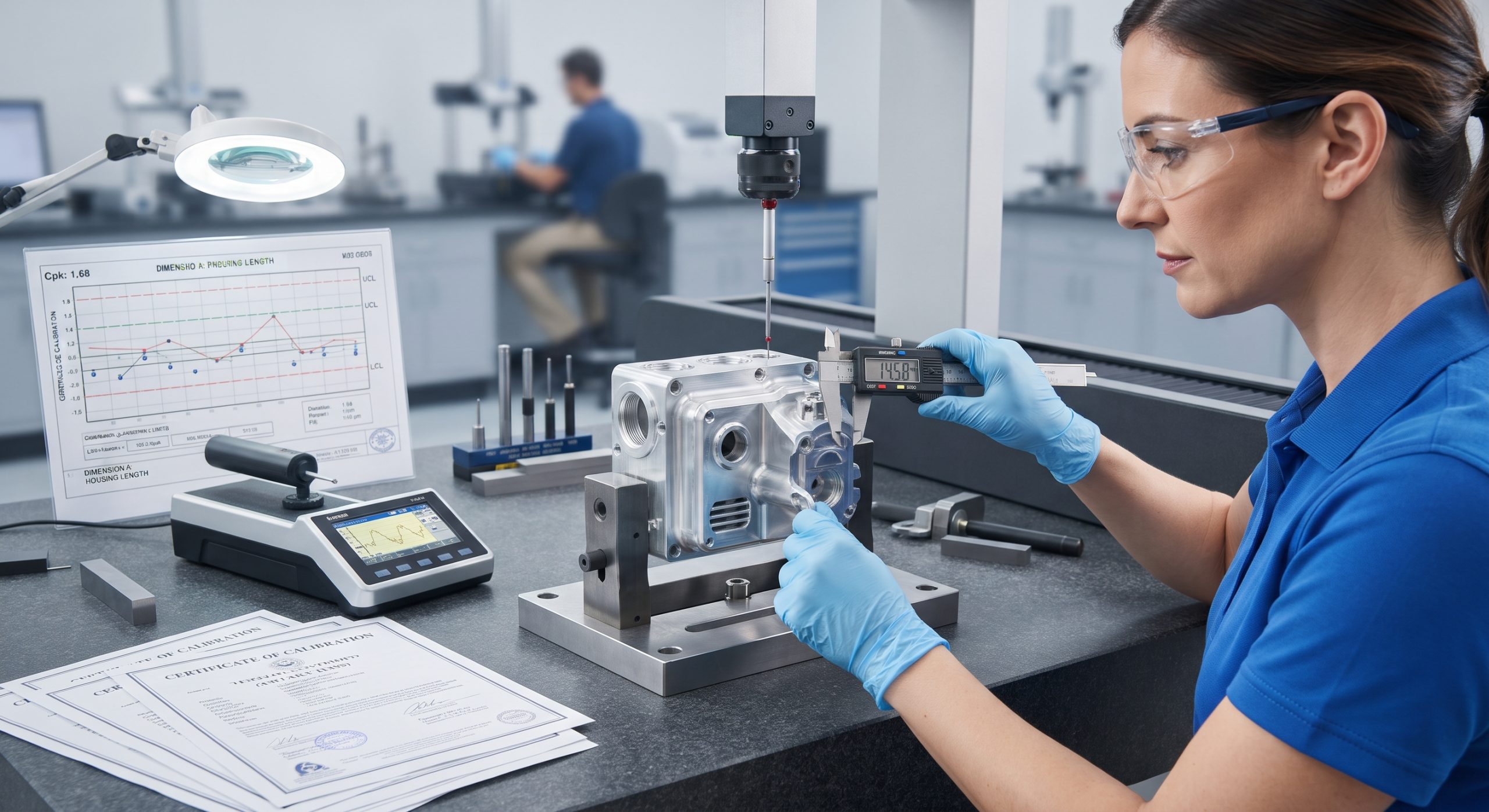
Ask for calibration certificates on all measurement equipment used for critical-to-quality characteristics, and for process validation records (IQ/OQ/PQ where applicable) on welding, heat treatment, and surface finishing. Under ISO 9001 clause 7.1.5, monitoring and measuring resources must be calibrated at defined intervals; a fabrication partner that cannot produce current calibration records for its CMM or profilometer cannot substantiate the dimensional data in its inspection reports.
First-Article Inspection and Ongoing Capability
A credible supplier performs AS9102-style or equivalent first-article inspection on new tooling and reports process capability (Cpk) on critical dimensions. For aesthetic device components, target Cpk ≥ 1.33 on optical mounting interfaces and cooling circuit sealing surfaces. Request SPC control charts for these characteristics across the last three production lots—process-driven fabrication shows stable control limits, not just in-tolerance results.
Regulatory Alignment: How Fabrication Discipline Supports FDA, Medical CE, and ISO 13485
Supplier Control Under ISO 13485 Clause 7.4
Your notified body and FDA auditor will examine supplier evaluation and re-evaluation records. A fabrication partner operating a genuine ISO 9001 QMS—with documented purchasing controls, incoming inspection, and process monitoring—reduces the audit burden on your organization and provides the objective evidence that clause 7.4.1 requires. Fabrication suppliers without certified systems shift verification responsibility entirely onto your incoming inspection, which is both costly and statistically weak for characteristics like weld integrity.
Design Transfer and Production Equivalence
When transferring a validated design into production, ISO 13485 clause 7.5.1 requires documented evidence that production outputs meet design outputs. Fabrication process capability data, first-article inspection reports, and controlled process parameters form the backbone of that evidence package. OEMs preparing 510(k) or Medical CE technical files should treat fabrication process validation records as part of the design history file, not as shop-floor paperwork.
Practical Procurement Checklist
- Current ISO 9001 certificate with verified scope and accreditation body.
- Documented supplier change notification and CAPA interface procedures.
- Material traceability from mill certificate to finished part serial number.
- Calibrated inspection equipment with certificates within interval.
- First-article inspection and Cpk data on critical-to-quality dimensions.
- Weld qualification records and leak-test acceptance criteria for fluid circuits.
- Surface finish and passivation validation for patient-contact components.
Commercial Impact and Conclusion: Process Discipline as Total Cost of Ownership
Fabrication defects in aesthetic devices rarely surface as incoming inspection failures—they surface as field service events: coolant leaks that take a handpiece out of service, alignment drift that forces recalibration, and finish inconsistencies that complicate cleaning validation. Each event carries direct service cost, downtime at the clinic, and reputational exposure for the OEM. An ISO 9001 process-driven fabrication partner reduces these failure modes through prevention rather than detection, and provides the documented evidence your ISO 13485 system, Medical CE technical file, and FDA quality records require. For OEMs scaling production of 755nm/808nm/1064nm diode platforms, the procurement decision should weigh fabrication process capability alongside laser bar quality and cooling architecture—because clinical reliability is built from both.