
Resource
Selective Photothermolysis Architecture Reference Document: High-Frequency In-Motion Diode Laser
SELECTIVE PHOTOTHERMOLYSIS ARCHITECTURE REFERENCE DOCUMENT: HIGH-FREQUENCY IN-MOTION DIODE LASER
EXECUTIVE SUMMARY
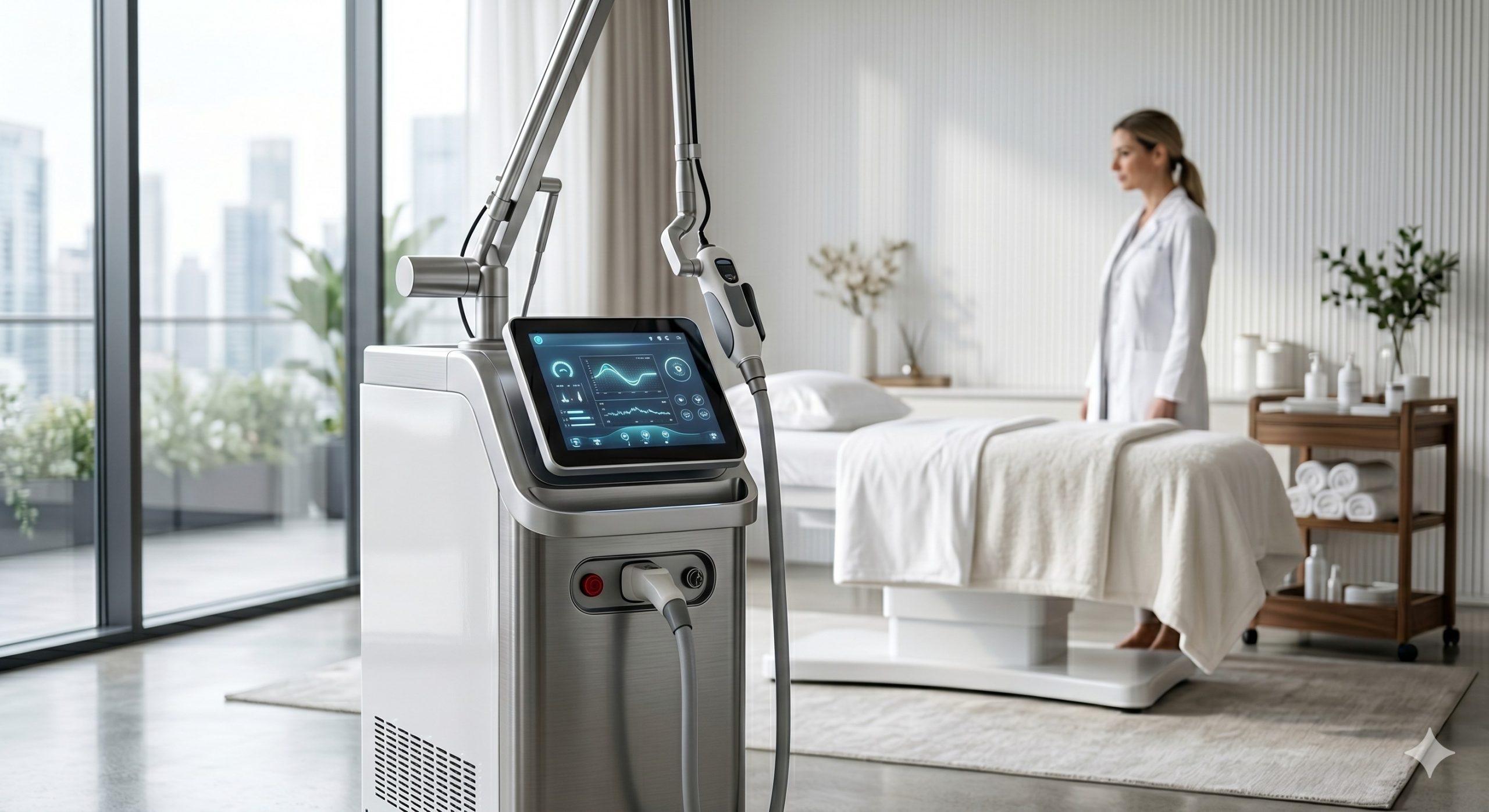
This document delineates the clinical engineering principles, performance architecture, and operational specifications of the High-Frequency In-Motion Diode Laser system. Designed to reconcile maximum thermolytic efficacy with uncompromised epidermal safety, the platform leverages a rapid pulse repetition rate and a proprietary in-motion delivery logic. By decoupling thermal relaxation time constraints from operator hand speed, the device enables homogeneous volumetric heating of follicular and vascular chromophores while maintaining a sub-threshold epidermal temperature. This whitepaper serves as the definitive technical reference for clinical procurement, biomedical engineering validation, and regulatory compliance assessment.
CLINICAL ARCHITECTURE & DESIGN
Optical Source & Pulse Generation Architecture
The system integrates a hermetically sealed, conduction-cooled diode laser stack employing indium-free gold-tin bonding for enhanced thermal fatigue resistance. The oscillator-amplifier configuration delivers a fundamental wavelength of 808 nm (dominant chromophore: melanin and oxyhemoglobin) with optional discrete channels at 755 nm and 1064 nm via a precision dichroic combiner. The high-frequency driver topology generates repetition rates from 2 Hz up to 25 Hz at pulse widths adjustable between 5 ms and 400 ms. This rapid pulsing regime creates a quasi-continuous thermal envelope, maximizing treatment speed for large surface areas such as the back or full-leg zones.
In-Motion Delivery Logic
Unlike conventional stationary stamping techniques that rely on single high-fluence pulses, the in-motion algorithm continuously correlates handpiece velocity (derived from an integrated 9-axis inertial measurement unit) with pulse frequency. The system automatically adjusts the inter-pulse spacing to maintain a 15-25% overlapping treatment track. Safety interlocks immediately suspend laser emission if handpiece motion drops below a validated 5 mm/s threshold, preventing intra-epidermal heat stacking and blister formation.
KEY INDICATIONS & CAPABILITIES
– Permanent Hair Reduction (Fitzpatrick Skin Types I-V)
– Acne Vulgaris Clearance (Inflammatory & Comedonal)
– Vascular Lesions (Telangiectasias, Cherry Angiomas)
– Pigmented Lesions (Lentigos, Ephelides)
– Non-Ablative Skin Rejuvenation (Collagen remodeling via sub-lethal thermal injury)
COMPLIANCE & STANDARDS
The device carries full conformity assessment under Council Directive 93/42/EEC (Medical Device Directive) as amended by 2007/47/EC. Specific certifications include: IEC 60825-1:2014 (Class 4 Laser Product), IEC 60601-1 (General Electrical Safety), IEC 60601-2-22 (Surgical, Cosmetic, Therapeutic Laser Equipment). FDA 510(k) cleared as a prescription-use aesthetic laser system. Risk management to ISO 14971:2019. All manufacturing facilities are ISO 13485:2016 certified.
TECHNICAL SPECIFICATIONS
| Parameter | Specification |
|---|---|
| Laser Medium | Gallium-Arsenide (GaAs) Diode Stack |
| Wavelengths (Selectable) | 755 nm / 808 nm / 1064 nm (±5 nm) |
| Maximum Output Power | 600 W (808 nm); 480 W (755 nm); 400 W (1064 nm) |
| Fluence Range | 1 – 120 J/cm² (depending on spot size and pulse width) |
| Spot Size (Standard) | 12 x 12 mm square (144 mm²) |
| Spot Size (Optional) | 15 x 15 mm (225 mm²), 6 x 6 mm (36 mm²), 6 mm round |
| Pulse Repetition Rate | 1 – 25 Hz (continuous adjustment) |
| Pulse Width Range | 5 ms – 400 ms (1 ms increments) |
| Cooling System | Dual-stage TEC + Sapphire contact + Closed-loop water circulation + Forced air |
| Sapphire Plate Temperature | -4°C to +20°C (proportional control, ±1°C accuracy) |
| Display Interface | 10.4” Industrial Capacitive Touchscreen (800×600) |
| Electrical Requirements | 110-240 VAC, 50/60 Hz, 15A (peak input 1800 VA) |
| Dimensions (Main System) | 420 mm (W) x 520 mm (D) x 1050 mm (H) |
| Weight (Full Assembly) | 38 kg (84 lbs) |
| Operating Conditions | Ambient 15°C – 30°C, Humidity 30% – 75% non-condensing |
CLINICAL PROTOCOLS
Hair Removal – In-Motion Technique
– Fluence Range: 8-14 J/cm² (upper body: axilla, bikini; lower fluence), 14-20 J/cm² (lower extremities, back)
– Repetition Rate: 10-15 Hz (standard); 6-10 Hz (skin type V)
– Number of Overlapping Passes: 2-4 bidirectional passes with 30% overlap
– Epidermal Protection: Dynamic cooling to -4°C via integrated sapphire plate; apply chilled ultrasound gel for skin types IV-V
Vascular Clearance – Stationary Mode
– Spot Size: 6 mm round (dedicated adapter)
– Fluence: 80-120 J/cm² (short pulse width 6-10 ms); 50-70 J/cm² (long pulse width 30-50 ms)
– Frequency: Single-shot or low repetition (1-2 Hz)
– Endpoint: Immediate purpura or vessel blanching; avoid overlapping within same session
Acne Therapy Protocol
– Wavelength: 755 nm preferred (sebaceous gland targeting) or 808 nm
– Fluence: 6-10 J/cm² (non-painful threshold)
– Pulse Width: 30-50 ms (selective thermal damage to Cutibacterium acnes and sebocytes)
– Frequency: 8-12 Hz in-motion scanning over active lesions; 3 weekly sessions initial cycle
Post-Treatment Management
Apply topical anti-inflammatory agent (corticosteroid or aloe vera). Strict photoprotection SPF 50+ for 4 weeks. Transient erythema and perifollicular edema resolve within 2-48 hours. For darker skin types (V), perform test spot at 8 J/cm² and observe for 48 hours.

📥 Download Technical Specification
Click the button below to view or download the full official PDF datasheet.