
Материал
Medical CE & FDA Technical Compliance Register: Product Safety Incident Escalation Workflow
CLINICAL SAFETY POSITIONING
The Product Safety Incident Escalation Workflow is a governed, closed-loop quality management subsystem engineered for medical aesthetic device platforms. It establishes a deterministic, auditable pathway for the identification, classification, reporting, and resolution of product safety incidents occurring during clinical operation. Designed in accordance with ISO 13485:2016 quality management principles and aligned with FDA 21 CFR Part 803 (Medical Device Reporting) and EU MDR 2017/745 post-market surveillance obligations, this workflow embeds patient safety at the center of the device lifecycle. It is not a standalone accessory; it is a native firmware-and-process framework that ensures every adverse event, near-miss, or device malfunction is captured at the point of care and escalated through a pre-validated chain of custody.
TEMPERATURE MONITORING CAPABILITIES
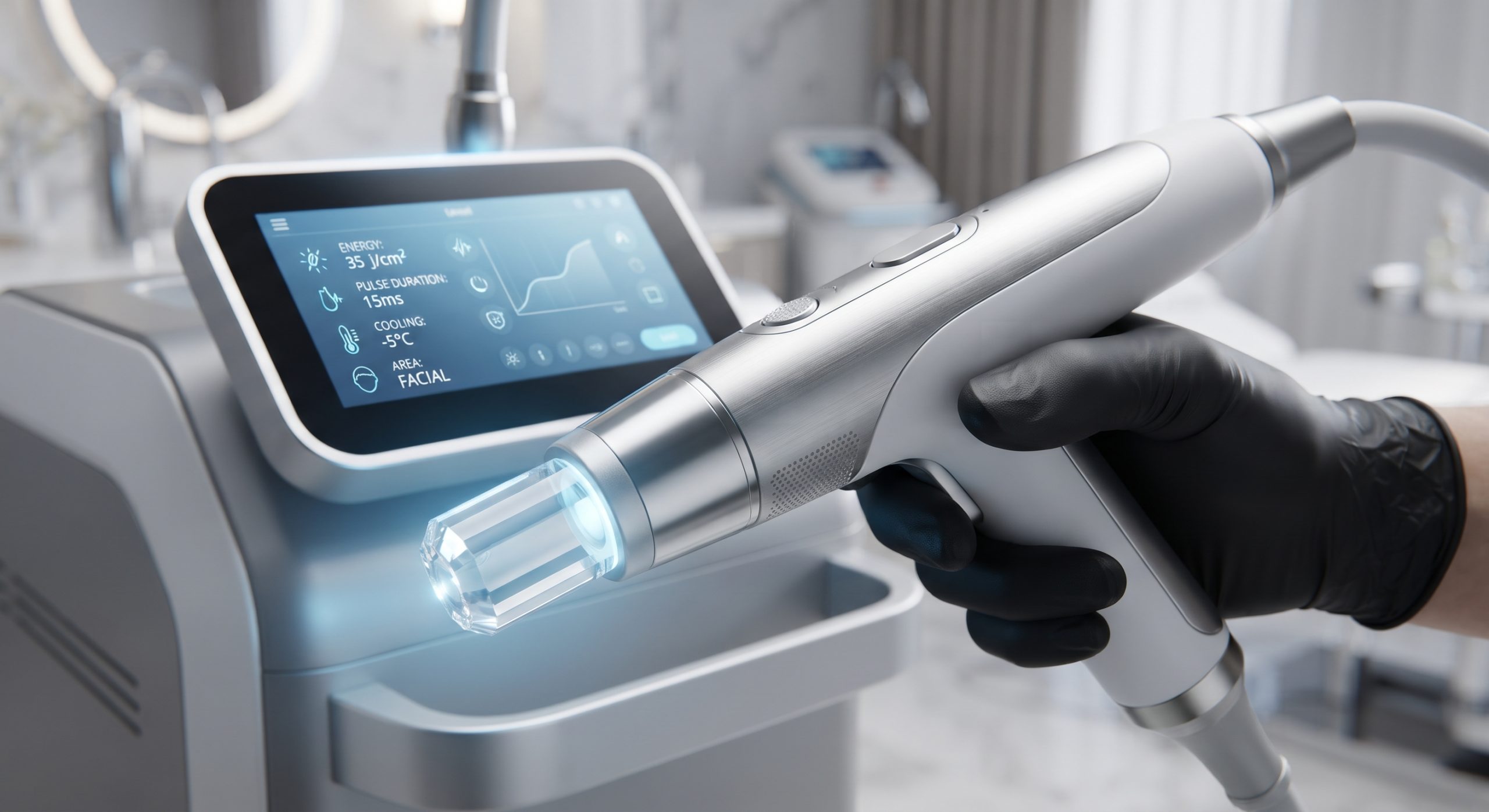
The workflow integrates continuous telemetry from the device’s thermal management subsystem, including TEC stack temperature, sapphire tip contact temperature, and coolant loop pressure. When a threshold breach is detected—such as a sapphire tip temperature exceeding 42°C or a coolant flow drop below 0.8 L/min—the system automatically generates a Tier-1 safety flag. This flag is time-stamped, geo-tagged to the clinical site, and locked from deletion, ensuring forensic integrity. Clinicians may also manually initiate a Tier-2 incident report via the touchscreen UI for observed adverse skin responses, unexpected fluence delivery, or handpiece anomalies. All telemetry is retained for a minimum of 7 years in compliance with device master record requirements.
PREMIUM COMPONENT ASSEMBLY
The escalation workflow is anchored in a redundant hardware architecture. A dedicated safety microcontroller operates independently of the main treatment CPU, monitoring watchdog timers and emergency stop circuits. The handpiece incorporates a dual-channel thermistor array with ±0.1°C accuracy, while the chassis houses an independent event logger with tamper-evident encrypted storage. This assembly ensures that incident data survives power interruption and cannot be altered post-capture. The workflow also supports integration with external quality management systems via HL7 or FHIR-compliant APIs, enabling seamless transmission of incident reports to the manufacturer’s post-market surveillance team.
DETAILED PARAMETERS
The following parameter registry defines the operational boundaries and escalation triggers for the Product Safety Incident Escalation Workflow. All thresholds are configurable by the OEM administrator and are locked against unauthorized modification via role-based access control.
| Parameter | Specification |
|---|---|
| Incident Classification Tiers | Tier-1 (Automated Threshold Breach), Tier-2 (Clinician-Reported Adverse Event), Tier-3 (Critical Malfunction / Patient Harm) |
| Escalation Response Time | Tier-1: <60 seconds automated alert; Tier-2: <4 hours to regional QA; Tier-3: <24 hours to OEM Regulatory Affairs |
| Temperature Monitoring Accuracy | ±0.1°C (dual-channel thermistor array, sapphire tip and TEC stack) |
| Data Retention Period | Minimum 7 years, tamper-evident encrypted storage (AES-256) |
| Audit Trail Compliance | 21 CFR Part 11 compliant electronic records and signatures |
| Integration Protocols | HL7 FHIR API, secure RESTful endpoint, offline-first local queue with automatic retry |
| Access Control | Role-based (Clinician, Clinical Lead, Regional QA Manager, OEM Regulatory Affairs) |
| Regulatory Reporting Support | FDA MDR (21 CFR 803), EU MDR Vigilance (Article 87), Health Canada Mandatory Problem Reporting |
MEDICAL CERTIFICATIONS
The Product Safety Incident Escalation Workflow is designed to support compliance with the following regulatory frameworks and standards: ISO 13485:2016 (Medical Devices — Quality Management Systems), ISO 14971:2019 (Application of Risk Management to Medical Devices), IEC 62304:2006/AMD1:2015 (Medical Device Software — Software Life Cycle Processes), IEC 62366-1:2015 (Usability Engineering), FDA 21 CFR Part 803 (Medical Device Reporting), FDA 21 CFR Part 820 (Quality System Regulation), EU MDR 2017/745 Annex IX (Conformity Assessment) and Chapter VII (Post-Market Surveillance), and Health Canada SOR/98-282 (Medical Devices Regulations). The workflow’s audit trail is designed to satisfy the data integrity requirements of 21 CFR Part 11 for electronic records and signatures.
CLINICAL ENVIRONMENT
The workflow is engineered for deployment across the full spectrum of medical aesthetic environments, from single-practitioner dermatology clinics to multi-site med spa fleets. In a single-clinic setting, incident reports are queued locally and transmitted to the OEM’s secure cloud portal upon network availability, with automatic retry and integrity verification. In enterprise fleet deployments, a centralized dashboard aggregates incident data across all sites, enabling trend analysis, root-cause investigation, and proactive field safety corrective actions (FSCA). The system supports multi-language incident forms, offline-first data capture, and role-based escalation matrices that route Tier-1 alerts to the on-site clinical lead, Tier-2 reports to the regional quality manager, and Tier-3 critical events to the OEM’s regulatory affairs division within 24 hours.
📥 Download Technical Specification
Click the button below to view or download the full official PDF datasheet.