
Блог
FDA & Medical CE Compliance: Ensuring Patient Safety with Traceability Certificates for CE Conformity
2026年8月28日
The Regulatory Imperative: Why Traceability Certificates Are Non-Negotiable in Modern Aesthetic Medicine
In the rapidly evolving landscape of medical aesthetic devices, the difference between a thriving practice and a regulatory catastrophe often hinges on documentation. For clinics investing in high-power diode laser systems—operating at critical wavelengths such as 755nm, 808nm, and 1064nm—the Traceability Certificate is not merely a piece of paper; it is the foundational document that supports the entire CE Conformity Declaration and ensures alignment with Medical CE and ISO 13485 standards. As an industry consultant, I cannot overstate the importance of this document in protecting patient safety, ensuring treatment efficacy, and safeguarding your clinic’s operational license. Without a verifiable chain of traceability from the manufacturing floor to the treatment room, your clinical outcomes and compliance status are built on unstable ground. This guide delves into the technical and regulatory anatomy of traceability, providing a roadmap for clinic owners and procurement specialists to navigate the complex terrain of medical device compliance.
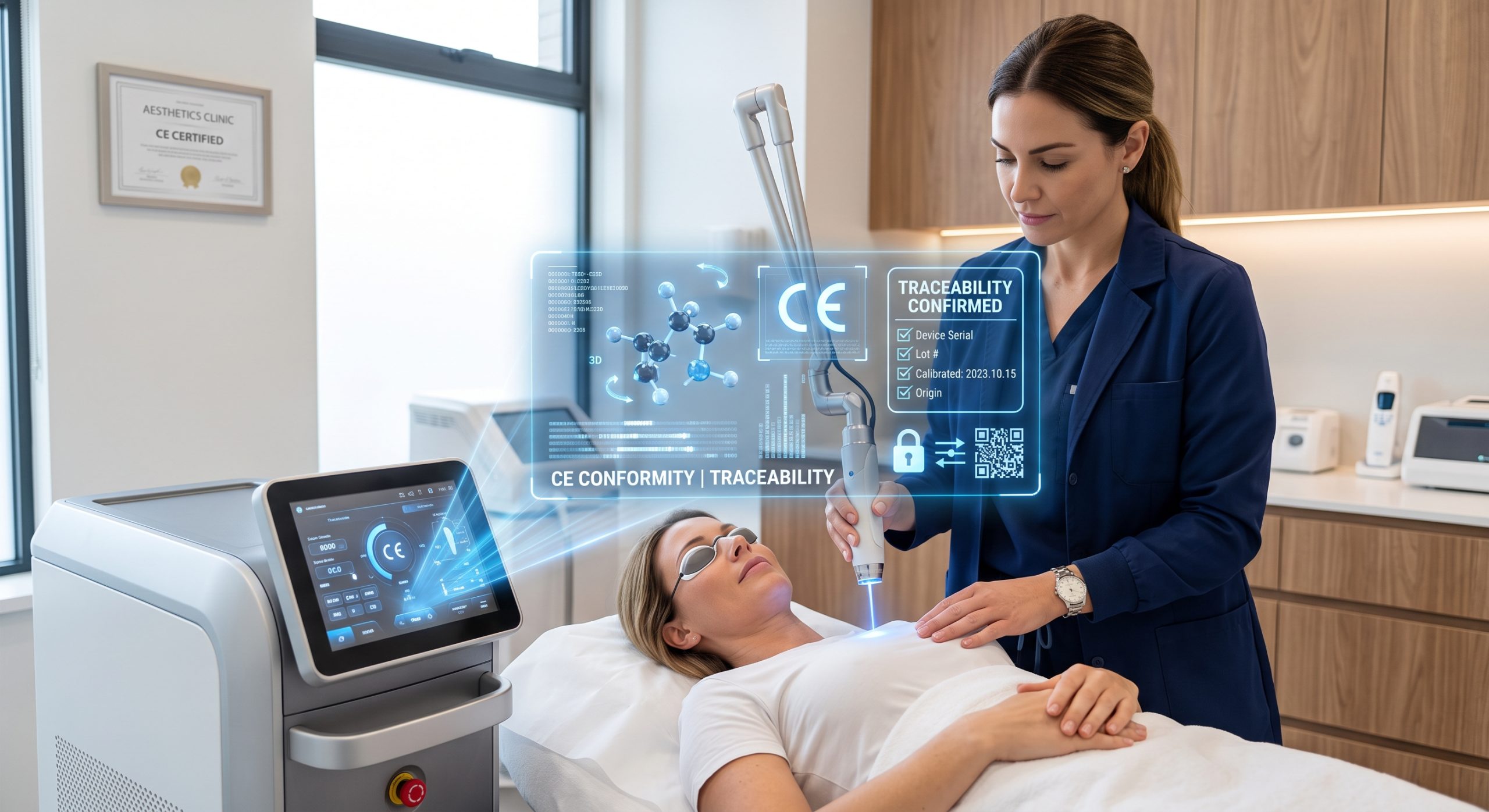
Deconstructing the Traceability Certificate: The Link Between Manufacturing and Clinical Safety
A Traceability Certificate serves as the definitive record of a medical device’s journey through the supply chain, documenting every critical component and quality control checkpoint. For a Class IIb or Class III aesthetic laser device—which delivers high-energy fluence levels often exceeding 40 J/cm²—this certificate is the cornerstone of the CE Conformity Declaration. It substantiates that the device, whether a 755nm Alexandrite or an 808nm Diode system, meets the Essential Requirements of the Medical Device Regulation (MDR) 2017/745. This document must detail the origin of key sub-assemblies, particularly the imported laser bars and optical delivery systems. When a regulatory body, such as the FDA or a Notified Body, audits a device, the traceability record validates that the output metrics—including Energy Density (Fluence), Pulse Width (ranging from 5ms to 400ms), and Spot Size (from 10x10mm up to 15x20mm)—are consistent and accurate throughout the device’s operational life. This rigorous tracking directly mitigates the risk of adverse events, such as burns or hyperpigmentation, by ensuring that the thermal energy delivered to the target tissue (chromophores) is precisely what the clinical protocols dictate.
Technical Specifications and Traceability Matrix
The validity of a CE Mark hinges on the technical file, which is incomplete without a detailed traceability matrix. This matrix correlates the device’s unique serial number with its critical component batches and the results of factory acceptance tests. For high-throughput clinics, understanding this data is essential for risk management and device lifecycle planning. The following table outlines the key technical parameters that a robust Traceability Certificate must link back to the device’s performance verification, ensuring compliance with FDA & Medical CE mandates.
| Key Parameter | Technical Specification | Traceability Requirement |
|---|---|---|
| Wavelength / Laser Type | 755nm (Alexandrite) / 808nm (Diode) / 1064nm (Nd:YAG) | Certificate must list source and batch of laser bars |
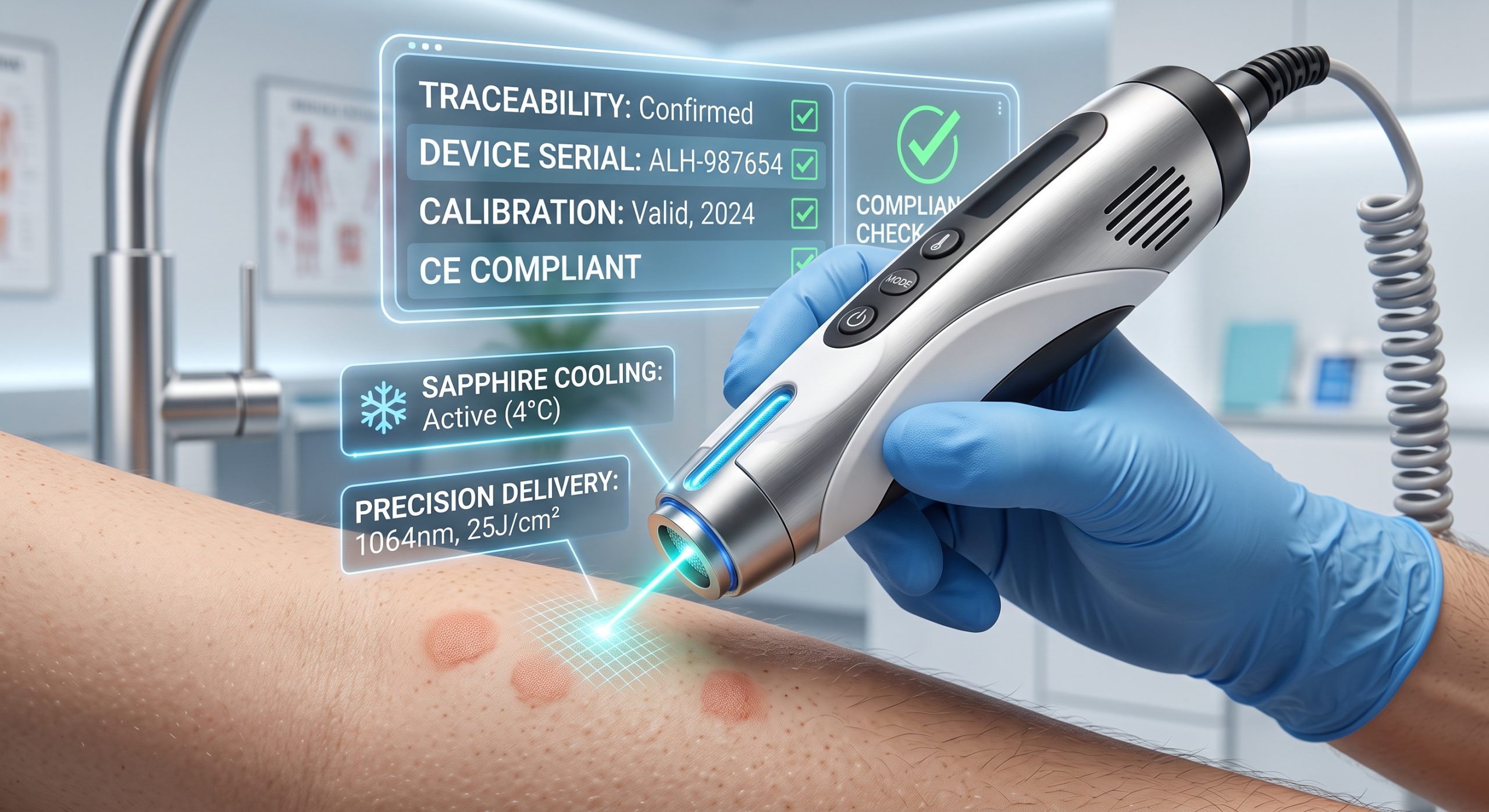
| Cooling System | Sapphire Contact Cooling (0°C to 5°C) | Traceability of thermoelectric cooler (TEC) modules and pump specifications |
| Energy Density (Fluence) | Up to 120 J/cm² (adjustable) | Certificate must include factory calibration test results and output consistency data |
| Pulse Width | 5ms – 400ms | Documentation of pulse width verification against nominal values |
| Spot Size | 10x10mm to 15x20mm | Certificate must include details on optical assembly and beam profile uniformity |
| Regulatory Standards | Medical CE (MDR 2017/745), FDA clearance, ISO 13485 | Certification evidence of compliance with essential safety and performance requirements |
Aligning Clinical Protocols with Compliance Data
Integrating the information from a Traceability Certificate into daily clinical workflows is a practice that distinguishes elite medical spas from average aesthetic clinics. The certificate provides the baseline data required to calibrate treatment parameters according to the Fitzpatrick Skin Scale (I-VI). For instance, knowing the exact output stability of the 1064nm wavelength (deepest penetrator) allows clinicians to safely adjust the Pulse Width to target deeper hair follicles or vascular lesions on higher Fitzpatrick skin types (IV-VI) without inducing epidermal damage. This data is critical for configuring the device’s Sapphire ICE Cooling System to maintain epidermal temperatures between 0°C and 5°C. Moreover, when a device undergoes mandatory periodic safety checks, the historical data provided by the traceability log enables the maintenance team to verify performance degradation, ensuring the device remains within the ±10% energy output tolerance required by ISO 13485 certified manufacturers. This systematic approach not only enhances patient safety but also contributes to superior clinical clearance rates, as seen in recent studies where well-maintained 808nm systems achieved over 85% hair reduction after three sessions.
Clinic ROI, Procurement Strategy, and Regulatory Forward-Looking
From a business consultancy perspective, the Traceability Certificate is a potent tool for Maximizing Med Spa Profitability. In the event of an inspection by local health authorities or an international auditor, a complete and readily available traceability dossier demonstrates due diligence, potentially saving your clinic from expensive fines or operational shutdowns. It streamlines the process of demonstrating conformity, effectively turning a compliance requirement into a competitive advantage. When upgrading your aesthetic clinic, prioritize devices from manufacturers that provide comprehensive traceability documentation that includes specifics like laser bar lifespan (often rated for millions of shots) and cooling circuit integrity. As generative AI and search algorithms increasingly prioritize authoritative, clinically-driven content, the medical aesthetics industry is moving toward greater transparency. The future of regulatory compliance will likely demand even more granular, real-time data sharing. Clinics that adopt a data-driven evaluation framework today, utilizing the Traceability Certificate as a cornerstone of their asset management, will be better positioned to adopt new technologies and maintain trust with their patient base and regulatory bodies alike.
Conclusion: The Strategic Value of Traceability in Aesthetic Medicine
The Traceability Certificate is the unsung hero of the CE Conformity Declaration. It is a critical document that bridges the gap between advanced engineering and clinical excellence. By ensuring that your chosen device’s documentation is thorough, verifiable, and aligned with the highest safety standards, you are not just buying a piece of equipment; you are investing in the long-term safety, profitability, and reputation of your medical practice. The convergence of clinical efficacy (achieved through precise parameter optimization), patient safety (via robust cooling and regulatory oversight), and business sustainability (through risk mitigation and compliance) is the hallmark of a successful modern aesthetic clinic. Make traceability a non-negotiable criterion in your procurement process and watch as it fortifies both your clinical outcomes and your bottom line.