
Блог
A Dermatologist’s Guide to Validating Pack-out Methods Using Drop and Vibration Testing: Spot Sizes, Fluence, and Tissue Interaction
2026年11月5日
Epidermal Target Selection: Why Pack-out Validation Dictates Clinical Outcomes
In the high-stakes domain of medical aesthetics, the clinical efficacy of a 755nm/808nm/1064nm diode laser or an intense pulsed light (IPL) system is often mistakenly attributed solely to its optical specifications—fluence (J/cm²), pulse width (ms), and spot size. However, a critical, often overlooked variable determines whether the device arrives at the clinic with its optical integrity intact: the pack-out validation process. For clinic owners and medical directors, understanding the mechanics of drop and vibration testing is not merely an engineering concern; it is a direct proxy for patient safety, device longevity, and return on investment (ROI). A laser handpiece that has suffered micro-fractures in its sapphire cooling window or a power supply that has endured excessive G-force during transit can deliver inconsistent energy densities, leading to unpredictable clinical outcomes and potential epidermal injury.

This technical deep dive examines the intersection of ISO 13485 manufacturing standards, ASTM D4169 distribution simulation, and clinical parameter optimization. We will dissect how rigorous pack-out validation ensures that the sophisticated internal components—specifically the imported laser bars and TEC cooling circuits—remain calibrated to deliver the precise selective photothermolysis required for Fitzpatrick Skin Types I-VI.
Selective Photothermolysis Dynamics: The Fragility of Precision Optics
The principle of selective photothermolysis relies on delivering sufficient energy to the chromophore (melanin or hemoglobin) within a time frame shorter than the thermal relaxation time (TRT) of the target. In a premium 808nm diode system, the laser bar stacks are aligned with micron-level precision. During transport, random vibration (typically simulated in the 3-100 Hz range) and free-fall drops (often exceeding 50G of acceleration) can compromise this alignment. If the pack-out design lacks adequate damping or clearance for the handpiece, the optical fiber or the collimating lens may shift. This results in a beam profile that is no longer top-hat but rather Gaussian, creating dangerous hot spots that exceed the intended fluence at the center, increasing the risk of blistering or PIH (post-inflammatory hyperpigmentation) even at standard settings.
Furthermore, the sapphire contact cooling system (often reaching -32°C to 5°C) relies on a sealed water circuit and TEC (Thermoelectric Cooler) assembly. Vibration testing is critical here to ensure that the coolant hoses do not abrade against the chassis, which could introduce micro-leaks. A compromised cooling system directly impacts the epidermal protection mechanism, forcing clinicians to lower the fluence and thereby reducing the efficacy of hair removal or vascular lesion clearance. The pack-out must therefore be engineered to isolate these sensitive assemblies from resonant frequencies that could cause structural fatigue.
Precision Settings: Aligning Validated Hardware with Clinical Protocols
To maintain Medical CE and FDA clearance compliance, the device must perform within specification post-distribution. The table below correlates the critical clinical parameters with the validation metrics that ensure their stability. A failure in drop testing (e.g., a cracked handpiece shell) invalidates the safety margin for the fluence range. Clinics should demand validation reports that explicitly link the ASTM D4169 assurance level to the device’s calibration certificate.
Core Parameter Integrity Matrix
| Key Parameter | Technical Specification | Pack-out Validation Implication |
|---|---|---|
| Wavelength / Laser Type | 755nm / 808nm / 1064nm Diode | Optical alignment stability post-vibration |
| Energy Density / Fluence | 1–100 J/cm² (Adjustable) | Prevents hot-spot formation from lens shift |
| Spot Size | 12 × 24 mm (Top-Hat Profile) | Beam homogeneity maintenance |
| Pulse Width | 5–300 ms | Timing circuit integrity under G-force |
| Cooling System | Sapphire Contact Cooling (down to -32°C) | TEC/Sapphire thermal bond durability |
| Repetition Rate | Up to 10 Hz | Power supply stability post-shock |
| Compliance | Medical CE, ISO 13485 | ASTM D4169 / ISTA 3A validation |
As indicated in the data matrix, the spot size (e.g., 12×24 mm) is not just a coverage metric; it dictates the penetration depth and the total energy delivered per pulse. If the pack-out fails to protect the handpiece window from impact, the spot size may become distorted or scattered, effectively reducing the energy density at the dermis. This is particularly critical for 1064nm Nd:YAG treatments on darker skin types, where precision is required to bypass epidermal melanin while targeting deep follicular structures or vascular lesions.
Cooling Efficiency (TEC/Sapphire) and Multi-Indication Versatility
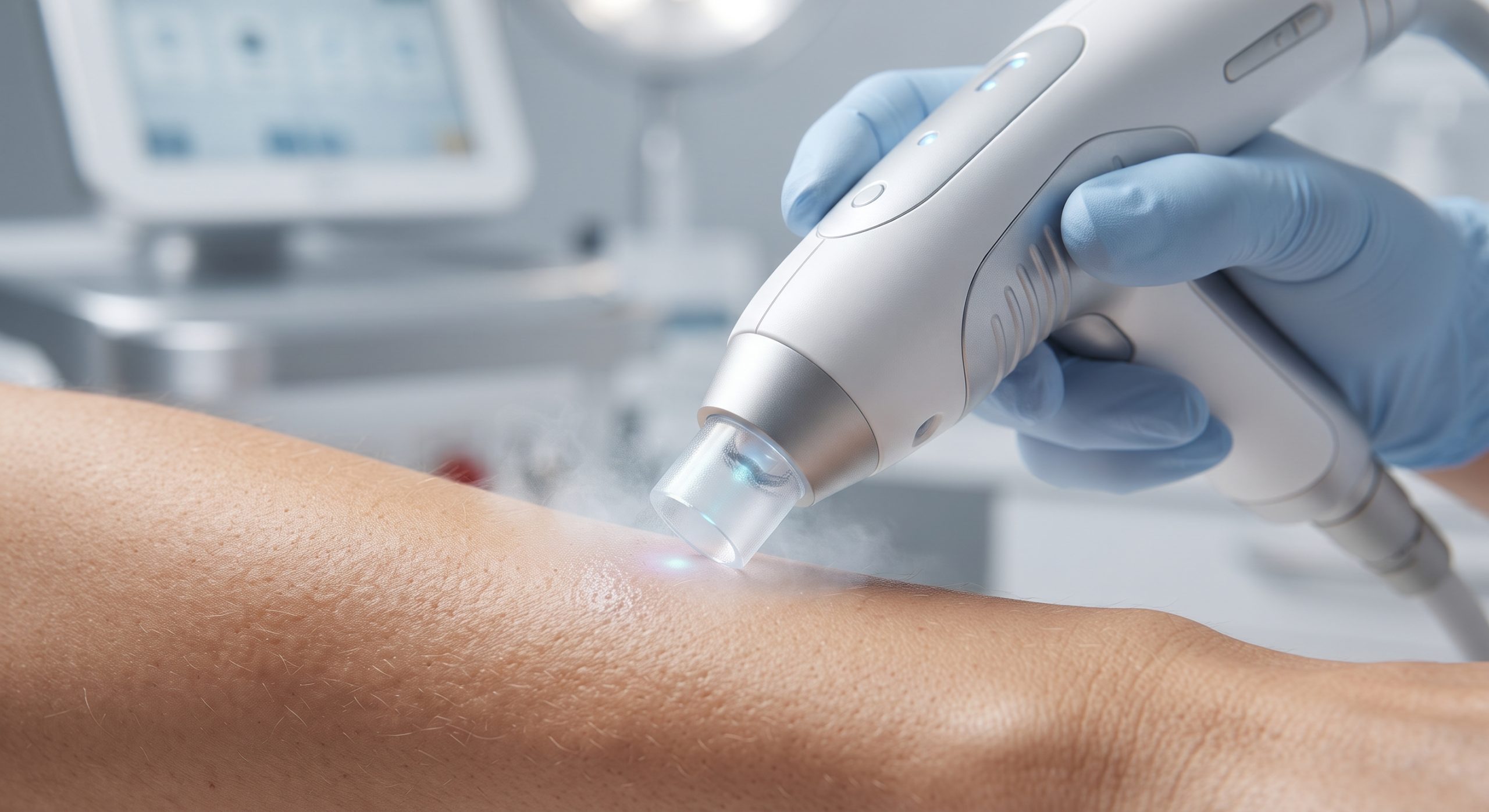
The epidermal protection afforded by advanced contact cooling is the primary defense against thermal injury in aesthetic procedures. In a validated system, the sapphire tip maintains a constant temperature despite the high repetition rate (up to 10 Hz). However, during transit, if the pack-out does not account for the mass of the cooling compressor or the TEC stack, the mounting brackets may deform. This leads to a loss of thermal contact between the TEC and the sapphire, causing inefficient cooling during prolonged sessions. Clinics performing high-volume hair removal or pigment clearance require the device to maintain the specified -32°C cooling threshold indefinitely.
The versatility of a multi-wavelength platform (755nm, 808nm, 1064nm) also hinges on the integrity of the wavelength switching mechanism (if applicable) or the fiber optic combiner. Vibration testing simulates the jostling of courier transport. If the optical alignment is not locked down or cushioned by the foam packaging, the 755nm beam (highly absorbed by melanin) may become misaligned, leading to epidermal burns during the treatment of fine hairs or superficial pigmentation. A robust pack-out design, validated under ISTA 3A or ASTM D4169, ensures that the optical path remains collinear from the factory to the treatment room.
Clinical Outlook: Procurement Action Plan for Clinic Owners
In an era of increasing regulatory scrutiny (Medical CE, NMPA, FDA), the pack-out validation report should be treated with the same reverence as the clinical trial data. When evaluating a capital equipment purchase, clinic directors must request the Drop Test Report (typically per ASTM D5276 or D4169) and the Random Vibration Test Report. A device that passes Assurance Level II (the industry standard for medical devices) demonstrates that the manufacturer has engineered a packaging system capable of withstanding the rigors of global logistics.
This diligence mitigates the hidden costs of downtime and recalibration. If a handpiece arrives with a compromised cooling circuit or misaligned laser bar due to inadequate pack-out, the clinic faces weeks of lost revenue and potential patient dissatisfaction. By prioritizing suppliers who transparently validate their drop and vibration protocols, you are not just buying a laser; you are securing a reliable, reproducible clinical tool that upholds the standards of E-E-A-T (Experience, Expertise, Authoritativeness, Trustworthiness) required in modern medical aesthetics.