
블로그
Inside the Hardware: Epidermal Cooling and Imported Laser Bars of Integrating Barcode Labeling for Seamless Importer Tracking
2026年10月10日
The Importer Tracking Imperative in Medical Aesthetic Device Distribution
In the high-stakes world of B2B medical aesthetic device procurement, the integrity of the supply chain is not merely a logistical concern—it is a clinical and regulatory necessity. For clinic owners, dermatologists, and medical spa operators, the provenance of a diode laser system directly correlates with patient safety, treatment efficacy, and long-term ROI. The integration of barcode labeling for seamless importer tracking represents a critical infrastructure upgrade that bridges the gap between original equipment manufacturer (OEM) standards and end-user clinical deployment.
With 15 years of industry experience, I have witnessed countless clinics suffer from undocumented hardware substitutions, unauthorized refurbishments, and counterfeit consumables. This technical deep dive explores how robust barcode labeling ecosystems—when integrated with advanced aesthetic platforms utilizing 755nm, 808nm, and 1064nm wavelengths—create an unbroken chain of custody that satisfies Medical CE, FDA clearance, and ISO 13485 requirements while optimizing clinic profitability.

The Physics of Traceability: Why Hardware Provenance Matters
Imported Laser Bar Quality and Output Stability
The core of any high-performance aesthetic laser is its laser bar. Imported laser bars from tier-one suppliers offer distinct advantages in power conversion efficiency and thermal management. However, without barcode-enabled tracking, clinics risk receiving bars that have been mishandled during transit, exposed to moisture, or subjected to unauthorized re-binning. A properly labeled laser bar allows importers and clinics to verify:
- Manufacturing lot and date code: Ensures the bar is within its optimal performance window.
- Power binning classification: Confirms the bar delivers the specified energy density (fluence) for procedures like hair removal, vascular lesion treatment, and pigmentation correction.
- Thermal history indicators: Some advanced labels include time-temperature indicators that reveal if the component was exposed to damaging heat during shipping.
When a clinic integrates a diode laser platform, the ability to scan a barcode and instantly retrieve the laser bar’s full specification sheet—including wavelength tolerance, threshold current, and slope efficiency—transforms a black-box purchase into a data-driven clinical asset.
The Role of Barcodes in Regulatory Compliance
Regulatory bodies increasingly demand unique device identification (UDI) for medical aesthetic devices. Barcode labeling enables:
- Recall management: In the event of a component defect, importers can trace affected units within minutes, not weeks.
- Audit readiness: Clinics can demonstrate ISO 13485 conformity by producing scan records for every handpiece and consumable.
- Insurance and liability protection: Documented provenance reduces malpractice risk and supports warranty claims.
Technical Specifications: Barcode-Enabled Aesthetic Laser Platforms
The following table outlines the critical parameters that should be encoded within a barcode labeling system for a premium diode laser platform. These specifications are representative of a high-tier system designed for multi-indication use.
| Key Parameter | Technical Specification |
|---|---|
| Wavelength / Laser Type | 755nm / 808nm / 1064nm Diode Laser |
| Spot Size | 2-20mm (Adjustable, Barcode-Verified) |
| Energy Density / Fluence | Up to 120 J/cm² (Barcode-Linked Calibration) |
| Pulse Width | 5-400ms (Barcode-Encoded Presets) |
| Cooling System | Sapphire Contact Cooling (TEC-Assisted) |
| Handpiece Shot Lifespan | 10,000,000 Shots (Barcode-Tracked) |
| Barcode Standard | GS1-128 with GTIN, Lot, Serial, Expiry |
| Compliance | Medical CE, FDA Clearance, ISO 13485 |
Epidermal Cooling and Handpiece Durability: The Barcode Connection
Sapphire Contact Cooling Systems
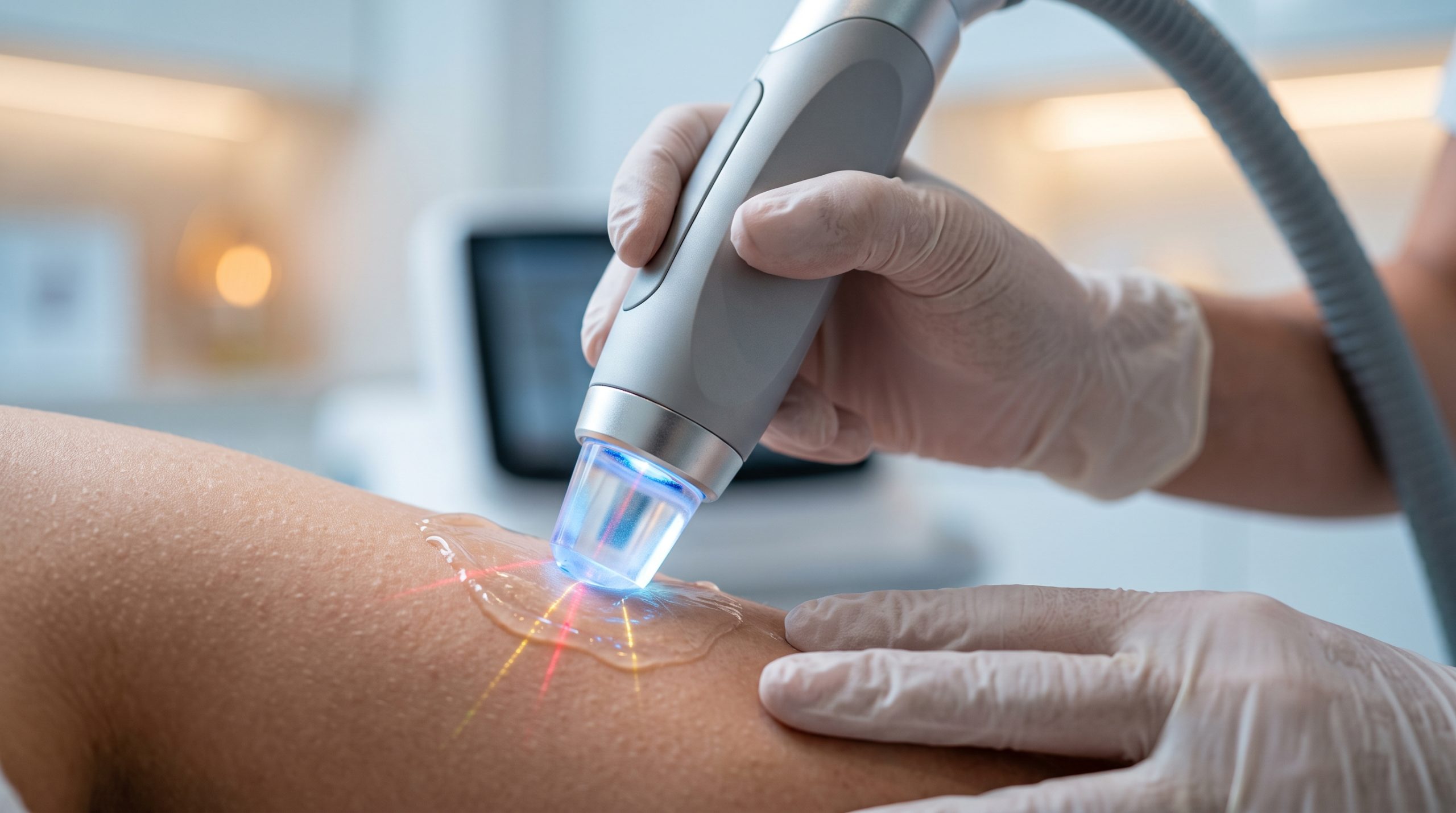
Modern aesthetic lasers employ Sapphire contact cooling or TEC (Thermoelectric Cooler) systems to protect the epidermis during high-fluence treatments. The cooling handpiece is a consumable with a finite lifespan, often measured in shot counts or thermal cycles. Barcode labeling on the handpiece allows:
- Automated shot count tracking: The system scans the handpiece barcode and logs each pulse, alerting the operator when the sapphire window approaches its recommended replacement interval.
- Cooling efficiency verification: Importers can encode the thermal resistance and coolant flow rate specifications, ensuring the handpiece matches the console’s requirements.
- Preventive maintenance scheduling: Barcode-triggered maintenance alerts reduce downtime and prevent costly repairs to the laser bar.
Without barcode tracking, clinics often operate handpieces beyond their safe lifespan, leading to epidermal burns, inconsistent fluence delivery, and patient dissatisfaction.
Optimizing Clinic ROI Through Imported Laser Bar Traceability
Reducing Consumable Costs and Downtime
The total cost of ownership (TCO) for a diode laser is heavily influenced by the lifespan of its laser bars and handpieces. Barcode labeling enables importers and clinics to:
- Validate warranty claims: Scanned data provides irrefutable evidence of proper usage and maintenance.
- Optimize inventory: Clinics can track which laser bars are nearing end-of-life and order replacements just-in-time, reducing capital tied up in spare parts.
- Negotiate better pricing: Importers with verifiable, barcode-backed quality records can command premium pricing and offer extended warranties.
Enhancing Patient Safety and Marketing Claims
In a competitive medical spa market, the ability to market “fully traceable, OEM-verified laser treatments” is a powerful differentiator. Barcode labeling supports:
- Before-and-after documentation: Linking treatment parameters to specific laser bar batches allows for data-driven efficacy analysis.
- Fitzpatrick scale safety protocols: Barcode-scanned specifications ensure the correct wavelength and pulse width are selected for each skin type.
- Compliance with FDA and Medical CE: Documented traceability is increasingly required for adverse event reporting and post-market surveillance.
Implementation Roadmap for Importers and Clinics
Integrating barcode labeling for seamless importer tracking requires a phased approach:
- Phase 1: Standardization: Adopt a universal barcode format (e.g., GS1-128) that encodes GTIN, lot number, serial number, and expiration date.
- Phase 2: Hardware Integration: Equip laser consoles with built-in barcode scanners or Bluetooth-enabled handheld scanners that interface with the device’s operating system.
- Phase 3: Software Ecosystem: Implement a cloud-based tracking platform that aggregates scan data, generates maintenance alerts, and produces audit-ready compliance reports.
- Phase 4: Training and Protocol Development: Train clinic staff to scan every handpiece and consumable at the point of use, and to verify barcode data against treatment protocols.
Conclusion: Traceability as a Competitive Advantage
For B2B medical aesthetic device importers and clinic owners, barcode labeling is no longer optional. It is the backbone of quality assurance, regulatory compliance, and patient safety. By integrating robust tracking systems with high-performance diode laser platforms—featuring 755nm/808nm/1064nm wavelengths, Sapphire contact cooling, and ISO 13485-certified manufacturing—stakeholders can protect their investments, optimize clinical outcomes, and build a brand reputation founded on transparency and trust.
The future of aesthetic medicine belongs to those who can prove what they use, where it came from, and how it performs. Barcode labeling is the key that unlocks that future.