
ブログ
The Ultimate Clinic Guide to First-Article Inspection (FAI): Efficacy, Wavelengths, and ROI
2026年6月29日
Introduction: The Clinical Imperative of Precision
In the high-stakes world of medical aesthetics, the margin for error is measured in microns. When you invest in a cutting-edge aesthetic laser or energy-based device for your med spa or dermatology practice, you are not just purchasing capital equipment; you are investing in patient safety, clinical outcomes, and your reputation. The question is: how can a clinic be certain that the device they are about to receive will perform with absolute precision and safety, mirroring the rigorous standards of the clinical trial? The answer lies in a stringent quality assurance protocol known as First-Article Inspection (FAI). This comprehensive process ensures that the complex engineering of devices—from the precision of the 755nm/808nm/1064nm wavelengths to the integrity of the imported laser bars—meets every specification before mass production .

Understanding First-Article Inspection (FAI) in the Aesthetic Context
First Article Inspection (FAI) is a systematic and formal quality control process used in the manufacturing industry to validate the initial production run of a new or revised product . It involves a comprehensive inspection of the first item (or a small representative sample) manufactured against all engineering drawings, design specifications, and customer requirements . For an aesthetic device, this means verifying that the laser module outputs the exact intended energy density (Fluence, measured in J/cm²), the pulse width (measured in milliseconds), and the precise spot size, all of which are critical to achieving selective photothermolysis.
The process is more than a simple check; it is an evidence-based validation that the entire manufacturing process—from the sourcing of the gallium arsenide diode bars to the assembly of the Sapphire ICE cooling systems—is capable of consistently producing a device that is safe and effective . A successful FAI provides documented proof of compliance, ensuring that the device in your hands is identical to the one that passed clinical trials and received critical regulatory certifications.
The Clinical Significance: Why FAI is Non-Negotiable
In the aesthetic industry, failure is not an option. A device that deviates from its technical specifications can lead to sub-optimal treatment outcomes, burns, hyperpigmentation, or scarring . FAI acts as a critical safeguard, preventing these issues before they reach the clinic.
1. Ensuring Patient Safety and Medical CE/FDA Compliance
Regulatory bodies like the FDA and the agencies overseeing Medical CE marks require that medical devices are manufactured under a rigorous Quality Management System (QMS), typically compliant with ISO 13485:2016 . An FAI provides the objective evidence required to demonstrate that the design transfer from R&D to manufacturing was successful. It confirms that the device meets all pre-defined safety and performance criteria, protecting the clinic from liability and ensuring patient safety is never compromised .
2. Validating Critical Technical Outputs
The efficacy of an aesthetic laser is determined by its technical specifications. FAI verifies these core parameters:
- Wavelength Precision: For a multi-wavelength device, FAI confirms the output of the 755nm (Alexandrite, ideal for superficial pigment), 808nm (Diode, the gold standard for deep hair follicles), and 1064nm (Nd:YAG, for deep penetration and vascular lesions). This ensures the device has the spectral purity required for specific chromophore targets .
- Energy Density (Fluence) and Spot Size: The relationship between spot size and energy density is fundamental. A larger spot size (e.g., 15mm or 22mm) penetrates deeper. FAI ensures the device can deliver the manufacturer’s claimed fluence across various spot sizes, a key factor in achieving clinical clearance rates.
- Cooling System Integrity: The efficacy of contact cooling mechanisms, such as the Sapphire ICE tip, is vital for epidermal protection, especially when treating Fitzpatrick Skin Types IV-VI. FAI validates the cooling performance, ensuring the device can maintain a safe epidermal temperature during high-energy delivery .
Technical Specifications & FAI Validation Framework
To understand what is being validated, one must look at the FAI Report (FAIR). The following table demonstrates how an FAI maps to the critical metrics of a medical aesthetic device.
| Key Parameter | Technical Specification & FAI Verification |
|---|---|
| Wavelength / Laser Type | 755nm (Alexandrite), 808nm (Diode), 1064nm (Nd:YAG) – Verified for spectral output precision. |
| Energy Density (Fluence) | Measured in J/cm²; FAI validates accuracy and stability across treatment modes. |
| Spot Size | Range (e.g., 10mm – 22mm); FAI confirms transmission quality and energy consistency per spot size. |
| Pulse Width | Measured in ms; Verified to match the specified thermal relaxation time for target chromophores. |
| Cooling System | Sapphire Contact Cooling (TEC); FAI validates temperature control and epidermal protection efficacy. |
| Standards & Compliance | ISO 13485:2016, Medical CE, FDA 510(k) Clearance; FAI provides the necessary evidence for regulatory audits. |
The FAI Process: A Step-by-Step Clinical Validation
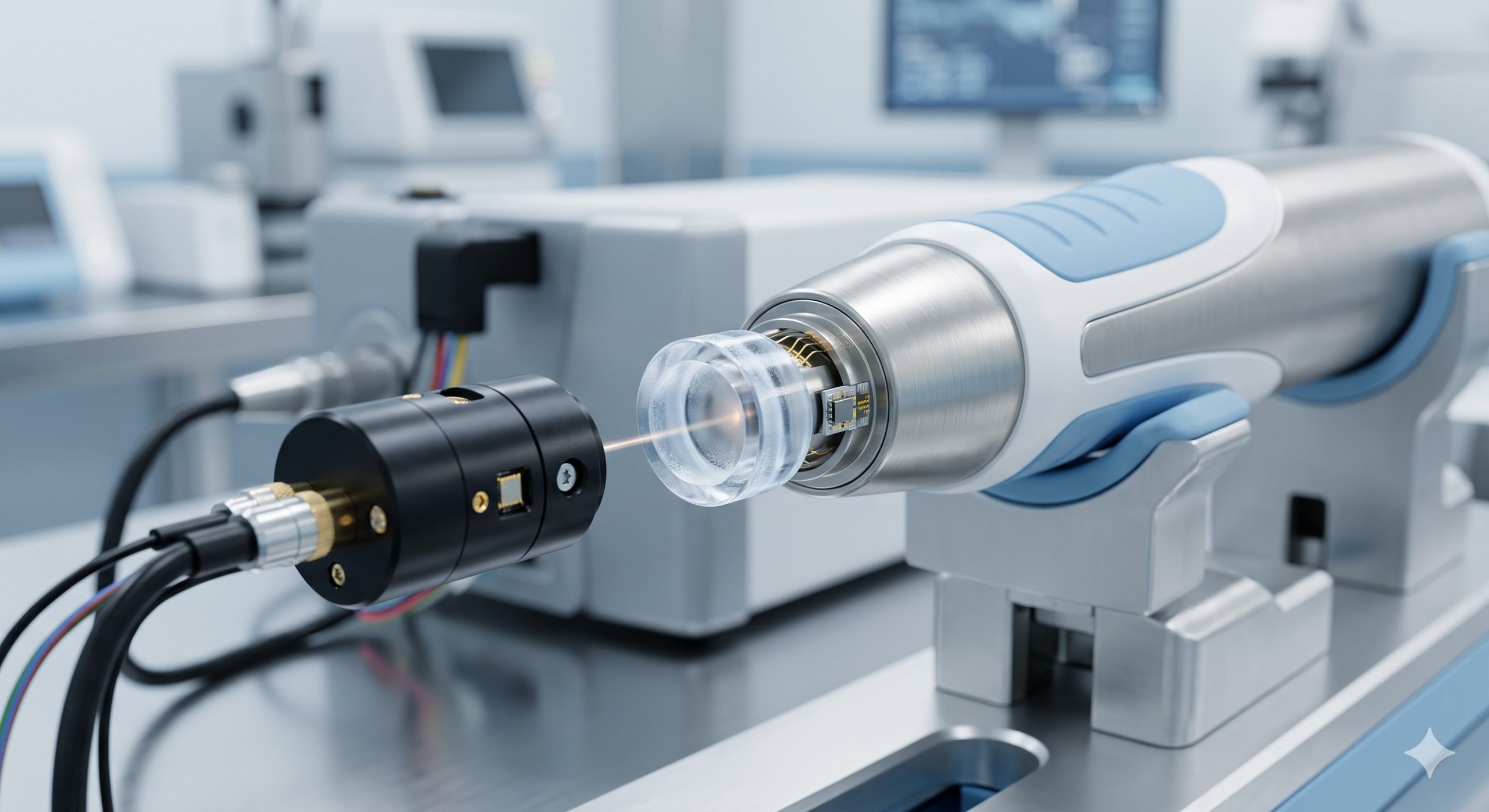
For a clinic, understanding the FAI process provides confidence in the supply chain. The process typically involves :
- Planning: The quality team reviews all design documentation and specifications to create a detailed inspection plan.
- Critical Characteristic Identification: Key features, such as the energy output stability and cooling efficiency, are identified as Critical-to-Quality (CTQ) factors.
- Measurement and Testing: Using calibrated equipment like power meters and thermocouples, the device is rigorously tested. For example, the pulse width must be measured to ensure it aligns with the specified value (e.g., 10ms, 50ms, or 100ms) to control the thermal relaxation time of the target tissue.
- Documentation of the FAIR: The First Article Inspection Report is generated, providing a certification of compliance. This document proves that every measured parameter is within the acceptable tolerance.
- Approval: If all specifications are met, the production batch is approved, and the clinic receives a device that performs as expected.
Clinic ROI and Conclusion
Integrating FAI into the procurement strategy is a business decision that protects the clinic’s Return on Investment (ROI). By ensuring the device’s energy output is stable and its consumables (like handpieces) are durable, the clinic avoids costly downtime, minimizes service calls, and guarantees a consistent patient experience. Ultimately, FAI ensures the laser’s clinical efficacy is validated from day one, upholding the high standards of a premium med spa and delivering measurable results for every patient.