
Blog
The Ultimate Clinic Guide to Documenting Compliance Evidence for Mission-Critical Environments : Efficacy, Wavelengths, and roi
2026年9月4日
Introduction: The High-Stakes Reality of Compliance in Aesthetic Medicine
In the rapidly evolving landscape of medical aesthetics, the difference between a thriving practice and a regulatory audit nightmare often comes down to one critical function: documenting compliance evidence for mission-critical environments. For clinic owners, lead physicians, and procurement directors, the burden of proof extends far beyond simple record-keeping. It involves creating a defensible, data-rich tapestry that demonstrates adherence to the stringent demands of Medical CE, FDA clearance, and ISO 13485 quality management systems.
This guide serves as your definitive roadmap. We move beyond theoretical risk management to dissect the specific technical metrics—from fluence and pulse width to spot size and cooling efficiency—that form the backbone of a robust compliance dossier. We will explore how meticulous documentation not only safeguards your clinic against liability but also drives superior clinical outcomes and maximizes return on investment (ROI).
The Physical Imperative: Understanding the Technology Behind the Evidence
Selective Photothermolysis and Parameter Precision
To document compliance effectively, one must first understand the physics governing the treatment. At the heart of modern aesthetic devices lies the principle of selective photothermolysis. This dictates that the laser wavelength must be precisely matched to the target chromophore—whether it be melanin for hair reduction or hemoglobin for vascular lesions—while the pulse duration (pulse width) must be less than or equal to the thermal relaxation time of the target to confine damage.
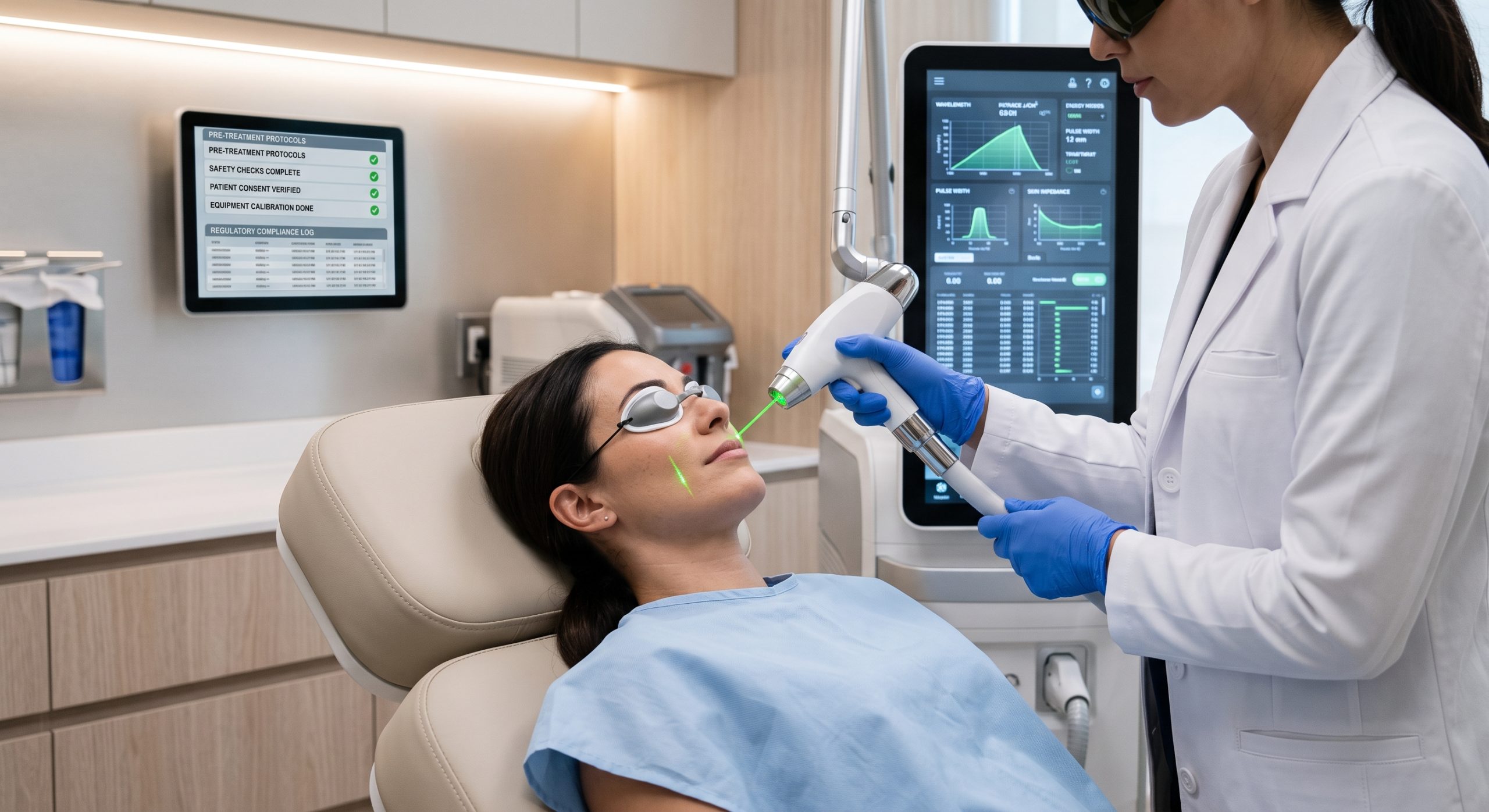
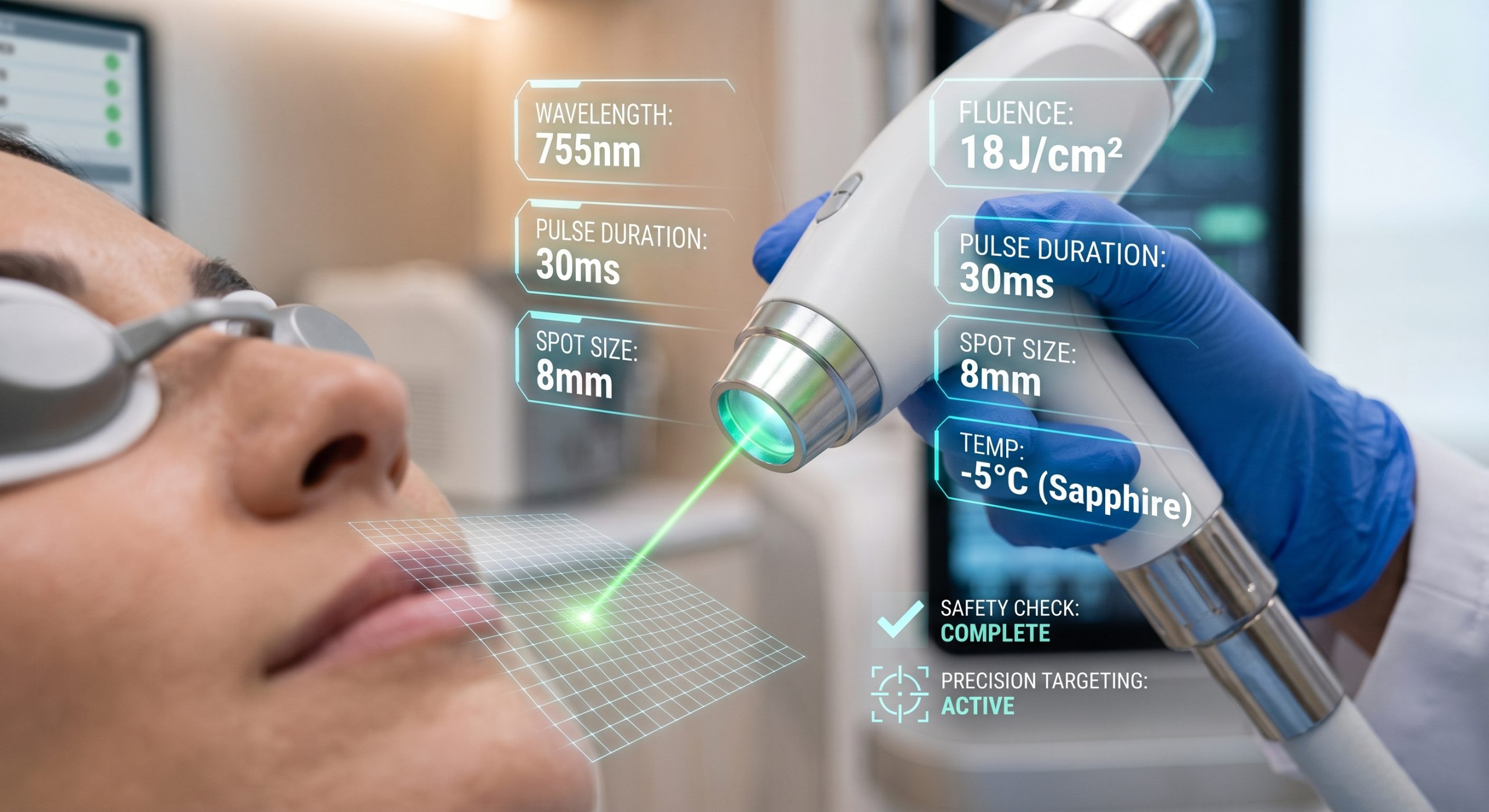
Your compliance logs must reflect this precision. For instance, when utilizing a diode laser platform, the evidence trail should capture the specific wavelength employed (e.g., 755nm, 808nm, or 1064nm), the exact energy density (Fluence) measured in J/cm², and the spot size in millimeters. These variables are not arbitrary; they define the treatment depth, efficacy, and safety profile. A 1064nm wavelength penetrates deeper, making it suitable for deeper hair follicles or vascular targets, while a 755nm wavelength is more superficially absorbed and ideal for lighter skin types.
Epidermal Cooling: A Critical Safety Metric
High-fluence treatments inevitably generate heat. To prevent epidermal burns and ensure patient comfort, advanced systems incorporate sophisticated cooling mechanisms. Sapphire contact cooling and thermoelectric cooling (TEC) systems are now industry benchmarks. When documenting compliance, you must record the cooling system’s pre-set temperatures and verify its functionality pre-treatment. Evidence of consistent cooling performance demonstrates adherence to FDA and Medical CE safety standards, directly impacting patient safety and treatment tolerability.
Technical Specifications
Below is a standardized template for the core specifications that should be documented and validated for any mission-critical aesthetic device. This data forms the foundation of your compliance evidence and clinical protocol.
| Key Parameter | Technical Specification |
|---|---|
| Laser Type / Wavelength | Diode Laser (e.g., 755nm, 808nm, 1064nm) |
| Energy Density (Fluence) | Up to 60 J/cm² (Adjustable) |
| Spot Size | 12mm x 12mm to 15mm x 15mm (Adjustable) |
| Pulse Width | 5ms – 400ms (Adjustable) |
| Cooling System | Sapphire Contact Cooling with TEC, Temperature Range: 0°C to 5°C |
| Shot Lifespan / Handpiece | Up to 5 Million Shots |
| Regulatory Compliance | Medical CE, FDA 510(k) Cleared, ISO 13485 Certified |
Integrating Standards: The CE, FDA, and ISO 13485 Trinity
True compliance is built on a framework of recognized international standards. ISO 13485 certification is the gold standard for quality management in medical devices. It mandates a systematic approach to documentation, traceability, and risk management. For the clinic operator, this means your compliance evidence must include:
- Device Validation Records: Verification of the device’s calibration and output energy consistency against manufacturer specifications.
- Maintenance Logs: Scheduled checks on the water cooling circuit, pump integrity, and handpiece shot count (lifespan).
- Staff Training Records: Proof of competency for practitioners operating the device, demonstrating understanding of the Fitzpatrick Skin Scale and parameter adjustment protocols.
- Incident Reporting: A clear, documented pathway for reporting adverse events or equipment malfunctions, as required by FDA and Medical CE regulatory bodies.
Generating Tangible ROI Through Diligent Documentation
While compliance is often viewed as an operational cost, when strategically managed, it becomes a powerful business asset. A meticulously documented clinical environment facilitates higher throughput by reducing treatment times through optimized parameter settings. It minimizes costly downtime associated with equipment failure by enforcing preventative maintenance schedules. Furthermore, robust evidence of safety and efficacy strengthens your clinic’s reputation, enabling you to command premium pricing for high-ticket aesthetic services and enhancing patient retention.
Conclusion: The Future of Clinic Success is Evidence-Based
In an age of increasingly stringent regulations and discerning patients, the ability to produce comprehensive compliance evidence is non-negotiable. It is the bedrock upon which clinical excellence, patient trust, and long-term profitability are built. By adopting a rigorous approach to documenting the technical performance, safety protocols, and quality systems of your laser devices, you are not only safeguarding your practice from risk but also positioning it as a leader in the medical aesthetics industry. The ultimate clinic guide concludes with a clear imperative: invest in your documentation strategy today to secure your success tomorrow.