
BLOG
The Ultimate Clinic Guide to Programmable CMMs: Precision, ROI, and Industry 4.0 Integration
2026年7月1日
Introduction: The New Standard in Dimensional Metrology
In today’s high-stakes manufacturing environment, precision is not merely a goal—it is a prerequisite. As we navigate the complexities of Industry 4.0, the limitations of manual inspection processes have become glaring bottlenecks. For precision manufacturing, particularly in critical sectors like aerospace and medical devices, the margin for error is measured in microns. Programmable Coordinate Measuring Machines (CMMs) have emerged as the definitive solution, bridging the critical gap between intricate design and flawless execution. This guide provides a comprehensive analysis of how programmable CMMs are revolutionizing quality control, enhancing profitability, and setting new benchmarks for manufacturing excellence.
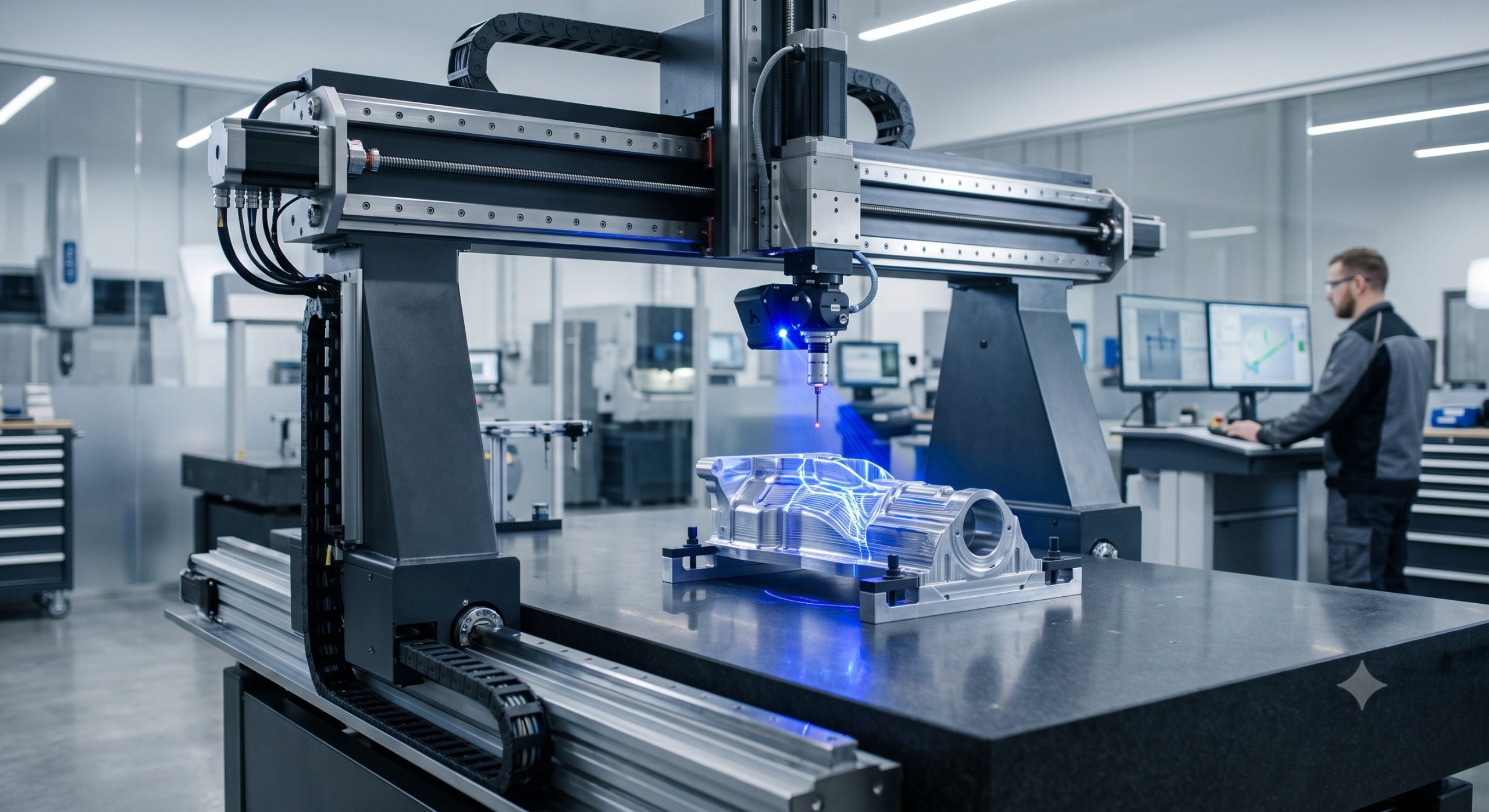
Programmable CMMs differ fundamentally from their manual or portable counterparts. While a portable CMM arm offers flexibility, a fully programmable system delivers unmatched speed, repeatability, and process control . Unlike manual devices that rely on operator skill, which can introduce variability, a motorized, programmable CMM automates the entire inspection sequence, ensuring that every measurement aligns precisely with engineering requirements .
The Evolution from Manual to Smart CMMs
The journey of metrology reflects the broader arc of manufacturing innovation. Initially, quality control relied heavily on manual tools like calipers and height gages, which were sufficient for simple geometries but inadequate for the complex contours of modern parts . The introduction of stationary CMMs was a significant leap forward, allowing for high-precision inspection of complex parts. However, early models often required laborious manual programming for each new task .
Today, the evolution of CMMs is defined by the integration with Industry 4.0 principles. Smart CMMs are no longer isolated verification tools but active, connected elements of cyber-physical production systems . This transformation is driven by three core pillars: Connectivity, facilitated by protocols like OPC UA and MQTT that enable seamless integration with MES and ERP systems; Intelligence, incorporating AI for predictive diagnostics and adaptive path planning; and Adaptability, allowing for rapid reconfiguration and multi-sensor integration .
Programmability as a Quality Enabler
The true power of a programmable CMM lies in its ability to execute a pre-defined measurement routine automatically, often referred to as a ‘lights-out’ operation. This goes beyond mere speed. By following a software-sequenced inspection plan, these systems eliminate the variation caused by human factors. Whether the part is the first or the hundredth in a batch, the inspection protocol remains identical, guaranteeing consistency. This process control reduces ambiguity, prevents missed measurements, and ensures that all data is recorded consistently for robust quality records .
Furthermore, the sophistication of CMM software is evolving. While manual programming has historically been time-consuming and reliant on specialized expertise, the future lies in automated programming. Emerging technologies like AI and Model-Based Definition (MBD) are driving a shift toward intelligent, context-aware programming where inspection routines are derived automatically from CAD models, validated virtually via simulation, and optimized using historical data .
Technical Specifications & Performance Metrics
When evaluating a programmable CMM, clinicians in the manufacturing process must focus on key metrics that define its capability and precision. The selection of the right machine and software is critical for ensuring confidence in the measurement data . The following table outlines the core technical specifications that characterize a state-of-the-art programmable CMM system.
| Key Parameter | Technical Specification |
|---|---|
| Accuracy / Tolerances | As close as ±0.0001 inches (0.0025 mm) |
| Typical Structure | Bridge, Gantry, Cantilever |
| Core Technology | Multi-sensor (Tactile, Optical, Laser) |
| Industry Standards | ISO 10360, ISO/IEC 62541 (OPC UA) |
| Software Capabilities | CAD-based, AI-driven, PMI/MBD compatible |
System Architecture and Probes
The performance of a programmable CMM is defined by its structural design and probing system. Common configurations include Bridge, Gantry, and Cantilever designs, each offering a trade-off between accuracy, flexibility, and measuring volume . For example, gantry CMMs are often used in aerospace for their ability to accurately measure large components, while cantilever designs, which boast high rigidity, are ideal for gauges and master parts that require the highest accuracy .
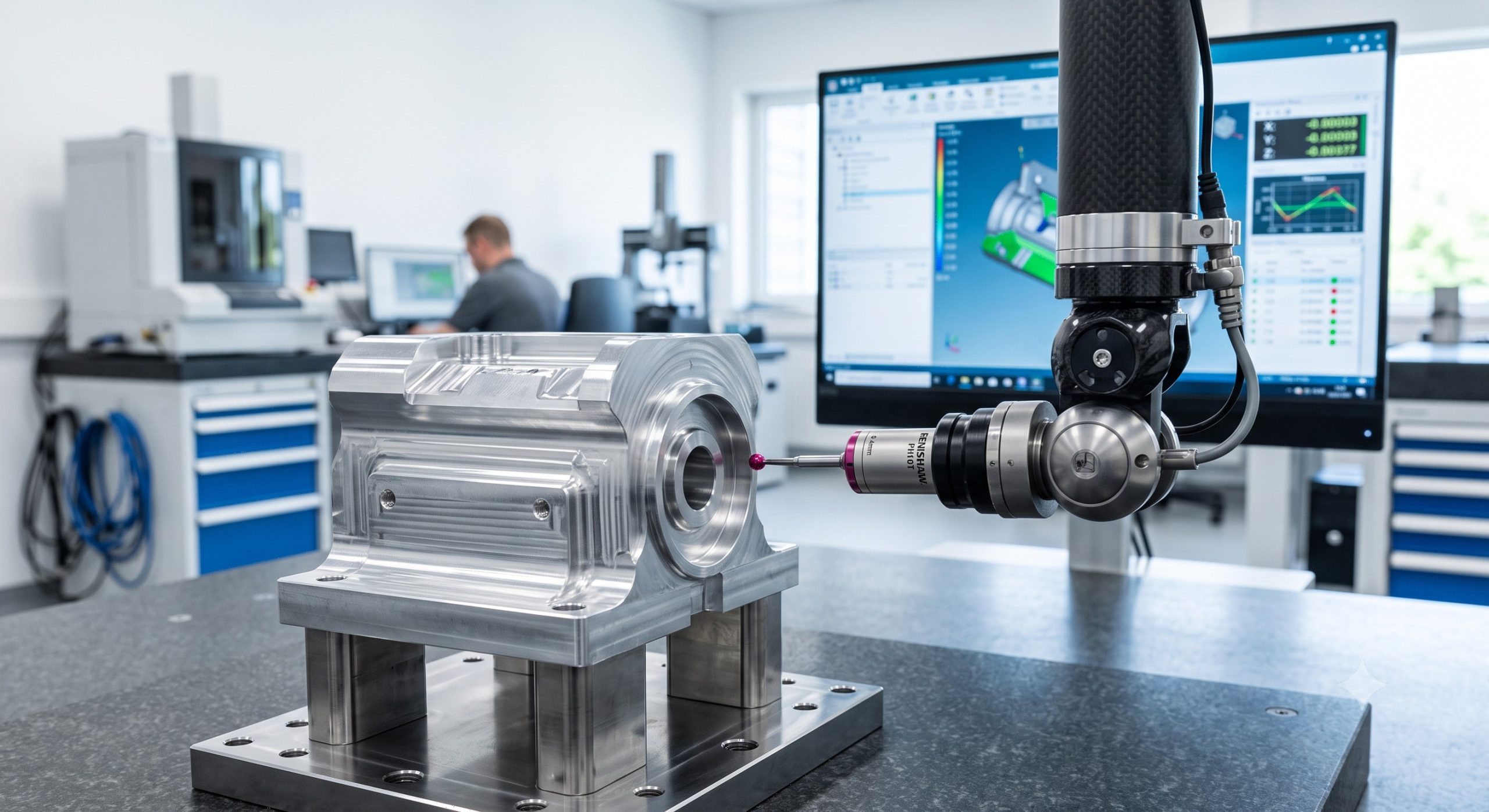
Equally important is the probing system. Modern smart CMMs often feature multi-sensor integration, allowing seamless switching between tactile, optical, and laser-scanning modalities within a single routine. This adaptability is crucial for inspecting diverse geometries without re-clamping the part . Renishaw’s REVO 5-axis system is a prime example of this capability, enabling automatic reorientation and multi-sensor configurations that dramatically reduce calibration time and improve utilization in high-mix production environments .
Dimensional Accuracy and Tolerances
In precision manufacturing, components often require tolerances as tight as ±0.0001 inches (0.0025 mm) . Programmable CMMs are essential for verifying these standards, particularly in high-performance industries like aerospace and medical devices where a single part’s failure can have catastrophic consequences . The programmability of the system guarantees that the inspection process itself does not introduce errors.
Understanding Measurement Uncertainty
A critical, yet often misunderstood, aspect of metrology is measurement uncertainty. It is impossible to know a part’s true value; the best we can achieve is a close approximation. Programmable CMM software plays a vital role here by implementing algorithms—such as Monte Carlo simulations—to quantify this uncertainty . As industry experts note, it’s not just about how fast data is collected, but the confidence you have in that data. If you lack confidence in the measuring system, you cannot have confidence in your products .
Clinic ROI and Business Impact
From a business perspective, investing in a programmable CMM is a strategic decision that directly impacts profitability. While portable, manual CMM arms offer a lower initial cost, programmable CMMs provide a superior return on investment in high-volume or high-mix production scenarios due to their unparalleled efficiency and consistency .
CapEx, OpEx, and Throughput
Although the capital expenditure (CapEx) for a programmable CMM is higher than that for manual systems, the operational expenditure (OpEx) savings are substantial. Automated measurement drastically reduces cycle times, allowing a single QC engineer to oversee multiple machines or attend to other duties while the CMM operates . This high throughput is critical for maintaining production flow and meeting delivery deadlines without sacrificing quality. Furthermore, by eliminating the need for multiple dedicated hand gages, a single programmable CMM can streamline the quality lab and reduce long-term equipment costs .
Industry Applications and Compliance
Programmable CMMs are indispensable across a range of demanding sectors. In the Medical Technology industry, the production of surgical instruments and implants requires extreme accuracy to fit with human anatomy and function reliably; reworking parts made of expensive titanium is not an option . In Aerospace, components like turbine blades must withstand immense forces, demanding exacting tolerances. This is where gantry-style CMMs, known for their accuracy and large measuring volumes, are heavily utilized .
Regulatory compliance is another major driver for adoption. Manufacturers in these industries must adhere to stringent quality standards, often enforced by bodies like the FDA and through certifications like ISO 13485 for medical devices. A programmable CMM, with its ability to create a reliable, consistent digital record of inspections, provides the traceability and evidence required to meet these audits .
Conclusion: The Imperative of Automation
The importance of programmable CMMs in precision manufacturing cannot be overstated. They represent a foundational technology for any organization serious about quality, efficiency, and scalability. By automating the inspection process, manufacturers eliminate human variability, significantly reduce measurement time, and generate verifiable data essential for decision-making and compliance.
The trajectory is clear: as the digital transformation of manufacturing accelerates, the reliance on manual inspection will diminish. Automated programming, driven by AI and MBD, is the future . Programmable CMMs are not just a tool for the quality lab; they are a critical component of the intelligent factory, enabling closed-loop manufacturing processes where inspection data directly informs and improves production on the fly.