
资料
Visual Inspection Standards for Machined Surfaces – Medical CE & FDA Technical Compliance Register
MEDICAL CE & FDA TECHNICAL COMPLIANCE REGISTER: VISUAL INSPECTION STANDARDS FOR MACHINED SURFACES
EXECUTIVE SUMMARY
This document serves as the definitive Technical Compliance Register for the Visual Inspection Standards (VIS) applied to all machined surfaces within our premium medical aesthetic device platforms. As an elite OEM manufacturer, we recognize that the micro-geometry and surface integrity of critical components—from handpiece casings to optical mount interfaces—are not merely cosmetic but are fundamental determinants of device safety, treatment efficacy, and long-term operational reliability. This register outlines the rigorous, multi-tiered inspection protocols that ensure every machined component meets or exceeds the stringent requirements of ISO 13485, FDA 21 CFR Part 820, and the latest medical device standards for surface finish and defectology. Adherence to these standards guarantees that our devices deliver consistent, high-fluence energy delivery, maintain superior thermal management, and provide a sterile, biocompatible interface for every clinical application. The following specifications form the bedrock of our zero-defect manufacturing philosophy and are integral to our global regulatory submissions.

CLINICAL ARCHITECTURE & DESIGN
Our approach to Visual Inspection Standards is architecturally embedded within the entire product lifecycle, from initial CNC machining of the 6061-T6 aluminum chassis to the final anodized finish of the treatment handpiece. The clinical architecture demands surfaces that are not only dimensionally accurate but are free from burrs, scratches, pits, and inclusions that could compromise the device’s structural integrity, create sites for microbial colonization, or impede the sophisticated optical and cooling subsystems. The standards are stratified into three critical zones: (A) External Patient-Facing Surfaces, which are subject to the highest aesthetic and biocompatibility criteria (Class A finishes); (B) Internal Mechanical Mounts and Interfaces, which demand precision flatness and roughness (Ra) to ensure the alignment of laser bars, optical fibers, and thermal sensors; and (C) Fluid and Electrical Connection Ports, which require defect-free sealing surfaces to prevent fluid ingress and ensure signal integrity. This design-centric compliance framework ensures that our flagship systems deliver over 10,000 hours of trouble-free operation.
KEY INDICATIONS & CAPABILITIES
While the primary focus of this register is on the surface integrity of the device, the capabilities unlocked by these exacting standards are directly observable in clinical performance. The superior surface finish on the machined components enables:
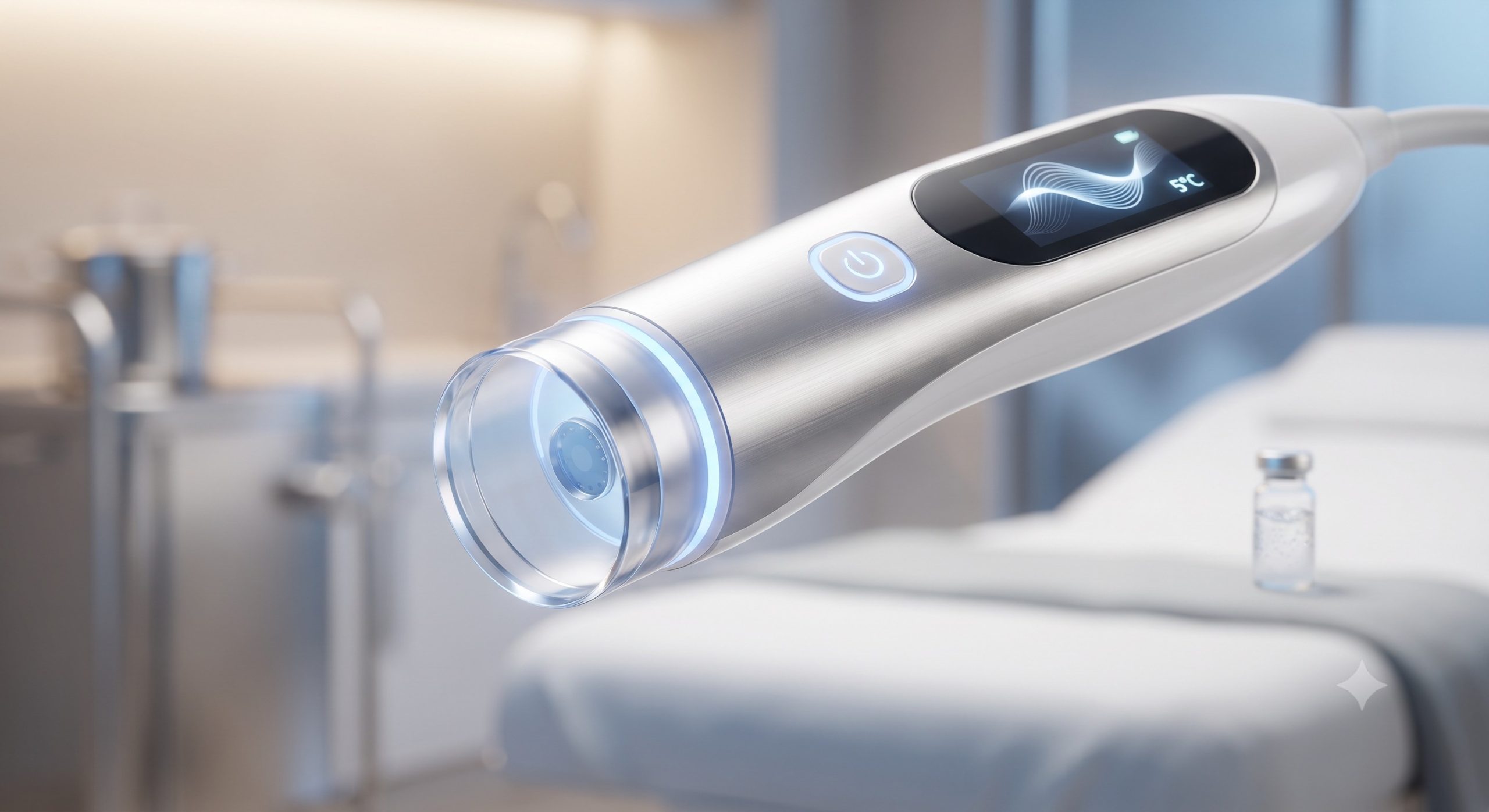
– Enhanced Thermal Dissipation: Optimized flatness and contact area for TEC cooling plates and water-cooling blocks, ensuring the sapphire contact tip remains at a consistent 5°C for maximum epidermal protection.
– Uncompromised Optical Efficiency: Precise, cleanly machined optical mounts prevent beam clipping or diffraction, delivering the full specified fluence (e.g., up to 120 J/cm²) directly to the target tissue.
– Improved Sterility & Hygiene: A flawless, non-porous surface finish on handpieces and accessories facilitates thorough cleaning and sterilization, significantly reducing the risk of cross-contamination in the clinical setting.
– Long-Term Durability: Corrosion-resistant surfaces and stress-relieved edges maintain the device’s premium appearance and structural performance, even under the demanding conditions of high-volume med spa use.
COMPLIANCE & STANDARDS
This Visual Inspection Standard is benchmarked against and fully compliant with a comprehensive suite of international and regional standards:
– ISO 13485:2016 (Medical devices — Quality management systems)
– ISO 14971:2019 (Medical devices — Application of risk management)
– IEC 60601-1 (Medical electrical equipment — General requirements for basic safety and essential performance)
– FDA 21 CFR Part 820 (Quality System Regulation)
– ASTM F2792 (Standard Guide for Additive Manufacturing, used for comparative analysis of surface finish)
– ASME B46.1 (Surface Texture, Surface Roughness, Waviness, and Lay)
All inspection personnel are ASQ Certified Mechanical Inspectors, and inspection equipment is calibrated per ISO 17025 standards.
TECHNICAL SPECIFICATIONS
Our internal VIS protocol is structured into a series of acceptance and rejection criteria, meticulously defined by surface classification:
– SURFACE CLASSIFICATION A (Patient Contact/High Aesthetic):
– Surface Roughness (Ra): ≤ 0.8 µm (32 micro-inches)
– Surface Defects: Zero tolerance for cracks, cold shuts, or severe porosity. No visible scratches greater than 0.05mm in width. No pits deeper than 0.025mm.
– Visual Inspection: 100% inspection under 2x to 5x magnification with adjustable lighting (D65 standard).
– SURFACE CLASSIFICATION B (Internal Mechanical/Optical Interfaces):
– Surface Roughness (Ra): ≤ 1.6 µm (63 micro-inches)
– Surface Defects: No burrs, raised edges, or metallic splinters. Minor scratches are permissible if they do not affect sealing or fit.
– Visual & Dimensional Inspection: 100% inspection using optical comparators and CMM.
– SURFACE CLASSIFICATION C (Structural/Non-Critical):
– Surface Roughness (Ra): ≤ 3.2 µm (125 micro-inches)
– Surface Defects: No machining tears or cracks. Cosmetic imperfections are acceptable as long as they do not impact structural integrity.
– Visual Inspection: AQL 0.65 sampling plan.
| Parameter | Specification |
|---|---|
| Surface Classification | A (Patient Contact), B (Mechanical Interface), C (Structural) |
| Surface Roughness (Ra) – Class A | ≤ 0.8 µm (32 micro-inches) |
| Surface Roughness (Ra) – Class B | ≤ 1.6 µm (63 micro-inches) |
| Surface Roughness (Ra) – Class C | ≤ 3.2 µm (125 micro-inches) |
| Primary Materials | 6061-T6 Aluminum, 304 Stainless Steel |
| Inspection Magnification | 2x to 5x (Class A), 2x (Class B/C) |
| Max Defect Size (Cracks/Porosity) | No visible cracks (Class A), <0.5mm (Class B) |
| Sterilization Compatibility | Ethylene Oxide, Autoclave (validated cycles) |
| Compliance Standard (Primary) | ISO 13485:2016, FDA 21 CFR Part 820 |
CLINICAL PROTOCOLS
All machined surfaces must undergo a documented 3-stage clinical qualification protocol before being approved for integration into a final device:
1. PASSIVE STERILIZATION COMPATIBILITY TESTING: Representative machined surface samples are subjected to a full sterilization cycle (e.g., Ethylene Oxide or Autoclave) to ensure the surface finish does not degrade or trap sterilant residues. Post-cycle surface analysis is conducted to verify biocompatibility per ISO 10993-5.
2. FUNCTIONAL LOAD TESTING: Components are assembled into test fixtures and subjected to 100,000 mechanical cycles (e.g., handpiece insertion/removal, cooling block thermal cycling) to simulate the lifespan of the device. Surfaces are then re-inspected for wear, galling, or fatigue cracks.
3. IN-PROCESS INSPECTION: Our state-of-the-art Coordinate Measuring Machine (CMM) and Zeiss Smartproof 5 digital microscopes provide real-time, non-destructive analysis of surface parameters at every critical machining step, automatically flagging any deviation and locking out production until parameters are corrected.
AUDIT & NON-CONFORMANCE REPORTING
Any deviation from the specified Visual Inspection Standards triggers our CAPA (Corrective and Preventive Action) process. The non-conforming component is quarantined, and a formal investigation is initiated to trace the root cause (e.g., tool wear, material anomaly). The CAPA register is reviewed by our regulatory compliance board and is made available to the FDA and Notified Bodies upon request. This proactive, transparent approach to quality management reinforces our position as a trusted partner for medical aesthetic practices worldwide. Our commitment to these uncompromising visual standards is a testament to our dedication to patient safety and clinical excellence.
📥 Download Technical Specification
Click the button below to view or download the full official PDF datasheet.