
Блог
FDA & Medical CE Compliance: Ensuring Patient Safety with Compliance Documentation
2026年8月5日
The Unseen Pillar of Medical Aesthetic Practice: Why Documentation Matters as Much as the Device
In the high-stakes world of medical aesthetics, the allure of a new laser platform often centers on its clinical outcomes: the promise of unparalleled hair reduction, skin rejuvenation, or vascular clearance. Clinic procurement committees invest significant resources in evaluating wavelengths, fluence, and cooling technologies. However, a costly and dangerous oversight often occurs when the focus remains exclusively on the hardware, relegating the device’s compliance documentation to an afterthought. This is a critical error that can jeopardize patient safety, invite regulatory scrutiny, and undermine the financial stability of a practice. As a consultant who has navigated the fallout from non-compliant device acquisitions, I can assert with absolute certainty that the regulatory dossier accompanying a medical aesthetic device is not a bureaucratic formality; it is the legal and clinical bedrock upon which a safe, profitable, and sustainable practice is built.
Defining the Scope: A Technical Glossary for Compliance in Aesthetic Lasers
Before delving into the legal implications, it is vital to understand the specific technical and regulatory language that defines compliance in our industry. The term ‘compliance documentation’ encompasses a wide array of certificates and declarations that prove a device has met stringent international and national standards for safety, performance, and manufacturing quality.
Key Technical and Regulatory Acronyms
- Medical CE (Conformité Européenne) Mark: This mandatory marking for products sold within the European Economic Area indicates that a medical device meets the requirements of the applicable European Medical Device Regulation (MDR). For aesthetic lasers, this requires a rigorous assessment by a Notified Body, signifying the device is safe and performs as intended. CE marking is not merely a sticker; it is backed by a detailed technical file demonstrating clinical evaluation, risk management, and post-market surveillance.
- FDA (Food and Drug Administration) Clearance: In the United States, the FDA requires clearance or approval for all medical laser devices. Most aesthetic lasers gain market access via the 510(k) premarket notification process, which demonstrates the device is ‘substantially equivalent’ to a legally marketed predicate device. This process mandates a detailed review of the device’s safety and effectiveness data. The FDA’s regulatory oversight also includes rigorous Quality System Regulation (QSR) requirements covering design, manufacturing, and testing.
- ISO 13485: This is the internationally recognized standard for a Quality Management System (QMS) specific to medical devices. An ISO 13485 certification indicates that a manufacturer has established and maintains a robust system for ensuring consistent design, development, production, and delivery of medical devices that meet regulatory requirements. This is a foundational element of trust and accountability.
- IEC 60825-1: This international standard for the safety of laser products is critical. It classifies lasers based on their hazard levels, with Class 4 being the highest and applicable to most therapeutic aesthetic devices. Compliance with this standard ensures the device is equipped with adequate engineering controls, such as protective housing, interlocks, and warning labels, to minimize the risk of ocular and skin injuries to both patients and operators.
Any clinic operating a Class 4 laser must have a comprehensive Safety Program that includes a Laser Safety Officer (LSO) and detailed Standard Operating Procedures (SOPs). The device’s documentation serves as the primary source of truth for these safety protocols.

The Tangible Clinical Impact: How Poor Documentation Undermines Clinical Efficacy
The connection between a device’s operating parameters, such as Wavelength (e.g., 755nm, 808nm, 1064nm), Spot Size, Energy Density/Fluence (J/cm²), and Pulse Width (ms), and its clinical outcome is undeniable. However, these critical parameters are only as valuable as the documentation that certifies their accuracy and safety. A device lacking proper FDA 510(k) or Medical CE documentation has not undergone the independent, rigorous testing required to validate these performance claims.
The inherent risk is that the energy output on the screen may not match the actual delivered dose due to inconsistencies in the laser bar, power supply, or calibration. Without validated documentation, a clinic operator could be applying a fluence that is significantly different from the displayed value, leading to suboptimal clearance rates, patient dissatisfaction, or severe burns.
Furthermore, the prescriptive use parameters and safety margins established in the device’s regulatory submission are the foundation of any clinical protocol. When a device is purchased without the full dossier—or worse, purchased through the gray market—this clinically validated guidance is lost. Let’s examine the specific technical hazards:
Unverified Output and Parameter Drift
Every medical laser requires routine calibration and verification to ensure energy output remains within its specified tolerance. A manufacturer’s technical manual, which is part of the compliance documentation, outlines the precise methods for this verification. Without this, clinics risk ‘parameter drift,’ where the delivered fluence is no longer consistent with the set value. For example, a laser operating at a higher-than-intended fluence on a Fitzpatrick Skin Type IV patient can lead to Post-Inflammatory Hyperpigmentation (PIH), a complication that can be legally and professionally damaging.
Lack of Validated Temperature and Cooling Data
Sophisticated cooling mechanisms, such as the Sapphire ICE Cooling Systems found in many modern diode lasers, are critical for epidermal protection. The efficacy of this cooling—its ability to protect the epidermis during the brief pulse duration—is documented in the device’s technical file, often detailing thermal relaxation times and cooling dynamics. Using a device where this cooling performance is unverified or undocumented is akin to performing surgery with a blindfold.
| Parameter | Certification Requirement | Clinical Significance |
|---|---|---|
| Wavelength (e.g., 808nm) | Must match FDA 510(k) & CE Technical File | Ensures precise targeting of chromophore; a documented, verified wavelength is critical for optimal energy absorption and safety. |
| Max. Fluence (J/cm²) | Must be within validated limits specified in regulatory filings. | Certifies the device’s ability to deliver the required therapeutic dose without exceeding safe epidermal limits. |
| Pulse Width (ms) | Must be verified in the device’s technical documentation. | Confirms the laser’s pulse duration is validated for the target’s Thermal Relaxation Time (TRT), minimizing collateral thermal damage. |
| Cooling System Type | Sapphire or TEC cooling performance must be documented. | Provides proof that the cooling interface is tested to maintain epidermal temperatures within safe limits during treatment. |
| Quality Standard | ISO 13485 Certification for the Manufacturer | Indicates the device was designed and manufactured within a stringent, regulated Quality Management System, ensuring consistency. |
Strategic Implications: The Financial & Legal Consequences of Non-Compliance
The clinical risks of inadequate documentation are severe, but they represent only one facet of the problem. The financial and legal repercussions can be equally catastrophic, directly impacting the Return on Investment (ROI) and long-term viability of a practice.
Insurance Coverage and Indemnification
Professional liability insurance and malpractice policies typically require that practitioners use FDA-cleared or CE-marked devices for their intended indications. In the event of an adverse event, such as a severe burn, the first question from any insurance adjuster will be: ‘Is the device FDA-cleared for this procedure?’ If the clinic cannot produce the 510(k) documentation, the claim will likely be denied. This can result in tens of thousands of dollars in liability and legal fees, borne entirely by the clinic owner. The manufacturer’s indemnification, which protects users from liability when a device is used per instructions, is void if the device is not used in compliance with its regulatory clearance or if it is found to be a non-compliant or counterfeit unit.
Audits, Fines, and Regulatory Penalties
State and national regulatory bodies, such as the FDA or local departments of health, can and do perform unannounced audits of medical aesthetic facilities. Penalties for operating non-FDA-cleared or non-CE-marked devices can include substantial fines, mandatory recall of services, and in severe cases, the revocation of a medical license to practice.
Furthermore, in many jurisdictions, the use of a non-certified laser constitutes practicing medicine without a valid device license, which is a serious legal offense. The safety program required for Class 4 laser operation—which includes documented training, safety audits, and equipment logs—is heavily dependent on the manufacturer’s guidelines.
Impact on Total Cost of Ownership (TCO) and ROI
Procuring a device without proper documentation often results in a lower upfront cost but a drastically higher Lifetime Cost of Ownership. These devices typically lack a legitimate service network, making it impossible to perform routine maintenance, software updates, or source authentic replacement parts like Imported Laser Bars or OEM handpieces. This hidden cost creates significant financial risk due to catastrophic downtime and lost revenue. Conversely, a compliant device from a certified manufacturer, often priced higher initially, offers a predictable and lower TCO, ensuring higher long-term profit margins.
Building a Culture of Compliance: A 4-Step Strategy for Clinics
Transforming the perception of compliance documentation from a ‘necessary evil’ to a strategic asset requires a proactive mindset. Here are my recommendations for integrating compliance into your clinical culture:
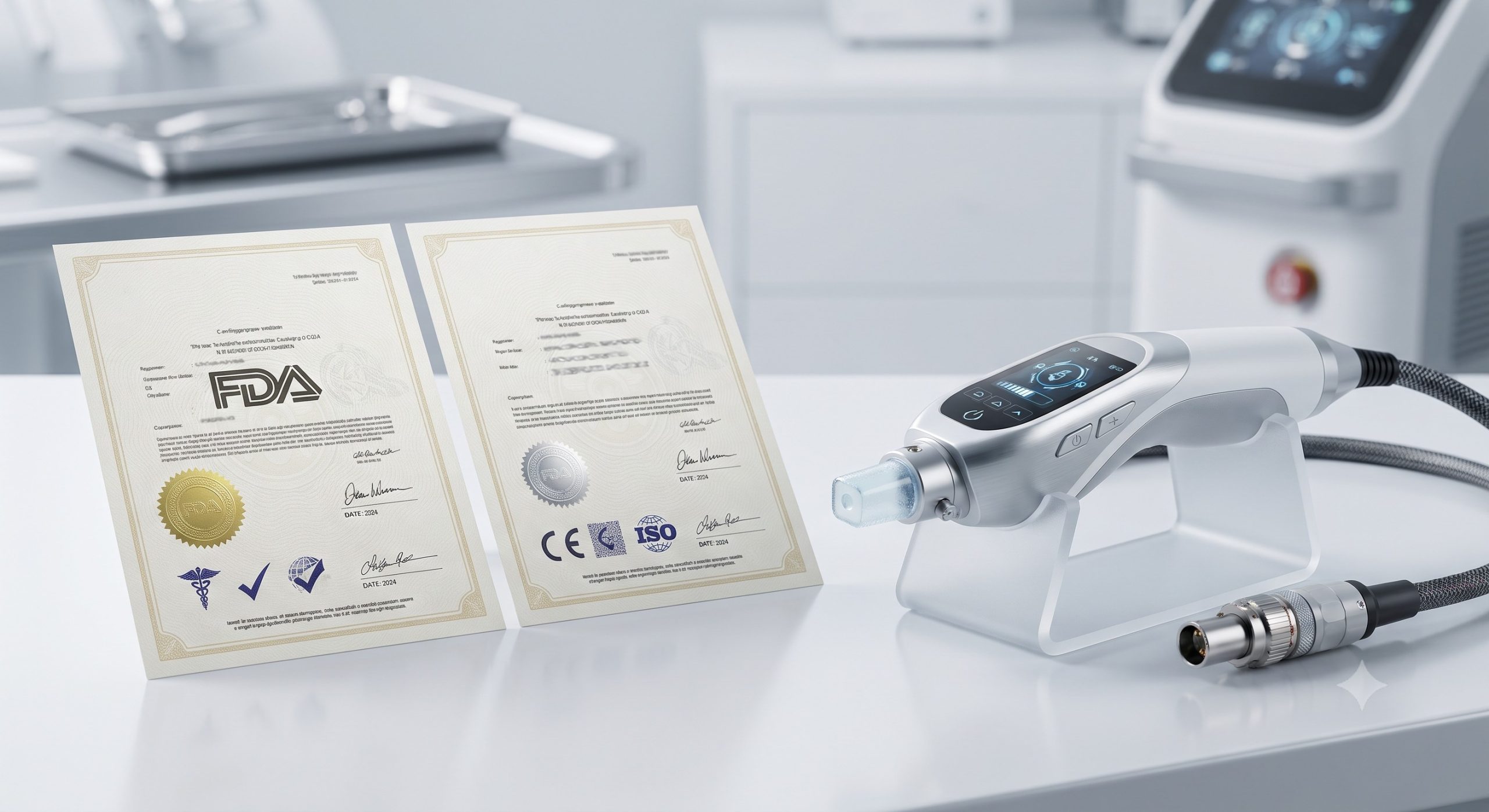
- Pre-Purchase Audit: Before signing a purchase order for any capital laser equipment, request a copy of the device’s FDA 510(k) clearance letter, Medical CE Certificate, and ISO 13485 certificate. These documents must be sourced directly from the manufacturer or its officially authorized local distributor. If a supplier hesitates or refuses, consider it a significant red flag.
- Establish a Digital Repository: Once the device is acquired, create a master folder for its compliance documentation. This should include the User Manual, Technical Service Manual, calibration logs, training records for all operators, and the official certificates of compliance. The presence of these documents, accessible to staff and regulators, is vital for both clinical consistency and emergency preparedness.
- Integrate Compliance into Operator Training: Initial and ongoing training for laser operators should include a dedicated module on documentation. Operators must understand the ‘why’ behind the protocols, linking their daily operations to the manufacturer’s validated specifications outlined in the device’s regulatory documentation. This knowledge empowers them to be the first line of defense against parameter drift or unsafe practices.
- Embrace Scheduled Audits: Conduct regular, internal audits of your device’s compliance status, treating them with the same seriousness as a financial audit. This ensures that documentation is updated, calibration remains on track, and all personnel remain proficient in safety protocols.
Final Clinical Conclusion: The Prescription for Longevity
In the pursuit of clinical excellence, a medical aesthetic device is merely a vessel. The power and safety of that vessel are certified not by its sleek exterior or powerful marketing, but by the technical and regulatory documentation that accompanies it. This ‘paperwork’ is the immutable evidence of a device’s quality, safety, and efficacy. For the discerning clinic owner, compliance documentation is not just a required accessory; it is the fundamental guarantee of patient safety, the primary defense against legal liability, and the ultimate driver of sustainable profitability. To overlook this essential component is to gamble with the very foundation of your practice. Prioritize the documentation as you do the device, and you build not just a business, but a legacy of trust and clinical excellence.