
FAQ
Technical Support FAQ: Resolving Errors and Optimizing Output on Your Aesthetic Laser System
Overview
For B2B medical aesthetic buyers, understanding the manufacturing lifecycle—specifically the final assembly of core components—is critical to ensuring device longevity, clinical safety, and predictable ROI. As a leading manufacturer of high-power aesthetic laser systems, we address the most pressing technical and procurement questions surrounding our in-house final assembly process. This FAQ covers everything from quality control protocols and supply chain transparency to post-sales technical support and maintenance, ensuring you have all the data needed for a confident purchasing decision.
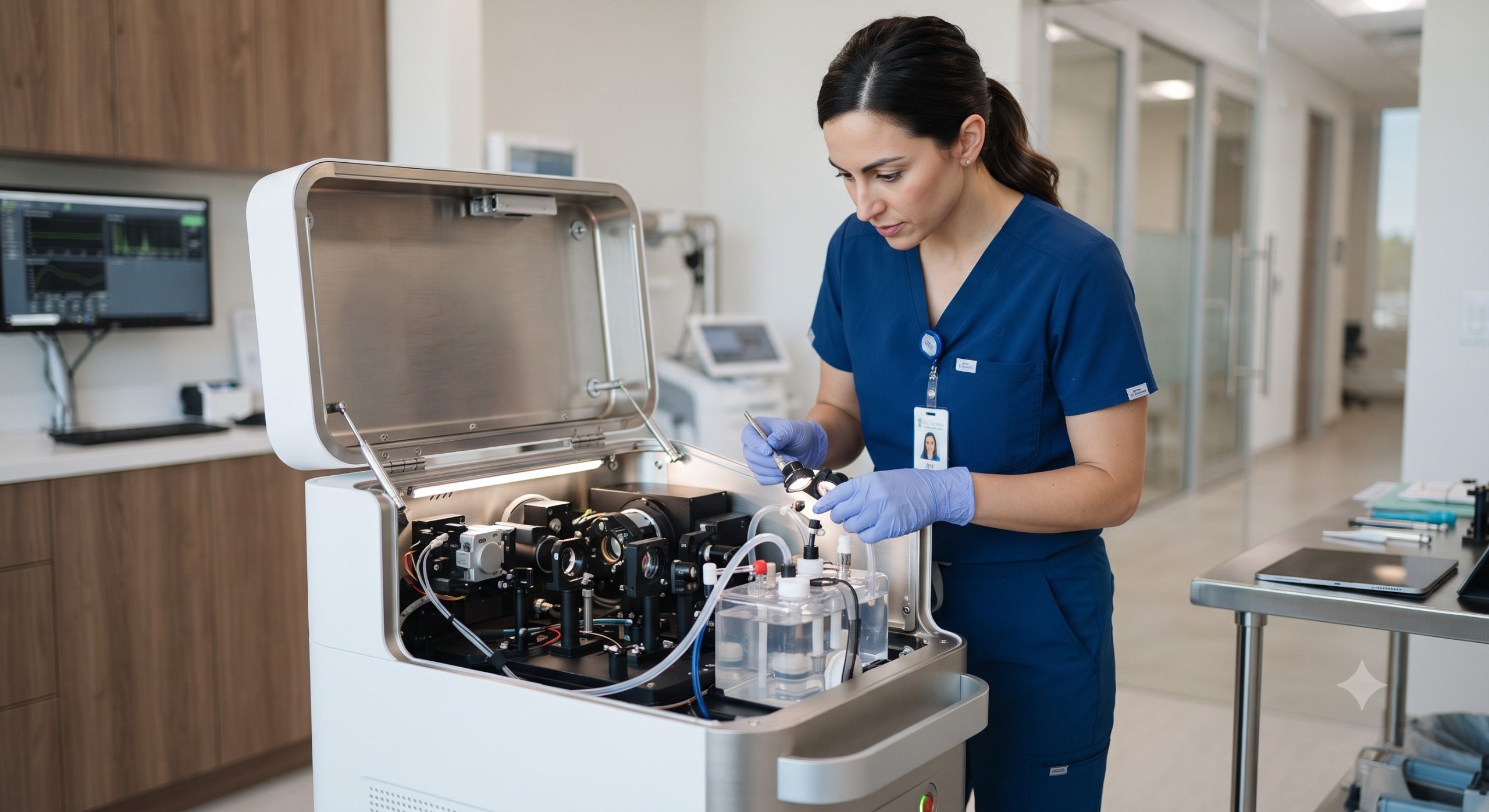
Frequently Asked Questions
Q1: Do you outsource the final assembly of the laser handpiece and main unit, or is it done in-house?
No, we do not outsource the final assembly of any critical systems. All final assembly of the laser handpiece, main unit, and cooling system is completed in our ISO 13485-certified facility. This vertical integration ensures strict quality control over optical alignment, electrical safety, and thermal regulation—parameters that are often compromised in outsourced assembly lines.
Q2: How does in-house final assembly impact the device’s warranty and my service agreement?
In-house final assembly directly enhances your warranty coverage and service agreement. By controlling the entire build process, we provide a comprehensive 2-year warranty on the main unit and a 12-month or 1 million shot warranty on the handpiece. Because our technical support team is directly involved in the assembly process, they can offer faster diagnostics and firmware updates without third-party delays.
Q3: What component-level quality control checks are performed during final assembly?
During final assembly, we execute a rigorous 72-point quality control checklist. This includes optical power output verification with a calibrated power meter, water flow rate testing for the closed-loop cooling circuit, and high-voltage isolation testing. Additionally, we perform a ‘burn-in’ stress test for 12 continuous hours to validate thermal stability before the device is packaged for shipping.
Q4: Since you source imported laser bars and pumps, does that complicate technical support or parts replacement?
No, sourcing premium imported laser bars (from Germany) and water pumps (from Japan) does not complicate support; it simplifies it. We maintain a 5-year buffer stock of these critical consumables at our global warehouses. Because we perform the final assembly, we possess exact technical specifications and tolerance data, enabling our engineers to swap parts seamlessly during field service without lengthy recalibration procedures.
Q5: What kind of technical training do you provide regarding the internal assembly for our clinic biomedical engineers?
We provide an intensive ‘Train-the-Trainer’ technical certification program for your clinic biomedical engineers. This 3-day on-site or virtual course covers internal assembly schematics, troubleshooting of the power supply board, and safe replacement of the water filter and quartz window. Upon completion, your team earns a certification enabling them to perform Level-1 maintenance, reducing your dependency on paid call-outs.
Q6: What is the typical lead time for a device if we require a custom final assembly configuration (e.g., specific spot size adapters)?
If you require a custom final assembly configuration—such as specialized spot size adapters or region-specific power cord certifications (e.g., UKCA or CE)—the standard lead time is 10-15 business days from the date of order confirmation. This includes the final integration, configuration, and extended quality assurance testing specific to your market’s regulatory standards.
Q7: How often do we need to send the device back to the manufacturer for recalibration based on the assembly design?
Based on our robust final assembly design, we recommend a full factory recalibration every 24 months or 2 million shots, whichever comes first. However, because we utilize ‘closed-loop’ feedback sensors during assembly, the device typically maintains its calibration within 5% tolerance for the first 18 months, far exceeding industry averages for assembled units that rely on manual calibration.
Q8: If a major component fails, do we need to replace the entire assembled chassis, or are parts replaceable in the field?
Our final assembly is engineered for modular field-replaceable units (FRUs). You never need to replace the entire chassis. Common components like the driver board, touchscreen interface, and water pump can be swapped in the field by a certified technician within 30 minutes. We include detailed exploded assembly diagrams in your technical documentation to facilitate this process without heavy down-time.