
Blog
Why Cleanrooms in Medical Device Final Assembly Outperform Legacy Manufacturing Environments
2026年9月21日
Limitations of Legacy Manufacturing Environments
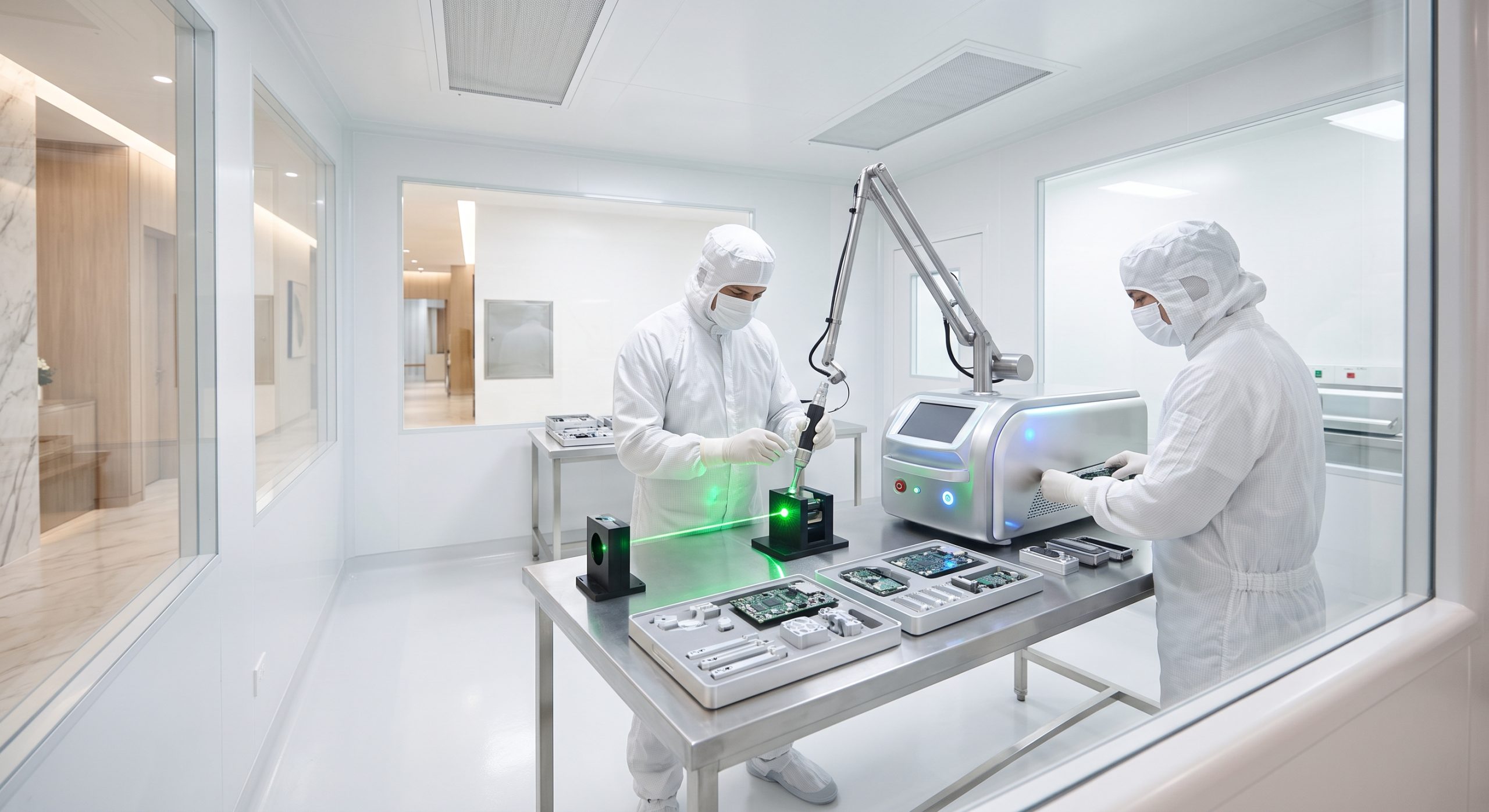
In the competitive world of B2B medical aesthetic devices, the difference between a market-leading laser platform and a liability often comes down to microscopic contamination. Legacy assembly environments—open bays, standard HVAC, and non-validated workflows—introduce particulates, microbial load, and electrostatic discharge (ESD) that compromise critical optical and electronic components. For devices operating at 755nm, 808nm, and 1064nm, even sub-micron debris on laser bars or fiber optic couplers can degrade energy density (fluence) and shorten handpiece lifespan. The result: inconsistent spot size, unpredictable pulse width, and costly warranty claims. Cleanrooms eliminate these variables by enforcing ISO 14644-1 classified environments, where particle counts, temperature, humidity, and pressure differentials are continuously monitored.
Breakthroughs in Cleanroom Final Assembly
Modern ISO 13485-certified manufacturing lines integrate ISO Class 7 (Class 10,000) or better cleanrooms for final assembly of diode laser stacks, TEC cooling modules, and sapphire contact cooling interfaces. Key breakthroughs include:
- HEPA/ULPA filtration with 99.99% efficiency at 0.3 µm, preventing particle deposition on optical facets.
- ESD-controlled flooring and ionizers to protect sensitive laser driver PCBs.
- Laminar flow benches for handpiece integration, ensuring imported laser bars remain contamination-free.
- Real-time particle counters tied to batch records for full traceability.
These measures directly affect clinical outcomes: a cleanroom-assembled 808nm diode array maintains stable peak power and fluence across millions of shots, whereas contaminated assemblies show 15–30% degradation within 6 months.
Component Superiority Through Controlled Environments
Cleanrooms are not merely clean—they are process-controlled ecosystems. For medical aesthetic devices, the following components benefit most:
- Laser bars and stacks: Prevention of dust-induced thermal runaway.
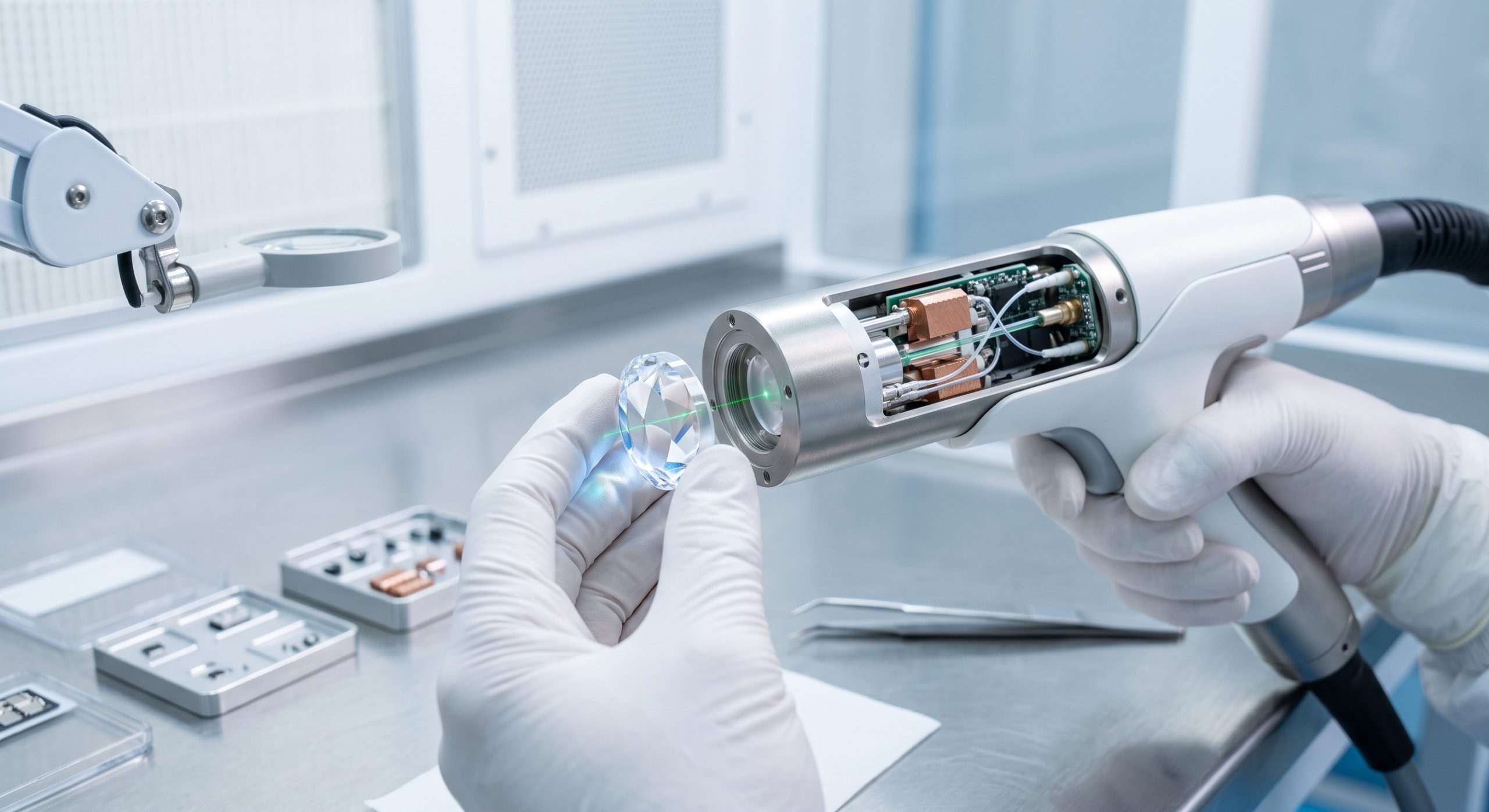
- Optical fibers and couplers: No particulate scattering, preserving spot size accuracy.
- Sapphire cooling windows: Assembly in low-humidity environments prevents condensation and microbial growth.
- Power supplies and TEC controllers: ESD-safe assembly ensures long-term reliability.
Manufacturers who invest in cleanroom final assembly report 30–50% fewer field failures and higher patient satisfaction due to consistent, painless treatments.
Spec Data Matrix
The table below summarizes critical cleanroom parameters and their impact on device performance for a typical 808nm diode laser platform.
| Key Parameter | Technical Specification |
|---|---|
| Cleanroom Classification | ISO Class 7 (Class 10,000) or better |
| Particle Count (≥0.5 µm) | < 352,000 particles/m³ |
| Air Changes per Hour | 60–120 |
| Temperature Control | 20–22°C ± 1°C |
| Relative Humidity | 45% ± 5% |
| Pressure Differential | 10–15 Pa positive to adjacent areas |
| ESD Protection | Ionizers + conductive flooring (< 1×10⁹ Ω) |
| Wavelength Applicability | 755nm / 808nm / 1064nm diode systems |
| Cooling System | Sapphire Contact Cooling (TEC-stabilized) |
| Handpiece Lifespan | 10–15 million shots (cleanroom-assembled) |
Consumable Savings and Long-Term ROI
While cleanroom infrastructure raises initial CapEx by 10–20%, the OpEx savings are substantial. Handpiece lifespan extends from ~5 million to 10–15 million shots, reducing consumable replacement costs. Clinics benefit from:
- Fewer downtime hours for handpiece repairs.
- Lower warranty claim rates, protecting brand reputation.
- Consistent energy density and pulse width, enabling predictable clinical endpoints.
For high-throughput med spas, this translates to an ROI improvement of 25–40% over three years.
Real Clinic Results
Clinics using cleanroom-assembled devices report:
- 95%+ clearance rates for hair removal across Fitzpatrick I–V.
- Reduced pain scores due to stable sapphire cooling.
- Consistent results for vascular and pigmented lesions at 1064nm and 532nm.
Final Advice
When procuring B2B medical aesthetic devices, demand evidence of cleanroom final assembly. Ask for ISO 13485 certificates, cleanroom classification reports, and particle count logs. Prioritize manufacturers who integrate Medical CE and FDA clearance with validated cleanroom protocols. The microscopic difference is your clinic’s macro advantage.