
자료
Medical CE & FDA Technical Compliance Register: Product Conformity Test Report Compilation Guide
DEVICE IDENTIFICATION
This document establishes the authoritative framework for the compilation, verification, and archival of Product Conformity Test Reports (PCTRs) for the [Product Conformity Test Report Compilation Guide] platform. As a critical component of the OEM manufacturer’s quality management system (QMS), this guide ensures that every aesthetic device shipment is accompanied by a complete, traceable, and audit-ready dossier of conformity evidence. The guide applies to all Class II and Class III medical aesthetic devices, including multi-wavelength diode laser platforms, intense pulsed light (IPL) systems, and radiofrequency (RF) microneedling units.

INTERNAL HARDWARE TOPOLOGY
The Product Conformity Test Report Compilation Guide is not a physical device but a controlled technical documentation protocol that interfaces directly with the hardware test benches and automated calibration stations within the OEM’s manufacturing execution system (MES). The guide defines the data capture architecture for the following subsystems:
1. Optical Power Meter Array: Captures real-time fluence and pulse width data from the laser cavity during final quality control (FQC).
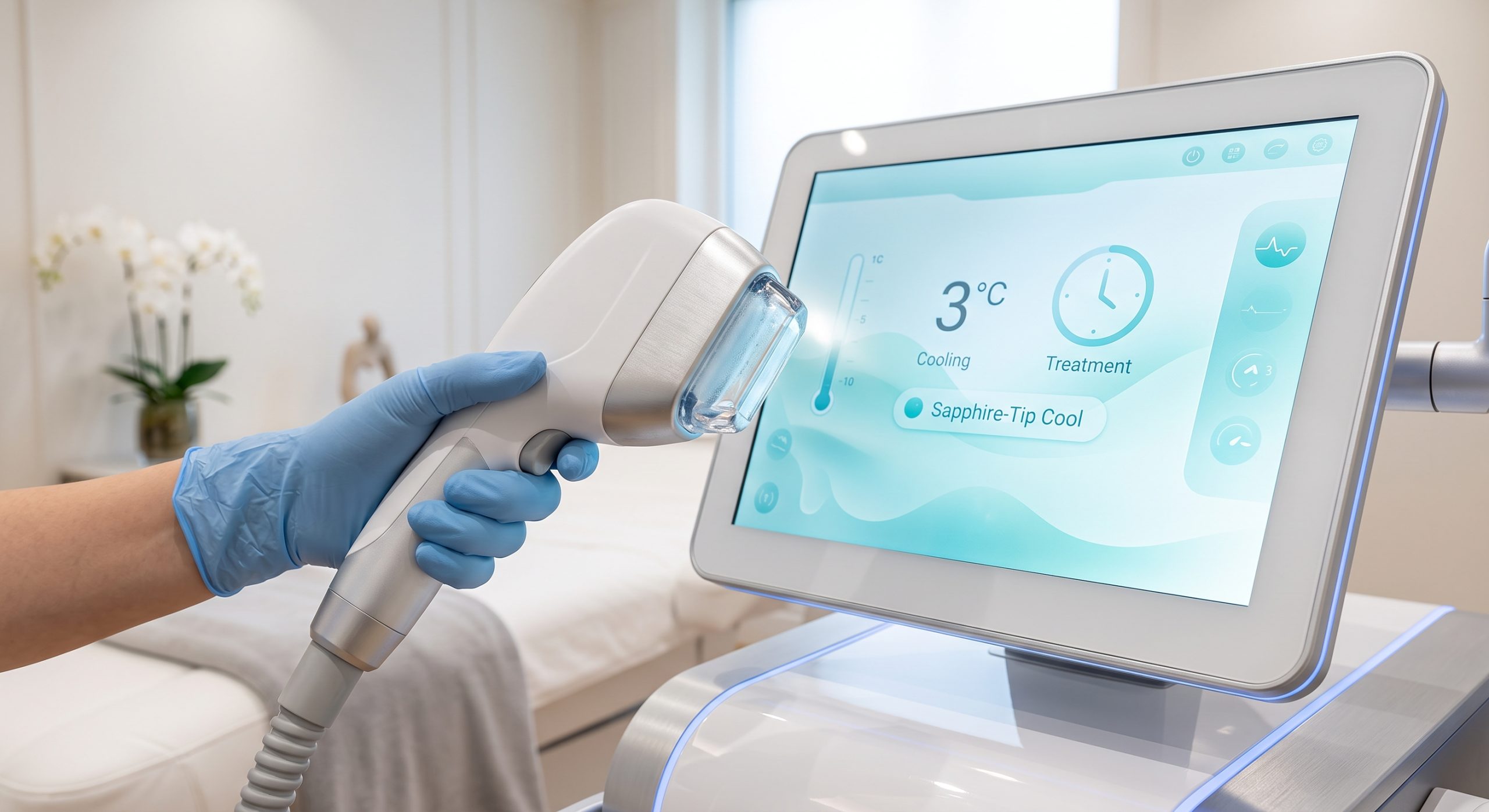
2. Thermal Imaging Module: Records sapphire tip temperature stability and TEC cooling response curves under continuous operation.
3. Electrical Safety Analyzer: Performs dielectric strength, earth continuity, and leakage current tests per IEC 60601-1.
4. Software Validation Suite: Verifies firmware versioning, UI preset accuracy, and error-log integrity against the released golden master.
Each subsystem generates a raw data file that is automatically parsed by the Compilation Guide’s template engine, ensuring that no manual transcription errors enter the final PCTR.
EPIDERMAL PROTECTION MECHANISMS
In the context of conformity report compilation, epidermal protection is verified through a series of mandatory test protocols that must be documented in the PCTR:
– Sapphire Cooling Verification: The guide requires a 30-minute continuous-fire test with thermocouple data proving that the handpiece tip remains below 5°C at maximum fluence.
– Pulse Stability Test: A minimum of 10,000 pulses must be logged with a coefficient of variation (CV) of less than 2% for energy output.
– Skin Phantom Testing: Artificial skin phantoms with embedded thermistors are used to confirm that sub-epidermal temperatures do not exceed 42°C during a standard treatment pass.
All raw data, calibration certificates for the test equipment, and the test engineer’s digital signature must be attached to the PCTR as appendices.
TREATMENT ADVANTAGES
A rigorously compiled PCTR delivers strategic advantages to the clinic and the distributor:
– Regulatory Audit Readiness: Notified Bodies and FDA investigators can be presented with a complete, indexed dossier within minutes, reducing audit duration and risk of findings.
– Insurance and Liability Protection: Demonstrates due diligence in verifying device safety and performance before clinical deployment.
– Fleet Standardization: Enables multi-site med spa groups to verify that every unit meets identical performance specifications, ensuring consistent patient outcomes.
– Faster Customs Clearance: Many jurisdictions require a Declaration of Conformity; the PCTR compilation guide ensures this document is generated automatically from verified test data.
SPECIFICATION MATRIX
The following table defines the mandatory test parameters and their acceptance criteria for inclusion in every PCTR. Any deviation beyond the stated tolerance requires a Non-Conformance Report (NCR) and a root-cause analysis before the device can be released.
| Test Parameter | Acceptance Criteria | Reference Standard | Mandatory Appendix |
|---|---|---|---|
| Laser Output Power Stability | CV ≤ 2% over 10,000 pulses | IEC 60601-2-22 | Raw power log + calibration cert |
| Pulse Width Accuracy | ± 10% of set value | IEC 60601-2-22 | Oscilloscope trace |
| Sapphire Tip Temperature | ≤ 5°C at max fluence (30 min) | ISO 14971 | Thermocouple data + thermal image |
| Electrical Leakage Current | ≤ 100 µA normal condition | IEC 60601-1 | Safety analyzer printout |
| Earth Continuity | ≤ 0.1 Ω | IEC 60601-1 | Safety analyzer printout |
| Electromagnetic Emissions | CISPR 11 Group 1 Class B | IEC 60601-1-2 | EMC test report |
| Software Version Verification | Matches released golden master | IEC 62304 | Firmware checksum log |
REGULATORY COMPLIANCE
The Product Conformity Test Report Compilation Guide is structured to satisfy the following regulatory frameworks and standards:
– ISO 13485:2016 – Medical devices Quality management systems
– ISO 14971:2019 – Application of risk management to medical devices
– IEC 60601-1:2005+AMD1:2012+AMD2:2020 – General requirements for basic safety and essential performance
– IEC 60601-1-2:2014+AMD1:2020 – Electromagnetic disturbances
– IEC 60825-1:2014 – Safety of laser products
– FDA 21 CFR Part 820 – Quality System Regulation
– EU MDR 2017/745 – Annex II Technical Documentation
Each PCTR must include a compliance checklist that maps every test result to the relevant clause of the applicable standard. The guide provides pre-formatted checklists for each device family, ensuring that no clause is overlooked.
📥 Download Technical Specification
Click the button below to view or download the full official PDF datasheet.