
자료
Critical Component Traceability Certificate Sample – Official Clinical Overview & Technical Datasheet
EXECUTIVE SUMMARY
The Critical Component Traceability Certificate Sample represents a paradigm shift in medical aesthetic device quality assurance and regulatory compliance documentation. This comprehensive certificate framework establishes an auditable, verifiable chain of custody for every critical component integrated into premium aesthetic platforms, ensuring that clinics, practitioners, and patients can trust in the provenance, authenticity, and performance integrity of their treatment systems. In an era where counterfeit components and unverified supply chains pose significant risks to clinical outcomes and patient safety, this traceability certificate serves as the definitive documentation standard for elite medical aesthetic OEM manufacturers.
The certificate encompasses full lifecycle documentation for high-value components including laser diode bars, optical delivery fibers, sapphire cooling tips, power supply units, control boards, and precision-machined handpiece assemblies. Each certificate is uniquely serialized and cross-referenced against manufacturing batch records, quality control test results, and international compliance certifications. This creates an unbroken chain of evidence that supports warranty validation, regulatory audits, and clinical efficacy claims.
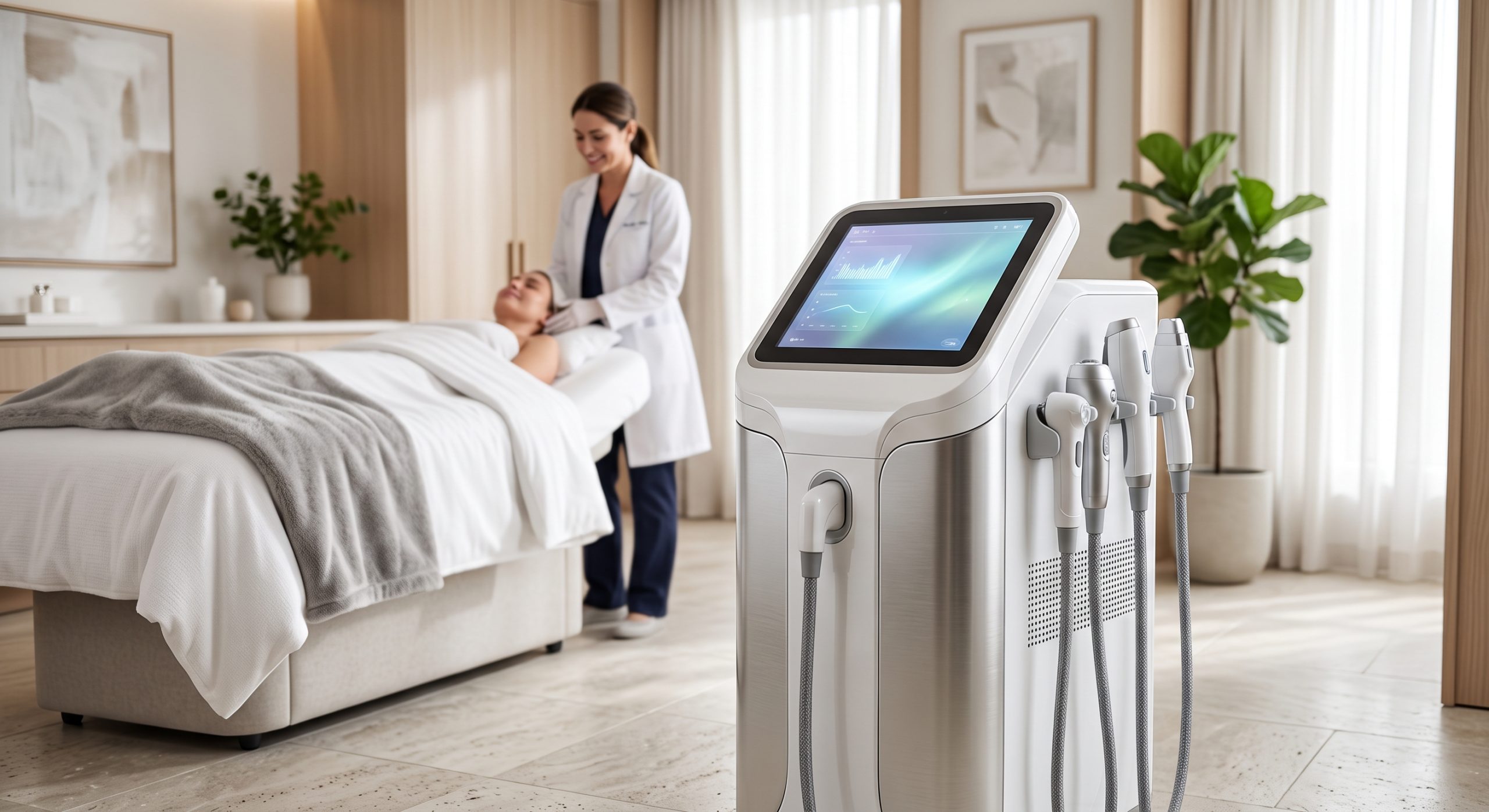
CLINICAL ARCHITECTURE & DESIGN
The Critical Component Traceability Certificate is architected around a multi-layer verification protocol that integrates seamlessly into existing quality management systems compliant with ISO 13485:2016 and FDA 21 CFR Part 820 requirements. The certificate structure comprises five primary verification domains: component identity authentication, manufacturing process validation, performance testing verification, regulatory compliance attestation, and supply chain integrity confirmation.
Each certificate contains a unique alphanumeric traceability code that maps to a secure digital record within the OEM’s enterprise quality management platform. This code enables real-time verification through an encrypted portal, allowing authorized stakeholders to confirm component authenticity, review test data, and access historical service records. The physical certificate itself incorporates anti-counterfeit features including microtext printing, UV-reactive security elements, and tamper-evident holographic seals, ensuring that the document maintains its integrity throughout its lifecycle.
The design philosophy behind this certificate system recognizes that medical aesthetic devices operate at the intersection of precision engineering and biological interaction. A single compromised component—whether a laser bar with degraded output stability, a cooling tip with compromised thermal conductivity, or a power supply with inadequate surge protection—can cascade into suboptimal treatment outcomes, patient discomfort, or device failure. The traceability certificate thus serves as both a quality assurance instrument and a risk mitigation tool.
KEY INDICATIONS & CAPABILITIES
The Critical Component Traceability Certificate supports a comprehensive range of medical aesthetic device platforms including diode laser systems for hair removal, Nd:YAG and Alexandrite lasers for pigmented lesion treatment, fractional CO2 and Er:YAG systems for skin resurfacing, intense pulsed light platforms for photorejuvenation, and radiofrequency devices for tissue tightening. For each platform category, the certificate documents platform-specific critical components and their respective verification parameters.
For diode laser systems, the certificate traces laser diode bars, FAC lenses, fiber optic delivery assemblies, and TEC cooling modules. For pulsed light systems, it documents xenon flash lamps, spectral filters, and capacitor banks. For RF platforms, it tracks electrode arrays, impedance monitoring circuits, and thermoelectric cooling elements. This component-level granularity ensures that every potential failure point is documented and verifiable.
The certificate additionally supports multi-unit fleet management, allowing clinic networks to maintain centralized traceability records across multiple device installations. This capability is particularly valuable for enterprise med spa operations seeking to standardize quality across locations and demonstrate regulatory compliance during health authority inspections.
COMPLIANCE & STANDARDS
The Critical Component Traceability Certificate Sample is engineered to satisfy the most stringent international regulatory frameworks governing medical device manufacturing and distribution. The certificate documentation aligns with ISO 13485:2016 Medical Devices Quality Management Systems, ISO 14971:2019 Application of Risk Management to Medical Devices, and IEC 60601-1 Medical Electrical Equipment Safety Standards. For European market access, the certificate supports MDR 2017/745 technical documentation requirements, while for United States market access, it fulfills FDA 21 CFR Part 820 Quality System Regulation and 21 CFR Part 11 Electronic Records requirements.
Additional compliance frameworks addressed include Health Canada Medical Devices Regulations SOR/98-282, TGA Therapeutic Goods (Medical Devices) Regulations 2002 for Australian market access, and NMPA regulations for Chinese market authorization. The certificate incorporates all required elements for CE marking technical file inclusion and supports Notified Body audits by providing verifiable evidence of component-level conformity assessment.
TECHNICAL SPECIFICATIONS
The Critical Component Traceability Certificate is issued in both physical and digital formats. Physical certificates utilize 120gsm security paper with embedded security fibers and chemical sensitizers. Digital certificates employ SHA-256 cryptographic hashing with blockchain-anchored timestamp verification. Certificate dimensions conform to A4 standard (210mm x 297mm) for easy filing and archival integration.
Each certificate contains a minimum of 27 discrete data fields organized into logical sections. Component identification fields include OEM part number, manufacturer lot number, serial number, and date of manufacture. Quality verification fields include test protocol reference, test equipment calibration status, test result values, and pass/fail disposition. Supply chain fields document country of origin, shipping documentation reference, and receiving inspection record. Compliance fields capture applicable standards, certification body references, and declaration of conformity statements.
| Parameter | Specification |
|---|---|
| Certificate Format | Physical A4 (210x297mm) + Encrypted Digital PDF |
| Security Features | Microtext, UV Reactive Elements, Holographic Seal, SHA-256 Hash |
| Data Fields | 27+ Discrete Fields Across 5 Verification Domains |
| Traceability Code | Unique Alphanumeric 16-Character Serialized Identifier |
| Component Categories | Laser Bars, Optical Fibers, Sapphire Tips, Power Supplies, Control Boards, Handpiece Assemblies |
| Regulatory Alignment | ISO 13485:2016, ISO 14971:2019, IEC 60601-1, MDR 2017/745, FDA 21 CFR 820/11 |
| Verification Portal | 24/7 Encrypted Online Authentication with Real-Time Response |
| Archival Retention | 10 Years Minimum per FDA 21 CFR Part 820.180 Requirements |
| Blockchain Timestamp | SHA-256 Anchored with Immutable Distributed Ledger Record |
| Language Support | English (Primary), with Multilingual Translation Options Available |
| Replacement Protocol | Certificate Verification Mandatory Pre-Installation for All Components |
| Enterprise Fleet Support | Centralized Multi-Device Traceability Register with API Integration |
CLINICAL PROTOCOLS
The implementation of the Critical Component Traceability Certificate within a clinical environment follows a structured protocol designed to maximize traceability value while minimizing administrative burden. Upon receiving a new device or replacement component, clinical staff should verify the certificate’s authenticity through the OEM’s secure verification portal using the unique traceability code. This verification should be documented in the clinic’s equipment maintenance log with the date, time, and staff member performing verification.
For ongoing quality assurance, the certificate should be cross-referenced during routine device maintenance, after any repair or component replacement, and during regulatory inspections. Clinics maintaining multiple devices are encouraged to establish a centralized traceability register that maps certificate numbers to device serial numbers, installation dates, and service history. This register becomes an invaluable asset during warranty claims, insurance audits, and accreditation reviews.
When component replacement is required, the replacement component’s certificate must be verified and linked to the original device record, maintaining the unbroken chain of traceability. Clinics should establish a policy requiring certificate verification for all replacement components prior to installation, rejecting any component lacking valid traceability documentation. This practice prevents the introduction of counterfeit or substandard components into the treatment ecosystem.
📥 Download Technical Specification
Click the button below to view or download the full official PDF datasheet.