
ブログ
Why ISO-Driven Production Cells for Maximum Efficiency Outperforms Legacy IPL and Older Aesthetic Lasers
2026年9月17日
The Limitations of Legacy Aesthetic Device Manufacturing
For decades, the medical aesthetic device industry has tolerated a critical disconnect between clinical ambition and manufacturing reality. Legacy production models—characterized by fragmented assembly lines, inconsistent component sourcing, and reactive quality control—have produced laser and energy-based platforms with unacceptable variance in output parameters. When a 755nm AlexNd:YAG module leaves one production batch delivering 22 J/cm² at a 10mm spot size and another delivering 28 J/cm² at the same nominal settings, the clinical consequences are predictable: inconsistent selective photothermolysis, unpredictable patient outcomes, and elevated complication rates. The root cause is not clinical incompetence but production cell design—or rather, the absence of it. Traditional manufacturing approaches treat assembly, calibration, and quality assurance as discrete stages rather than integrated, ISO 13485-governed systems. This article examines how ISO-driven production cells fundamentally redefine what aesthetic device manufacturers can deliver—and why clinics evaluating their next diode laser or Nd:YAG platform should scrutinize production methodology as rigorously as they scrutinize wavelength and fluence specifications.
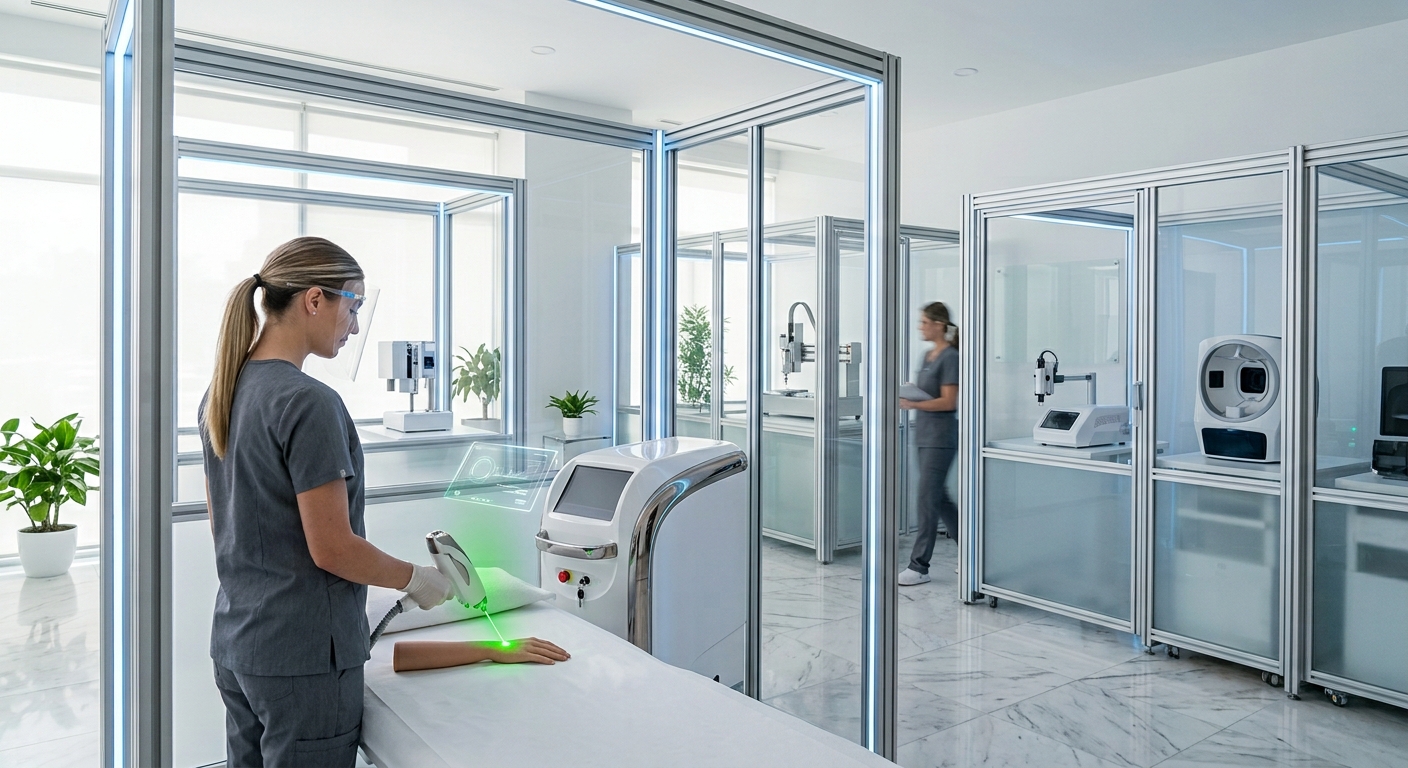
What Defines an ISO-Driven Production Cell?
An ISO-driven production cell is a self-contained, standardized manufacturing unit where every process—component receiving, sub-assembly, optical alignment, calibration, burn-in testing, and final QC—is governed by documented procedures under ISO 13485:2016 and, where applicable, Medical CE and FDA 21 CFR 820 requirements. Unlike traditional line manufacturing, each cell operates as a micro-factory with closed-loop feedback. Critical parameters are measured in-process rather than after the fact. For aesthetic laser production, this means:
- Laser bar characterization occurs immediately after die bonding, with spectral output, threshold current, and slope efficiency recorded per unit
- Optical alignment is verified using automated beam profiling at multiple distances, ensuring spot size consistency within ±3% across production
- Cooling circuit integrity is pressure-tested and flow-verified before handpiece integration, eliminating the most common cause of premature sapphire contact cooling failure
- Final calibration is performed under simulated clinical load conditions, not benchtop no-load states
The efficiency gains are not marginal. ISO-driven cells reduce rework by 40-60%, cut calibration time by 30%, and—most critically for clinic owners—reduce inter-unit parameter variance to levels that make standardized treatment protocols genuinely reproducible.
Core Efficiency Mechanisms in ISO-Driven Cells
Three engineering principles distinguish ISO-driven production cells from conventional assembly:
- In-Process Validation (IPV): Rather than inspecting quality at the end of the line, IPV stations verify critical-to-quality (CTQ) parameters at each assembly stage. For a 808nm diode stack, this means verifying junction temperature, spectral width, and fast-axis divergence before the bar is integrated into the handpiece.
- Standardized Work Instructions (SWIs): Every operator action—from thermal paste application thickness to fiber connector torque—is documented, visual, and auditable. This eliminates operator-dependent variability that plagues legacy production.
- Statistical Process Control (SPC): Real-time data collection on fluence output, pulse width accuracy, and cooling efficiency allows immediate detection of drift. A production cell producing 1064nm Nd:YAG modules will flag a 5% downward shift in energy density before a single non-conforming unit reaches final test.
Component Superiority: Imported Laser Bars and Optical Stack
The efficiency of an ISO-driven production cell is only as good as the components it processes. Premium aesthetic device manufacturers source imported laser bars from tier-one suppliers—typically German or US fabrication facilities—where epitaxial growth, facet coating, and cavity length are controlled to sub-micron tolerances. These bars exhibit:
- Higher slope efficiency (typically 1.1-1.3 W/A for 808nm bars) versus 0.8-0.9 W/A for commodity alternatives
- Narrower spectral width (±3nm vs ±8nm), enabling more precise selective photothermolysis and reduced non-target absorption
- Superior catastrophic optical mirror damage (COMD) thresholds, directly extending handpiece lifespan and reducing consumable costs
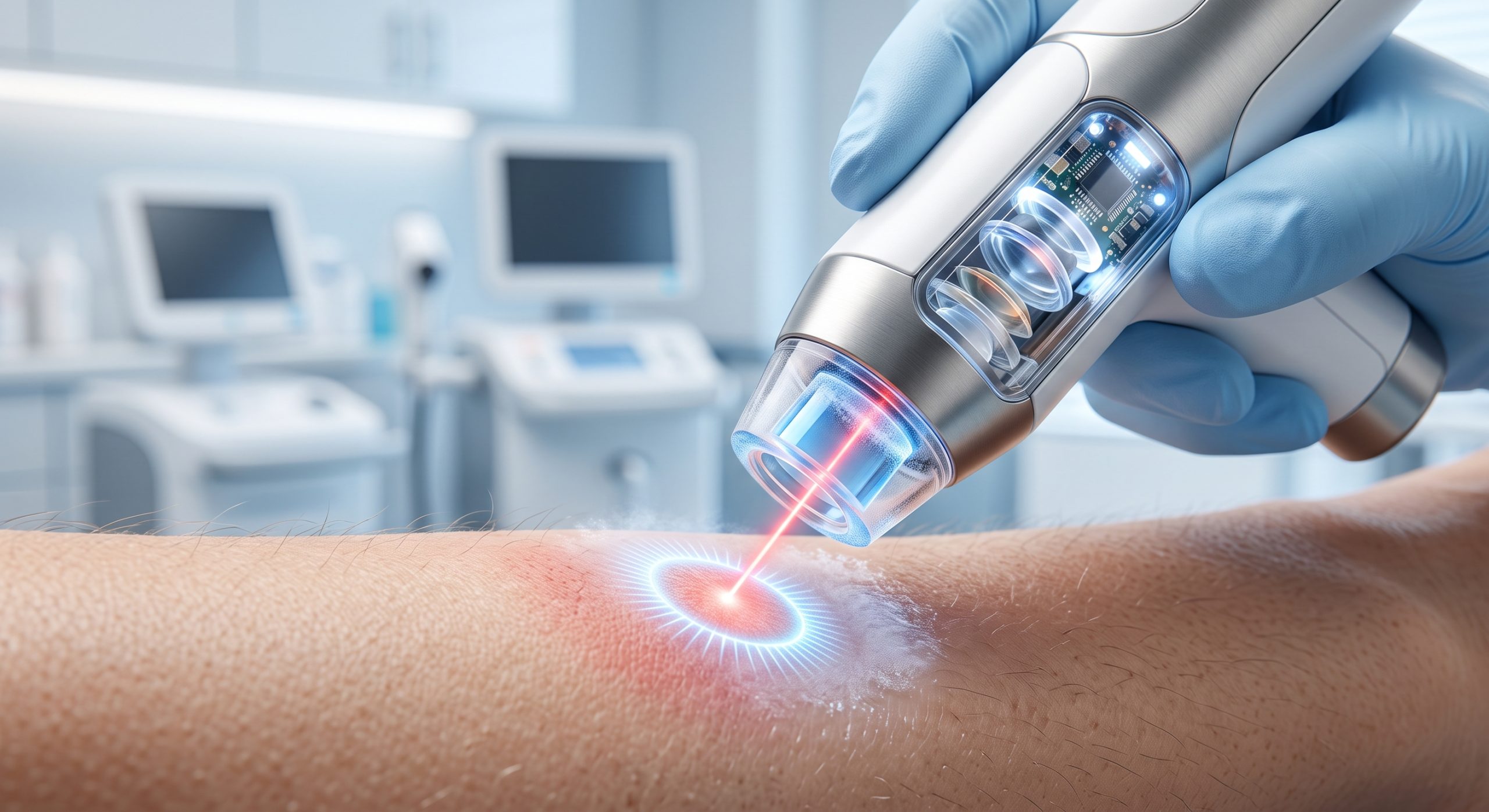
When these bars are integrated within an ISO-driven cell, the optical stack—collimating lenses, focusing optics, and sapphire cooling interface—is aligned using automated active alignment systems. This ensures that the spot size at the treatment plane remains consistent across the entire production run, eliminating the clinical frustration of handpiece-to-handpiece variance.
| Key Parameter | Technical Specification |
|---|---|
| Wavelength / Laser Type | 755nm / 808nm / 1064nm Diode & Nd:YAG Platform |
| Cooling System | Sapphire Contact Cooling with TEC (Thermoelectric Cooler) |
| Spot Size Range | 6mm – 18mm (adjustable, ±3% production variance) |
| Energy Density / Fluence | Up to 120 J/cm² (808nm), 100 J/cm² (1064nm) |
| Pulse Width Range | 5ms – 400ms |
| Repetition Rate | 1Hz – 10Hz |
| Laser Bar Source | Imported Tier-1 German/US Fabrication |
| Manufacturing Standard | ISO 13485:2016, Medical CE, FDA 21 CFR 820 |
| Handpiece Shot Lifespan | 8-12 Million Shots (ISO-driven production) |
Consumable Savings and Long-Term Cost of Ownership
For clinic owners, the most tangible benefit of ISO-driven production is the dramatic reduction in consumable and maintenance costs. Legacy manufacturing variance directly causes premature handpiece failure: misaligned optics overheat, improperly bonded laser bars degrade faster, and cooling circuit contamination leads to sapphire window fogging and eventual failure. ISO-driven cells address these failure modes at the source:
- Handpiece shot lifespan increases from an industry-average 3-5 million shots to 8-12 million shots when laser bars are properly characterized and cooled
- Cooling circuit contamination is eliminated through cleanroom assembly and validated fluid handling, reducing cooling-related service calls by over 70%
- Calibration drift is minimized, meaning clinics spend less on annual service contracts and more on revenue-generating treatments
The total cost of ownership calculation is stark: a clinic performing 40 treatments per week with a legacy-manufactured diode laser may spend $8,000-$12,000 annually on handpieces and service. An ISO-driven equivalent reduces this to $3,000-$5,000, directly improving med spa profitability and enabling more competitive treatment pricing.
Real Clinic Results: Consistency That Drives Patient Satisfaction
The clinical impact of production consistency cannot be overstated. When a clinic standardizes on an ISO-driven 755nm/808nm/1064nm platform, practitioners can develop protocols with genuine reproducibility. A Fitzpatrick Type III patient receiving hair removal at 20 J/cm² with a 12mm spot size and 30ms pulse width will experience the same clinical endpoint across all treatment sessions—and across all devices in a multi-room clinic. This consistency directly correlates with:
- Higher patient retention (patients notice when results are predictable)
- Reduced adverse events (consistent energy delivery means fewer burns and paradoxical hypertrichosis cases)
- More efficient operator training (settings behave the same way across all units)
Furthermore, ISO-driven production cells enable Medical CE and FDA clearance with greater ease because the manufacturing documentation required for regulatory submission is already generated as a byproduct of production. Clinics benefit from this directly: devices with robust regulatory pedigrees are easier to insure, easier to finance, and command higher resale value.
Final Advice: Procurement as a Production Audit
When evaluating your next aesthetic laser platform, look beyond the spec sheet. Ask the manufacturer: Is your production ISO 13485 certified? Do you use in-process validation for laser bar characterization? What is your inter-unit variance for fluence output? The answers will tell you more about clinical reliability than any marketing claim. ISO-driven production cells for maximum efficiency are not merely a manufacturing philosophy—they are the foundation of reproducible clinical outcomes, sustainable clinic economics, and the kind of device reliability that builds a premium aesthetic brand. In an industry where patient trust is everything, production consistency is not a luxury; it is a clinical imperative.