
ブログ
The Ultimate Clinic Guide to Tracking Coating Batches for Industrial and Medical Parts: Efficacy, Wavelengths, and ROI
2026年7月2日
Introduction: The Silent Variable in High-Stakes Medical Aesthetics
In the world of high-performance medical aesthetic devices, the conversation often revolves around peak power, wavelength precision, and cooling efficiency. However, a critical, often overlooked element that dictates the longevity, safety, and clinical efficacy of your investment is the integrity of its surface coatings. For industrial and medical parts, particularly those within diode laser handpieces, tracking coating batches is not merely a quality control checkbox; it is a fundamental pillar of patient safety and device ROI. Variations in optical coatings can alter the fluence delivered to the target tissue, leading to inconsistent clinical outcomes or, worse, adverse events. This guide provides a comprehensive, data-driven approach to managing this essential variable in a busy med spa or dermatology practice.
The Physics of Failure: Why Coating Integrity Matters
The performance of an aesthetic laser is defined by its ability to deliver a specific energy density (Fluence) measured in J/cm² at the target depth. This is governed by the principle of selective photothermolysis. The laser rods, mirrors, and the sapphire output window—all critical industrial and medical parts—are coated with anti-reflective (AR) or highly reflective (HR) films. A degradation or batch-to-batch variance in these coatings directly impacts the transmission efficiency of the specific wavelength. For example, a variance in the coating batch on the 808nm diode bar can reduce transmission by 2-3%. While seemingly minor, this translates to a loss of up to 2 J/cm² of effective fluence, potentially moving a treatment from a therapeutic zone (e.g., 12-15 J/cm² for hair removal) into a sub-therapeutic range, jeopardizing clinical clearance rates.
Wavelength Penetration and Skin Interaction
Different wavelengths target different chromophores. 755nm (Alexandrite) is ideal for superficial melanin in Fitzpatrick Skin Types I-III, 808nm (Diode) offers a deep, safe penetration for Types I-V, and 1064nm (Nd:YAG) is the gold standard for deeper vessels and darker skin Types V-VI. Consistent coating batch tracking ensures that the precise pulse width (measured in milliseconds) and the selected wavelength are not compromised by optical inefficiencies, maintaining the intended tissue interaction profile.
Critical Technical Metrics in Coating Quality
To ensure FDA clearance and Medical CE compliance, a robust tracking system must monitor specific technical metrics that validate the coating’s performance against the manufacturer’s specifications. These are often verified during routine maintenance or calibration checks.
- Optical Density (OD): A measure of absorption or reflection. A 0.5 OD variance can indicate film degradation.
- Transmission/Reflection Efficiency (%): The percentage of light energy successfully delivered to the skin. High-quality coating batches maintain efficiency >99.5%.
- Laser-Induced Damage Threshold (LIDT): The maximum power the coating can withstand before failure. This is critical for high-energy, high-frequency clinical protocols.
- Surface Roughness (Ra): Measured in nanometers, affecting scatter and cooling efficiency of the sapphire contact window.
Technical Specifications & Parameter Optimization
When integrating a new handpiece or replacing optical components, the tracking data should be cross-referenced with the device’s performance logs. Here is a standard matrix of how coating integrity links to clinical parameters.
| Key Parameter | Technical Specification | Impact of Coating Variance |
|---|---|---|
| Wavelength / Laser Type | 755nm / 808nm / 1064nm Diode | Shift in peak absorption; reduced target specificity. |
| Cooling System | Sapphire Contact Cooling (TEC) | Roughness (Ra) increases; reduces thermal transfer & patient comfort. |
| Energy Density (Fluence) | 10 – 40 J/cm² | Up to 15% loss in delivered energy if coating OD is compromised. |
| Pulse Width | 5 – 400 ms | Inconsistent temporal output; causes thermal diffusion to surrounding tissue. |
| Regulatory Compliance | Medical CE, FDA Clearance, ISO 13485 | Failure leads to non-compliance and voided warranty. |
Clinic ROI and Lifecycle Cost Management (TCO)
Implementing a strict tracking coating batches protocol significantly reduces the Total Cost of Ownership (TCO) and maximizes Med Spa Profitability. Un-tracked or degraded coatings lead to decreased treatment throughput (more pulses required for same result) and increased electrical consumption. More critically, a loss of efficacy can lead to patient dissatisfaction and ‘no result’ refunds, directly impacting your bottom line. By auditing the handpiece durability and coating lifespan, you can anticipate replacement needs, avoiding costly downtime and ensuring high-throughput clinics maintain their treatment schedules without interruption.
Regulatory Compliance: CE and FDA Requirements
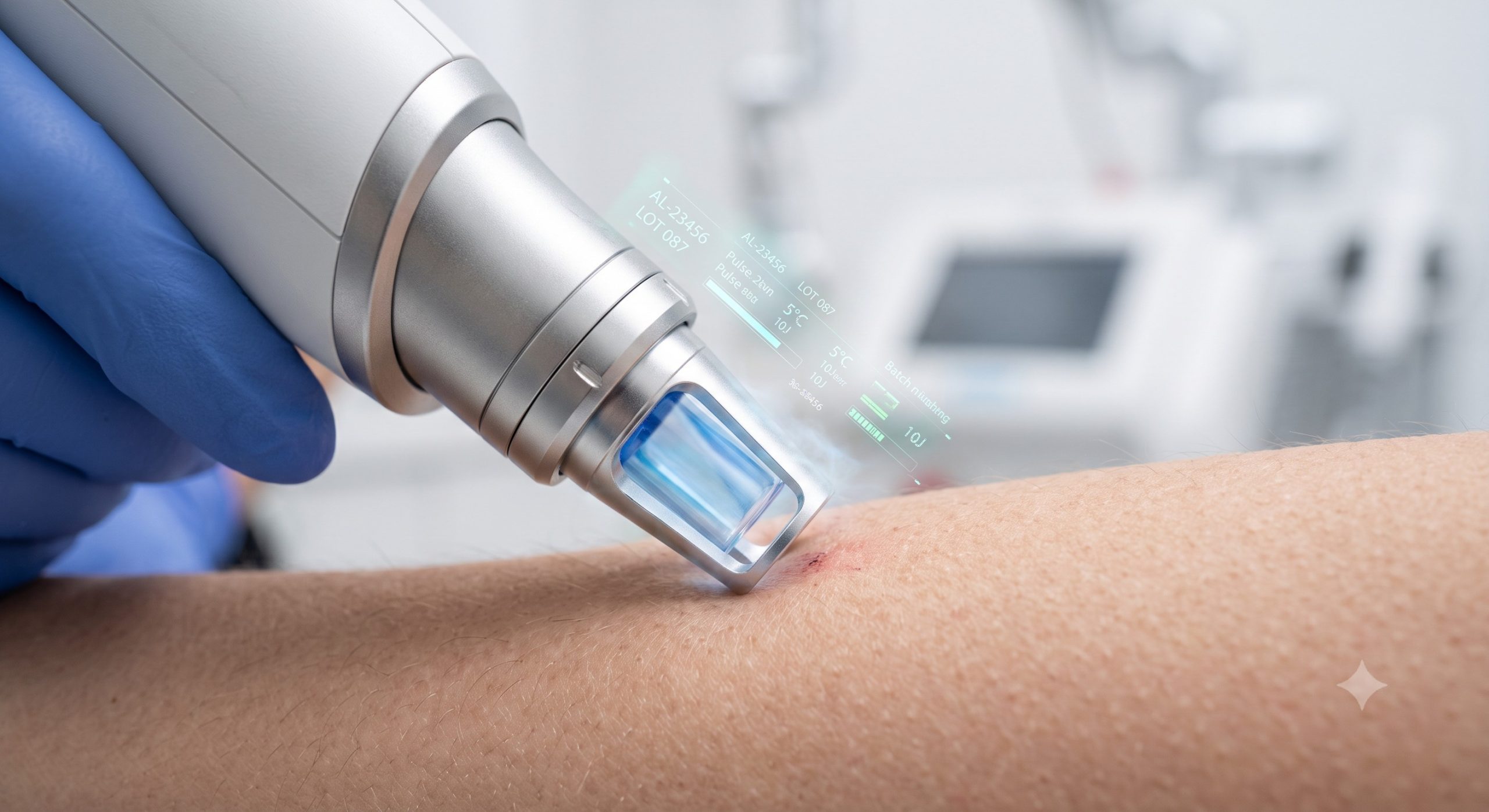
For a device to maintain its ISO 13485 certification and FDA clearance, the manufacturing process must include rigorous batch control. Clinics performing in-house maintenance or using refurbished parts must ensure that the replacement components come with verifiable coating batch reports. This is not just about performance; it is a critical component of your Clinic Audit Protection. In the event of a patient complication, traceability of the exact coating batch can be vital for root cause analysis, demonstrating due diligence in device management.
Conclusion: Standardizing the Coating Tracking Protocol
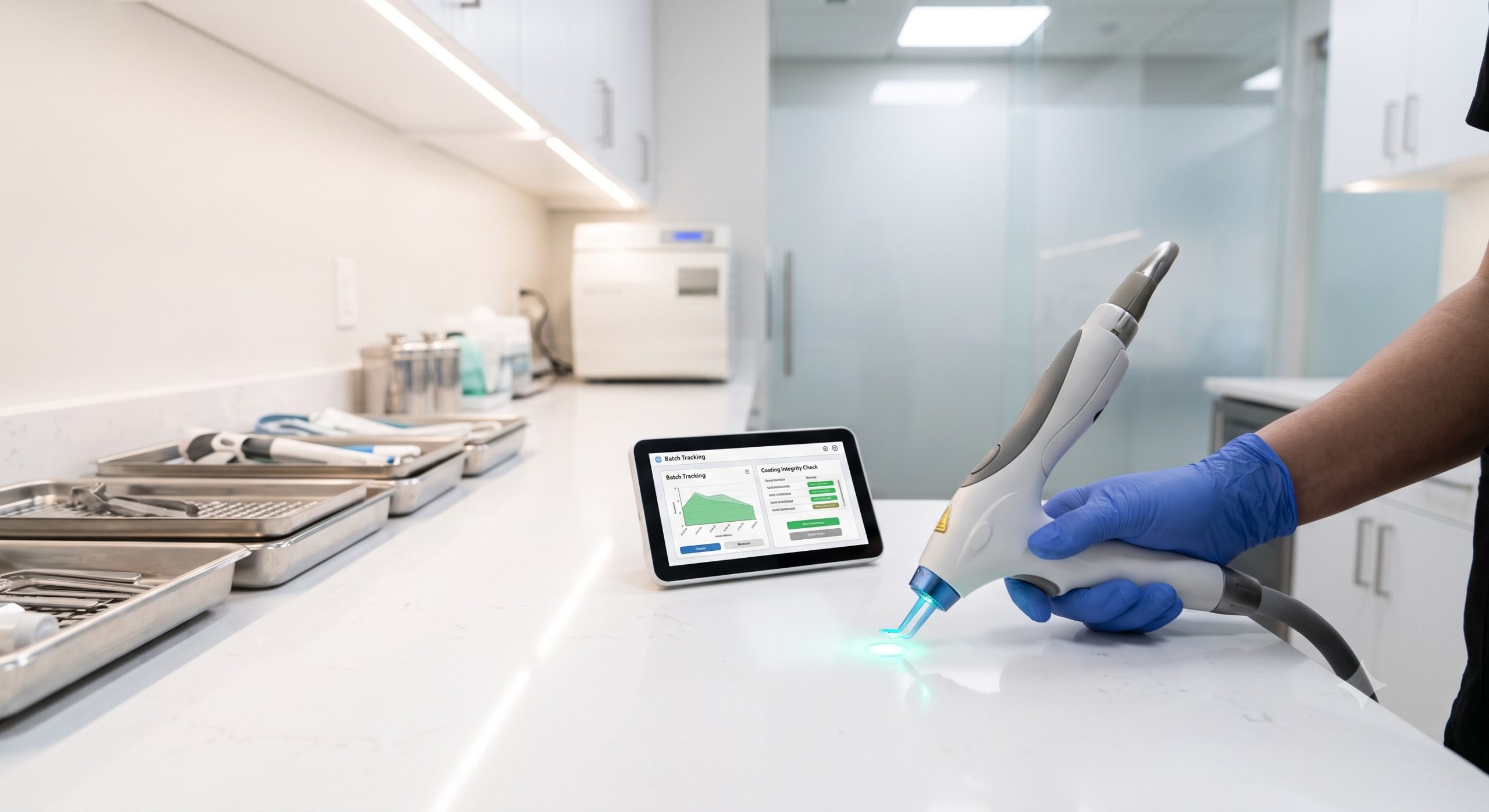
To elevate your practice from a standard provider to a high-ROI clinical asset, you must treat your device’s optical coatings as a medical consumable. Tracking coating batches is an investment in patient safety, clinical consistency, and business sustainability. We recommend implementing a digital logbook that records the batch number, installation date, and output verification (J/cm²) for every optical component introduced to your clinic environment. This data-driven approach ensures you are not leaving clinical outcomes up to chance, but mastering the engineering beneath the aesthetic.