
ブログ
FDA & Medical CE Compliance: Ensuring Patient Safety with 808nm Diode Laser Hair Removal Systems
2026年11月19日
The Compliance Gap That Puts Clinics at Risk
Most clinic owners assume that a device bearing a CE mark or an FDA clearance number is universally safe to deploy across all markets. In reality, the regulatory architecture governing medical aesthetic lasers has diverged sharply over the past five years. A system legally cleared for marketing in the United States under a 510(k) may not satisfy the EU MDR requirements for clinical evidence and post-market surveillance, while a device carrying a valid Medical CE certificate may still require a separate UKCA pathway for deployment in Great Britain.
For the 808nm diode laser—the clinical workhorse for hair removal and vascular applications—this regulatory fragmentation creates tangible risks: insurance invalidation, MHRA enforcement action, and civil liability exposure. This analysis dissects the three dominant compliance regimes through the lens of a single clinical platform, providing procurement teams and medical directors with an actionable framework for multi-market deployment.
Regulatory Classification: Why the 808nm Diode Occupies a Contested Space
EU MDR: Annex XVI and the IIa/IIb Distinction
The European Union’s Medical Device Regulation (EU) 2017/745 introduced a pivotal change for aesthetic devices through Annex XVI, which brings certain products without an intended medical purpose into the medical device framework. For laser and IPL equipment, the classification hinges on the claimed indication:
- Class IIa: Devices intended solely for hair removal. This classification permits a self-certification route for the technical documentation, though a Notified Body is still required for Quality Management System (QMS) certification.
- Class IIb: Devices claiming skin resurfacing, tattoo removal, vascular lesion treatment, or pigmentation correction. A full Notified Body assessment of both the technical file and QMS is mandatory.
The clinical implication is immediate: an 808nm diode platform marketed exclusively for hair removal may qualify as Class IIa, but adding a vascular indication (e.g., telangiectasia) automatically escalates the device to Class IIb, triggering substantially higher clinical evidence and surveillance obligations. Procurement teams must verify that the CE certificate explicitly covers every indication the clinic intends to market.
FDA Framework: 510(k) Clearance and the QMSR Transition
In the United States, the 808nm diode laser is regulated as a Class II powered laser surgical instrument (Product Code GEX) under 21 CFR 878.4810. Market access is achieved through 510(k) premarket notification, demonstrating substantial equivalence to a legally marketed predicate device. Critically, FDA clearance is indication-specific: a device cleared for hair removal is not automatically cleared for vascular treatment or skin rejuvenation.
A significant regulatory shift is underway with the FDA Quality Management System Regulation (QMSR), effective February 2, 2026, which incorporates ISO 13485:2016 by reference, replacing the former 21 CFR Part 820 CGMP framework. Manufacturers and importers must confirm that their supplier’s QMS is certified to the current ISO 13485:2016 standard, as this will become the de facto baseline for FDA compliance audits.
UKCA: The Post-Brexit Parallel Pathway
Great Britain (England, Scotland, Wales) now operates a dual-recognition regime. UKCA marking is the domestic approval route under the UK Medical Device Regulations 2002, requiring assessment by a UK Approved Body for Class IIa and higher devices. However, the UK government has extended recognition of CE marked devices indefinitely, meaning a valid Medical CE certificate remains a viable pathway for GB market access for the foreseeable future.
The practical nuance: clinics in Great Britain can accept CE-marked devices, but the MHRA retains enforcement powers and requires registration. For Northern Ireland, the CE UKNI marking applies. A single 808nm diode system deployed across the UK and EU must therefore hold either a CE certificate naming an EU Notified Body or a UKCA certificate from an Approved Body—the two are not automatically interchangeable.
Technical Specifications and Compliance Verification
The following parameter matrix represents the critical output characteristics that regulatory auditors and clinical directors should verify against the device’s technical file. Discrepancies between marketed specifications and certified values constitute a compliance failure under all three regimes.
| Key Parameter | Technical Specification | Compliance Relevance |
|---|---|---|
| Wavelength | 808nm (±5nm) Diode | Primary chromophore: melanin; water absorption minimal |
| Spot Size | 10 × 12 mm (typical) | Larger spot reduces scatter; verify certified vs. marketed value |
| Energy Density (Fluence) | 10–100 J/cm² | Must align with cleared/CE-certified indication range |
| Pulse Width | 10–400 ms | Critical for Fitzpatrick IV–VI safety; verify thermal relaxation time alignment |
| Repetition Rate | 1–10 Hz | Throughput metric; affects epidermal heat accumulation |
| Cooling System | Sapphire contact, 0–5°C | Essential for epidermal protection; audit maintenance logs |
| Laser Bar Origin | Imported (e.g., Germany/US) | Affects power stability and lifespan; request traceability documentation |
Clinical Safety and the Fitzpatrick Imperative
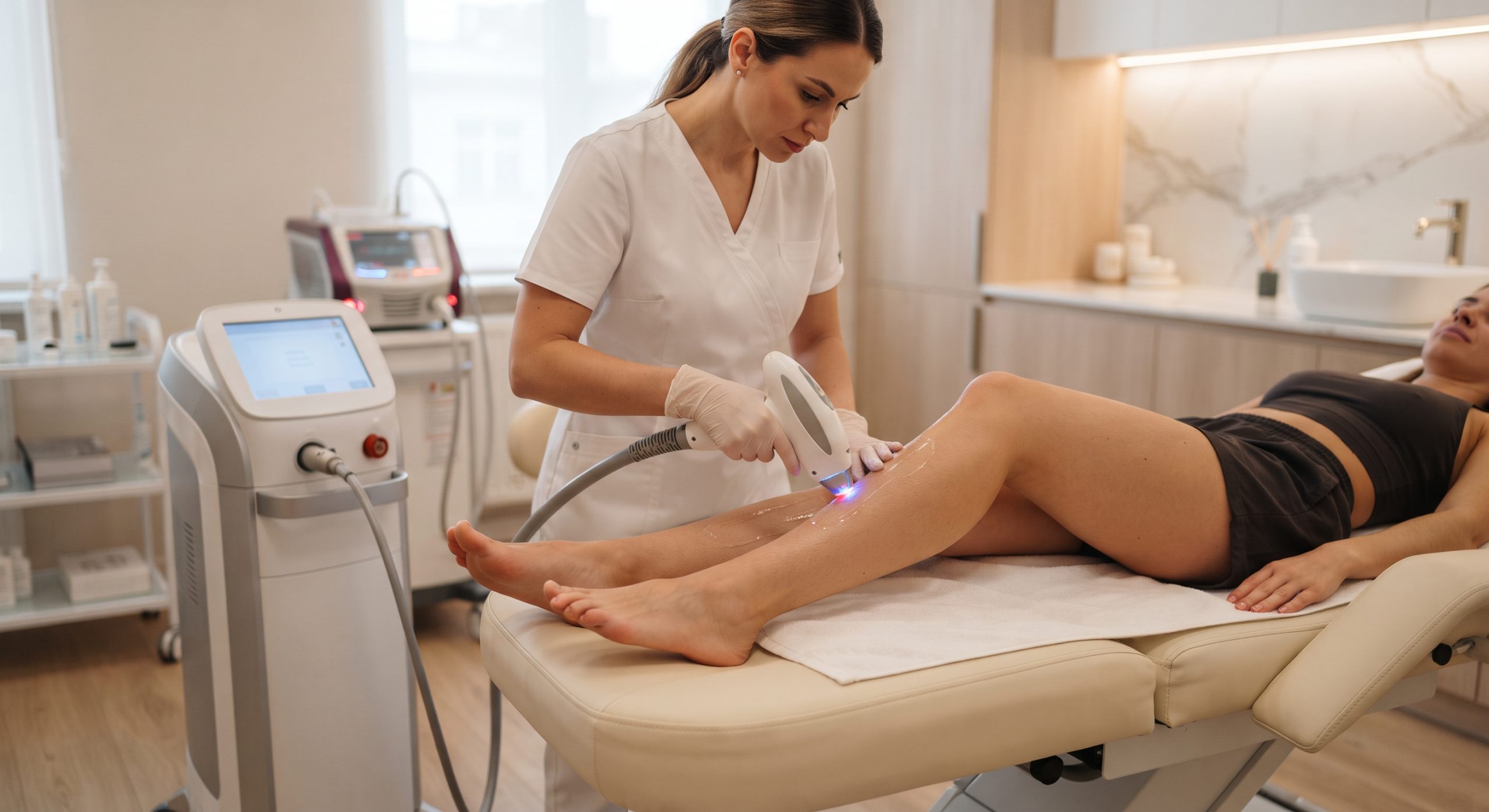
Regulatory compliance is inseparable from clinical safety, particularly for 808nm diode lasers operating on Fitzpatrick skin types IV–VI. The wavelength’s preferential absorption by melanin—while advantageous for follicular targeting—creates a competing chromophore risk in the epidermis. Without adequate epidermal cooling (sapphire contact cooling at 0–5°C) and appropriate pulse widths (typically 10–400 ms for hair removal), the risk of post-inflammatory hyperpigmentation (PIH) and thermal injury rises significantly.
The EU Common Specifications for Annex XVI products explicitly require risk management documentation that addresses risks to both patients and operators. For a clinic, this translates to a documented training protocol for operators, a maintenance log for the cooling system, and clear contraindication labeling—all of which are subject to Notified Body or FDA inspection during a post-market audit.
Procurement Protocol: What to Demand Before Signing
Compliance is a documentary exercise. A supplier’s brochure is not evidence. Before committing capital to an 808nm diode platform, require the following:
- FDA 510(k) clearance letter naming the exact model and listing the cleared indications. Verify the number against the FDA’s public 510(k) database.
- EU CE Certificate with the four-digit Notified Body number and a Declaration of Conformity citing the applicable Annex (typically Annex IX for full QMS). Confirm that the certificate’s scope covers the indications you intend to offer.
- ISO 13485:2016 certificate from an accredited registrar, with a scope that explicitly includes the design and manufacture of laser-based medical devices.
- UKCA documentation (if applicable) and confirmation of a UK Responsible Person for MHRA registration.
The absence of any single document is not a minor administrative gap—it is a direct threat to your clinic’s insurance coverage and legal standing. In an era of increasing regulatory scrutiny on aesthetic devices, the procurement decision is a compliance decision.