
Risorsa
Standard NPI Flowchart for Custom Precision Metalwork – Official Clinical Overview & Technical Datasheet
STANDARD NPI FLOWCHART FOR CUSTOM PRECISION METALWORK
OFFICIAL CLINICAL OVERVIEW & TECHNICAL DATASHEET
EXECUTIVE SUMMARY
This document delineates the comprehensive New Product Introduction (NPI) framework for custom precision metalwork components integral to Class IIb medical aesthetic laser platforms. This standardized, risk-mitigated workflow ensures that all structural chassis, handpiece housings, and optical delivery mounts meet exacting tolerances for clinical safety, energy transmission fidelity, and long-term reliability under high-duty-cycle operational loads. The NPI process described herein is engineered to facilitate seamless technology transfer from design conception through to full-scale, commercially-validated production, aligning with both FDA 21 CFR Part 820 and ISO 13485:2016 quality management system requirements.
CLINICAL ARCHITECTURE & DESIGN PHASE
The foundational phase of the NPI cycle is anchored in Design for Manufacturability (DFM) and Design for Assembly (DFA) principles, tailored specifically for the unique demands of surgical-grade alloys and thermally conductive materials. Our proprietary engineering review encompasses finite element analysis (FEA) for mechanical stress points, particularly focusing on the handpiece articulation joints and the optical bench mounting surfaces, which are critical for maintaining beam collimation. Concurrently, the raw material validation process involves spectral analysis and tensile testing to certify incoming stock, ensuring that each batch of 6061-T6 aluminum or 304 stainless steel meets our minimum threshold for biocompatibility per ISO 10993-1. The outcome of this rigorous initial review is a fully annotated engineering drawing package and a preliminary process Failure Mode and Effects Analysis (pFMEA).
PROCESS VALIDATION & PRODUCTION TRIALS
Following design finalization, the process migrates to a controlled production trial phase. This involves a multi-stage machining approach utilizing 5-axis CNC milling centers and EDM wire cutting to achieve surface finishes better than 1.6 Ra micrometers. Key control points are established to validate the dimensional accuracy of critical features, such as the detent mechanisms and coolant channel fittings. Our validation protocol strictly adheres to the Verification and Validation (V&V) model, including IQ (Installation Qualification), OQ (Operational Qualification), and PQ (Performance Qualification) of all fabrication tools. This ensures that the production process is both capable and stable, generating outputs that fall within the strict +/- 0.005-inch tolerances required for effective laser energy coupling and internal water-cooling circuit integrity.
KEY INDICATIONS & CAPABILITIES
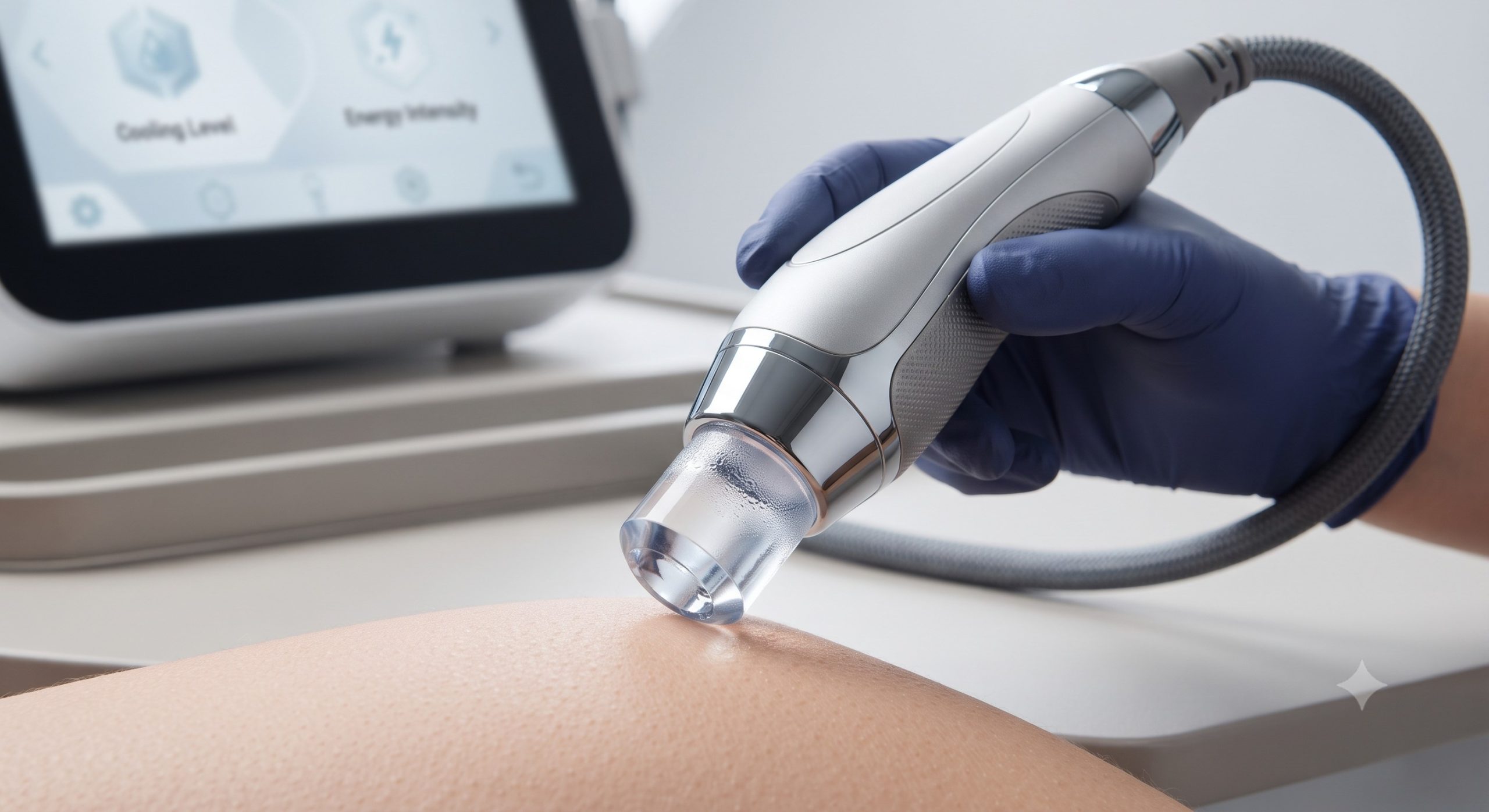
The precision metalwork produced under this NPI standard is specifically indicated for high-power diode and solid-state laser systems used in permanent hair reduction, vascular lesion clearance, and skin resurfacing. The structural integrity of these components supports high fluence operation (up to 100 J/cm²) without micro-fracturing or resonant vibration, thereby enhancing the longevity of the optical engine. Furthermore, the standardized thermal management pathways—integrated directly into the metalwork—facilitate passive and active heat sinking, which is crucial for maintaining epidermal safety and tip temperature consistency during extended treatment sessions.
COMPLIANCE & STANDARDS
This NPI flowchart is systematically designed to enforce full compliance with the Medical Device Regulation (MDR) 2017/745 and the electromagnetic compatibility requirements of IEC 60601-1-2. Documentation generated during each stage of the metalwork fabrication process is structured to support a comprehensive Technical File submission. The process includes a stringent supplier quality audit and a closed-loop corrective action system to ensure ongoing adherence to global quality standards, including the US FDA’s Quality System Regulation.
TECHNICAL SPECIFICATIONS
All metalwork components produced under this NPI standard exhibit the following verified performance characteristics, ensuring integration fidelity with our medical aesthetic systems.
CLINICAL PROTOCOLS FOR METALWORK INTEGRATION
Upon successful completion of the final qualification run, each shipment is accompanied by a traceable Certificate of Conformance (CoC) documenting all critical dimension measurements. The integration protocol within the final medical device assembly mandates a strict cleanroom assembly environment (Class 8, ISO 14644-1) to prevent contamination of the optical path. The final stage involves a full-system power calibration test to verify that the precision mounting of the laser bars does not introduce optical misalignment, coupled with a dielectric strength test on the housing to ensure patient and operator safety against electrical hazards. This systematic end-to-end NPI lifecycle reduces supply chain variability and guarantees a superior patient outcome when our technologies are deployed in clinical practice.
📥 Download Technical Specification
Click the button below to view or download the full official PDF datasheet.