
Risorsa
Calibration Certificate Verification Checklist – Official Clinical Overview & Technical Datasheet
CLINICAL ARCHITECTURE & PERFORMANCE REFERENCE MANUAL: CALIBRATION CERTIFICATE VERIFICATION CHECKLIST
EXECUTIVE SUMMARY
The Calibration Certificate Verification Checklist (CCVC) represents a proprietary, systematic documentation framework engineered to establish and maintain the absolute energetic fidelity of medical aesthetic laser and light-based platforms. Within the high-stakes environment of clinical dermatology and med spa operations, the accuracy of delivered fluence (J/cm²) and pulse duration directly correlates to treatment efficacy, patient safety, and regulatory compliance. This whitepaper delineates the comprehensive architecture of the CCVC, detailing its role as a mandatory quality assurance instrument that bridges the gap between manufacturing tolerances and clinical performance. The protocol is designed to ensure that every treatment session is conducted with verified, traceable energy outputs, thereby mitigating the risks of sub-therapeutic outcomes or adverse events due to energy miscalibration.
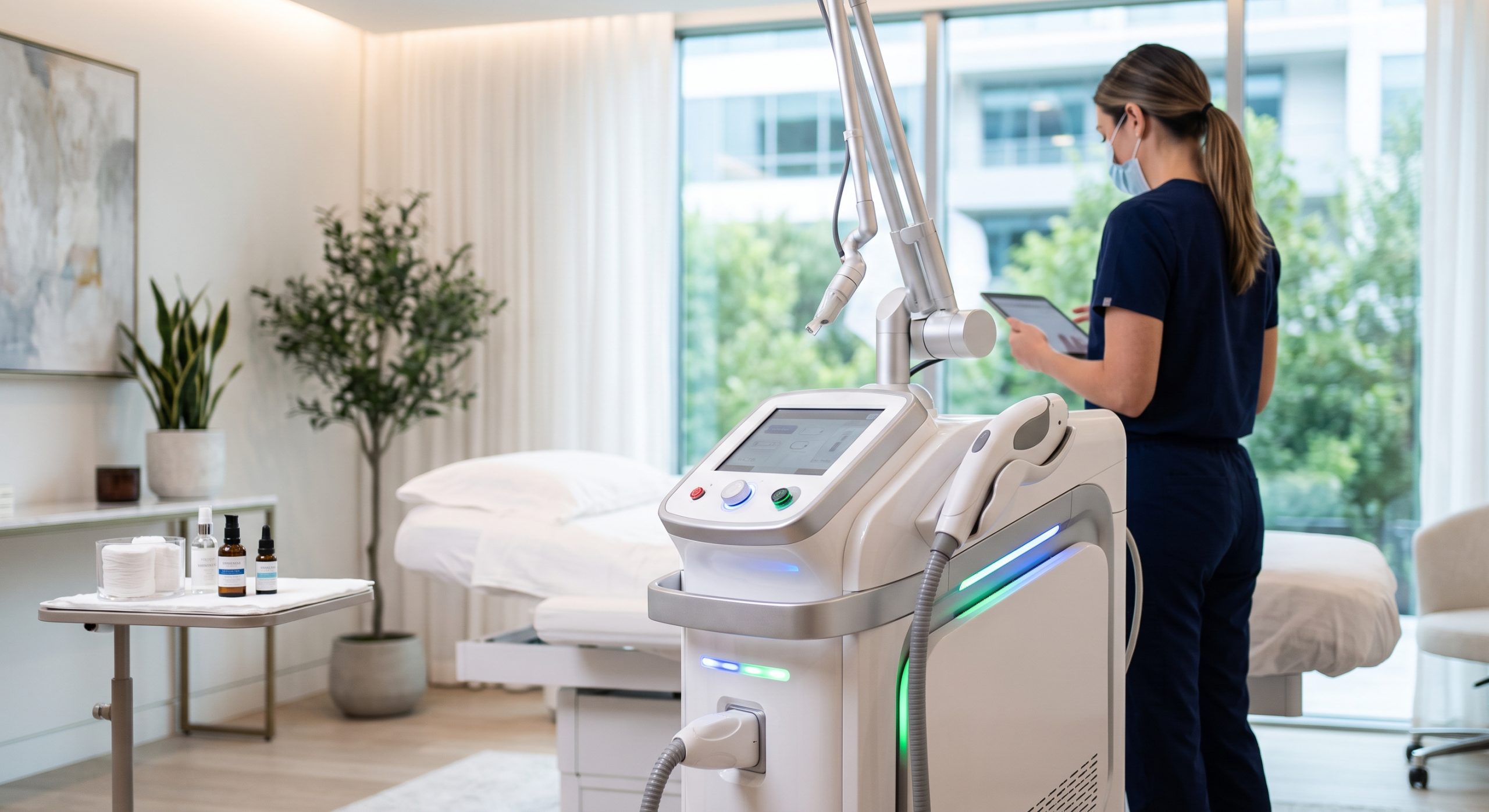
CLINICAL ARCHITECTURE & DESIGN
The CCVC is not a singular document but a stratified, multi-layered verification system. Its foundational architecture is predicated on a cascade of checks that verify the entire optical chain, from the laser diode or flashlamp source to the distal tip of the treatment handpiece. The system is designed to be intrinsically linked to the device’s internal feedback mechanisms, providing a secondary, independent verification layer.
A. Primary Standard Verification
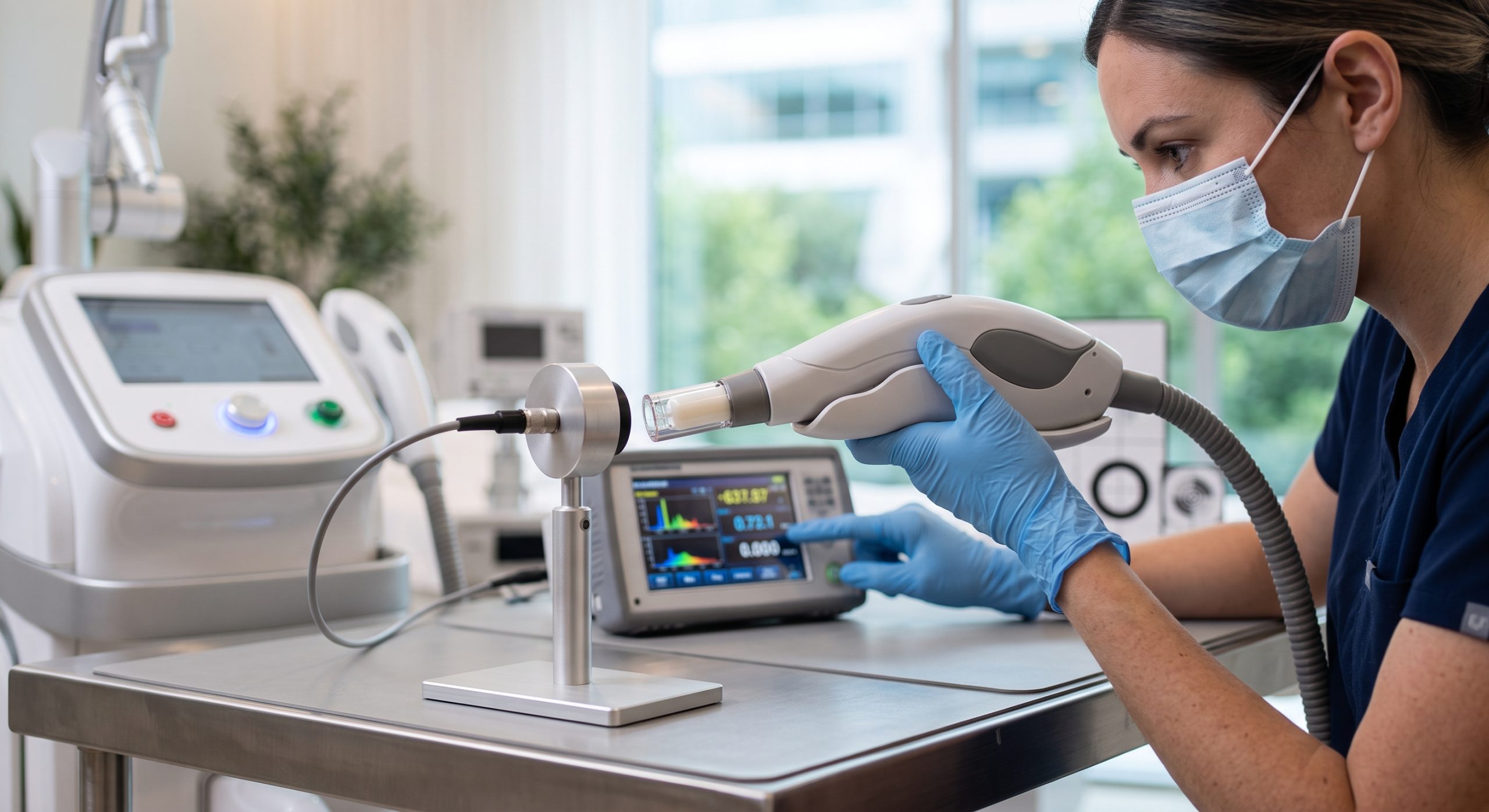
At its core, the checklist mandates the use of a NIST-traceable or equivalent national standard power meter and energy meter. These primary standards are periodically calibrated by certified external laboratories, ensuring a direct and unbroken chain of metrological traceability to international base units. The CCVC process involves a comparative analysis where the device’s internal energy monitors are validated against the readings from these external, high-precision standards.
B. Secondary Reference Point Protocol
The checklist establishes a rigorous protocol for taking measurements. This includes defined environmental parameters (ambient temperature, humidity) and specific spatial positioning of the energy meter’s detector head relative to the handpiece aperture. The protocol dictates a standardized distance and alignment jig to eliminate cosine and scattering errors, ensuring that the verification data is reproducible and scientifically valid regardless of the operator’s technique.
C. Failure Mode Analysis & Acceptable Tolerances
The CCVC document defines precise acceptable tolerances for energy output deviations. Typically, an OEM-standard tolerance of ±10% to ±15% of the set fluence is permitted for high-power aesthetic devices. However, the checklist contains a decision matrix that guides the clinical engineer through corrective actions when readings exceed these thresholds. This matrix includes steps for cleaning the handpiece window, checking the cooling water purity, and initiating a hardware recalibration routine.
KEY INDICATIONS & CAPABILITIES
The application of the CCVC spans the entire lifecycle of an aesthetic device:
– Pre-Delivery Inspection (PDI): Prior to the initial clinical use, the CCVC serves as the final quality gate, confirming that the device performs to its specified parameters after transport and installation.
– Routine Calibration Schedules: The checklist is implemented at mandatory intervals (e.g., every six months or after a defined number of pulses) to proactively identify and rectify ‘drift’ in the optical output, ensuring consistent clinical outcomes.
– Post-Service Verification: Following any major component replacement (e.g., laser diode bars, flashlamps, or handpiece assemblies), the CCVC is executed to verify the integrity of the repair and the performance of the new components.
– Pre-Clinical Session Check: For high-fluence or critical treatments, clinics may use a simplified version of the checklist to verify the handpiece performance against a built-in or external test fixture just prior to patient treatment.
COMPLIANCE & STANDARDS
Adherence to the CCVC is a prerequisite for compliance with international safety and quality standards. The checklist framework is designed to align with the documentation requirements of:
– IEC 60601-2-22:2019: Requirements for the basic safety and essential performance of surgical, cosmetic, therapeutic, and diagnostic laser equipment.
– ISO 13485: Medical devices – Quality management systems – Requirements for regulatory purposes, ensuring consistent design, development, and post-market surveillance.
– ISO 14971: Application of risk management to medical devices, ensuring that calibration drift is identified as a potential hazard and mitigated through verification.
– National Regulations: Meets the stringent reporting requirements for FDA (USA) and TGA (Australia) regarding device performance monitoring and incident reporting.
TECHNICAL SPECIFICATIONS
The following specifications define the operational limits and requirements for the successful execution of the CCVC protocol.
| Parameter | Specification |
|---|---|
| Primary Verification Standard | NIST-Traceable Power/Energy Meter |
| Measurement Wavelength Range | 755nm – 1064nm (Diode / Nd:YAG) |
| Fluence Accuracy Tolerance | ± 12% (Typical OEM Specification) |
| Pulse Duration Verification | Single Shot & Repetitive Pulse Modes |
| Verification Frequency | Every 6 Months or 100,000 Shots |
| Environmental Operating Range | 15°C – 30°C / 20% – 80% RH (non-condensing) |
| Measurement Uncertainty (K=2) | < 3.0% (Using Primary Standard) |
| Protocol Reference | OEM Calibration Procedure CP-101 Rev. 6 |
CLINICAL PROTOCOLS
To operationalize the CCVC, a strict, step-by-step clinical engineering protocol must be followed:
1. SYSTEM WARM-UP: Ensure the aesthetic device has been powered on for a minimum of 30 minutes to allow the internal cooling and optical systems to stabilize to their nominal operating temperature.
2. HANDHELD CLEANING: Inspect and clean the distal output window of the handpiece with isopropyl alcohol to remove any debris or residue that could attenuate the laser beam.
3. METER SETUP: Position the primary standard power/energy meter on a stable surface and ensure its detector is appropriately sized for the maximum expected energy density. Connect the meter and allow it to stabilize.
4. TEST FIRING: Set the device to a specific test protocol (e.g., 15 J/cm², 10mm spot, 10ms pulse). Fire a sequence of pulses (e.g., 10 pulses) into the meter, discarding the first to allow the detector to stabilize.
5. DATA RECORDING: Record the average measured energy or power from the standard meter for a defined number of shots (e.g., 5-10 consecutive pulses).
6. DEVIATION CALCULATION: Calculate the percentage deviation between the set energy and the measured energy.
– *Formula: ((Measured – Set) / Set) * 100*
7. PASS/FAIL DETERMINATION: Compare the deviation against the acceptable tolerance. If the deviation is within the specified tolerance, the device ‘Passes’ the verification. If it is outside the tolerance, the ‘Fail’ protocol is initiated, requiring service intervention and recalibration.
8. CERTIFICATION STAMP: Upon successful completion, the verification checklist is signed, dated, and logged, providing a legally defensible record of the device’s performance status.
📥 Download Technical Specification
Click the button below to view or download the full official PDF datasheet.