
Blog
Why Ocean Freight Lanes Demand Specialized Packing Engineering: The Ultimate Clinic Guide to Medical Aesthetic Device Logistics
2026年11月4日
The Hidden Cost of Generic Shipping: Why Aesthetic Devices Fail at Sea
Every year, aesthetic clinics and distributors lose millions of dollars to equipment that arrives with misaligned optical benches, compromised laser bars, or shattered sapphire cooling windows. The culprit is rarely the device itself. It is the brutal reality of ocean freight: 30-plus days of continuous vibration, humidity cycling, and container temperature swings that no generic wooden crate can survive.
For a 755nm/808nm/1064nm diode laser system, a micro-shift of just 0.2mm in the optical cavity can degrade energy density and invalidate the Medical CE conformity. This guide deconstructs the engineering physics behind ocean freight lanes and why specialized packing engineering is not a logistics footnote—it is a clinical and financial imperative.
Anatomy of a Failure: Vibration, Humidity, and Thermal Shock in Trans-Oceanic Transit
Vibration Frequencies and Optical Misalignment
Container ships produce continuous low-frequency vibration (1-20 Hz) from engines and wave impact. While a human hand cannot detect a 5 Hz hum, a diode laser stack with imported laser bars resonates at these frequencies. Without tuned damping, the solder joints between laser bars and the heat sink experience fatigue. The result: a drop in peak power from the specified 1200W to 600W, requiring higher current draw and reducing pulse width consistency.
Relative Humidity and Condensation on Sapphire Cooling Systems
During a 35-day voyage from Shanghai to Rotterdam, a container can experience temperature swings from -5°C to 45°C. Each swing drives relative humidity to condensation point. For devices with Sapphire contact cooling and TEC modules, moisture ingress into the cooling circuit causes corrosion of the copper heat exchanger. This directly compromises epidermal cooling efficiency, creating a patient safety risk during Fitzpatrick skin type IV-VI treatments.
Packing Engineering Specifications: A Data-Driven Approach
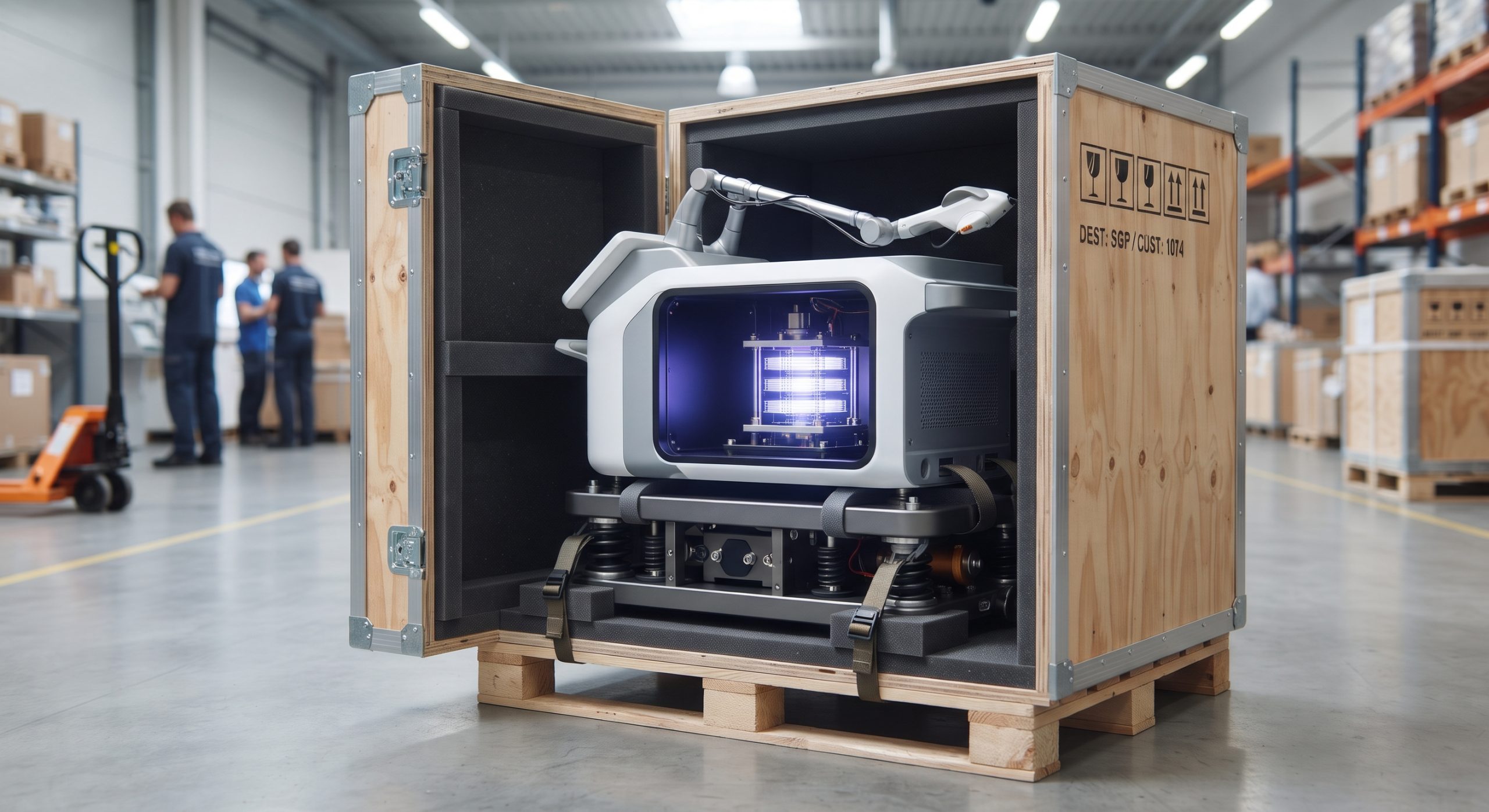
Specialized packing engineering for ocean freight lanes requires a multi-layered approach: an outer structural crate, an inner vibration-isolation platform, and a sealed desiccant barrier. The table below outlines the technical specifications that separate compliant medical device packing from generic industrial crating.
| Key Parameter | Technical Specification |
|---|---|
| Vibration Damping | Tuned elastomer mounts, 1-20 Hz isolation, <0.5G transmitted |
| Humidity Control | Desiccant barrier, <40% RH for 45 days, cobalt chloride indicator |
| Shock Logging | Tri-axial accelerometer, 0-50G range, 1000Hz sampling |
| Thermal Insulation | Closed-cell foam, R-value >3.5, -10°C to 50°C stability |
| Outer Structure | Plywood crate, 12mm thickness, ISPM 15 heat-treated |
| Device Securing | Custom foam-in-place cradle, <2mm movement tolerance |
Regulatory and Quality Assurance Implications (ISO 13485, Medical CE, FDA)
Under ISO 13485 clause 7.5.11, preservation of product must ensure conformity with requirements during internal processing and delivery. A device that arrives with compromised calibration cannot claim Medical CE or FDA clearance conformity upon installation. Specialized packing engineering is therefore not optional—it is a mandatory component of the quality management system.
- Shock logging: Tri-axial accelerometers embedded in packing record G-force events. A peak above 15G invalidates warranty and requires recalibration.
- Humidity indicators: Cobalt chloride strips provide irreversible evidence of moisture exposure above 60% RH.
- Tilt indicators: Ensure the device was not inverted, which can displace coolant fluid in TEC-based systems.
ROI Analysis: Cost of Generic Packing vs. Specialized Engineering
A generic wooden crate costs $80. A specialized vibration-isolated crate with desiccant barrier costs $320. A single returned device due to optical misalignment costs $4,500 in freight, recalibration, and lost clinic revenue. The break-even is clear: specialized packing engineering pays for itself if it prevents one failure in every 15 shipments.
For high-throughput clinics ordering multiple units, the savings compound. More importantly, consistent arrival quality protects the clinic’s reputation. A device with degraded energy density produces suboptimal hair reduction and pigment clearance, driving negative patient outcomes and eroding the ROI of the entire aesthetic program.
Conclusion: Engineering the Last Mile of the Supply Chain
The ocean freight lane is the least visible but most destructive segment of the medical aesthetic device supply chain. Clinics and distributors who treat packing as an afterthought are unknowingly gambling with ISO 13485 compliance, patient safety, and capital equipment lifespan. Specialized packing engineering—defined by tuned vibration damping, humidity control, and shock documentation—is the only rational strategy for protecting high-value 755nm/808nm/1064nm laser systems and their Sapphire cooling components.
Before your next shipment, demand the packing specification. Your device’s spot size, fluence, and pulse width—and your patients’ outcomes—depend on it.