
Blog
Ensuring Zero Contamination During Medical Part Pack-Out: A Clinical Deep Dive into Cleanroom Protocols, Sterile Barrier Systems, and ISO 13485 Compliance
2026年11月11日
The Hidden Risk in Medical Device Manufacturing: Contamination During Pack-Out
In the highly regulated world of medical aesthetic device manufacturing, the final pack-out stage represents one of the most underestimated contamination vectors in the entire production chain. Whether you are producing laser handpieces, sapphire cooling tips, or optical fiber assemblies, the moment a sterile or sub-assembled component leaves the controlled environment and enters its primary packaging, it becomes vulnerable to particulate, microbial, and pyrogen contamination. For B2B buyers sourcing devices cleared under Medical CE and FDA 510(k), a single contamination event can trigger field safety corrective actions (FSCA), recall costs exceeding $250,000, and irreparable brand damage.
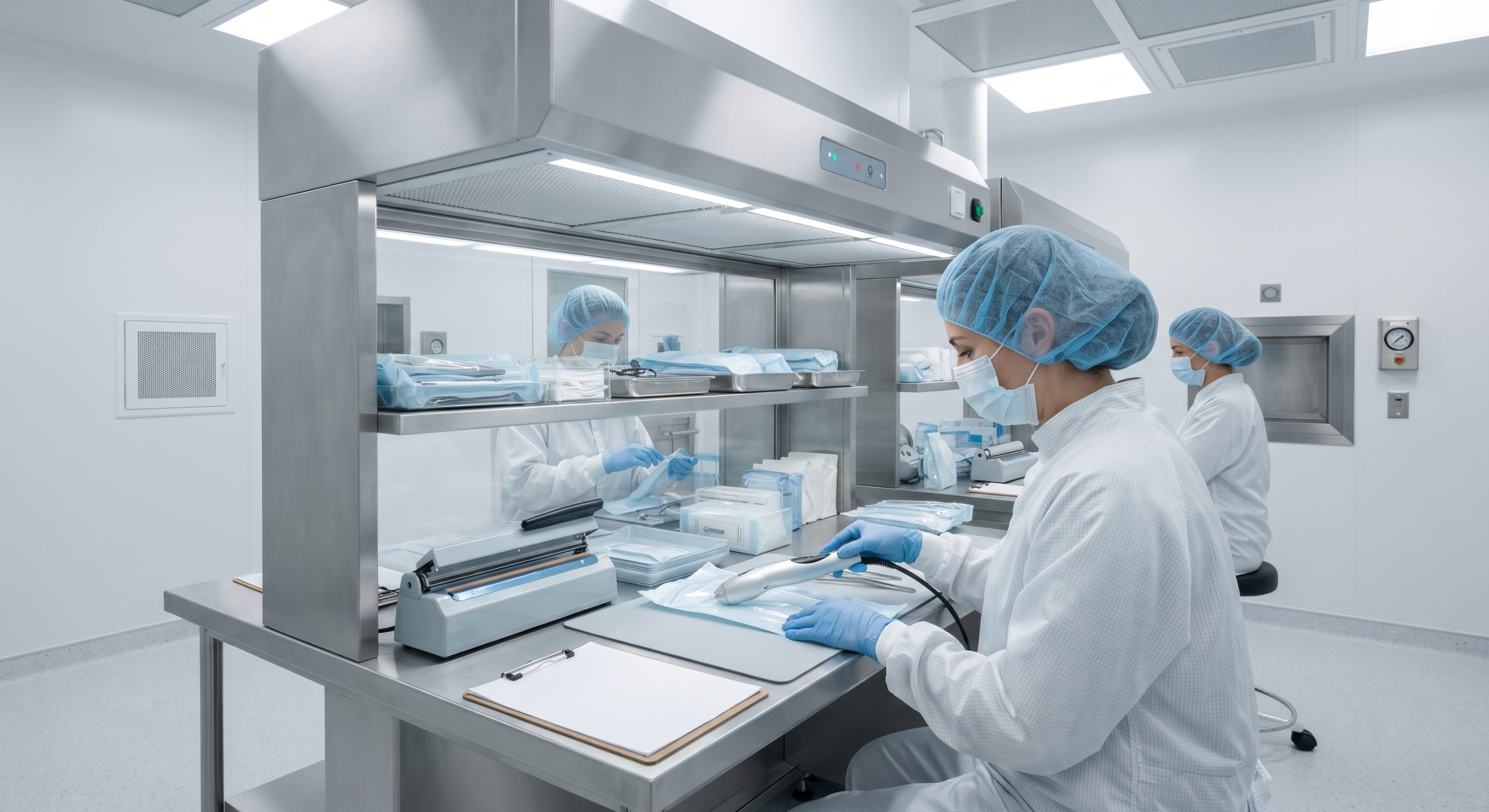
This technical deep dive examines the engineering controls, environmental monitoring protocols, and sterile barrier system (SBS) validation required to achieve zero contamination during medical part pack-out. We will analyze ISO Class 5 (Grade A) laminar flow environments, ISO 11607-1/-2 packaging validation, and ISO 13485:2016 clause 7.5.5 requirements, with direct application to aesthetic laser handpiece manufacturing and consumable optical component assembly.
Understanding the Contamination Triad: Particulate, Microbial, and Pyrogen
Particulate Contamination: The Optical Pathway Killer
In aesthetic laser systems operating at 755nm, 808nm, and 1064nm wavelengths, particulate contamination on optical fibers, collimating lenses, or sapphire cooling interfaces can cause energy density (fluence) attenuation of 15-30%, leading to inconsistent clinical outcomes and potential thermal damage to the handpiece. The ISO 14644-1 standard classifies cleanrooms by airborne particle concentration; for pack-out of sterile barrier systems, an ISO Class 5 environment (≤3,520 particles ≥0.5μm per m³) is mandatory under EU MDR Annex I 10.1.
Microbial Contamination: The Sterility Assurance Level (SAL) Requirement
For devices labeled sterile, ISO 11137 (radiation) or ISO 11135 (ethylene oxide) validation must demonstrate a Sterility Assurance Level of 10⁻⁶. However, terminal sterilization cannot compensate for excessive bioburden introduced during pack-out. ISO 11737-1 requires bioburden monitoring at defined intervals; a bioburden exceeding 100 CFU per device may invalidate the sterilization cycle and require reprocessing or rejection.
Pyrogen and Endotoxin Control
Bacterial endotoxins (lipopolysaccharides) are heat-stable and can survive terminal sterilization. For handpieces contacting mucosal surfaces or intravascular components, USP <161> and ISO 8536-4 limit endotoxin levels to 0.5 EU/mL. Depyrogenation tunnels operating at 250°C for ≥30 minutes (or validated equivalent) must be integrated into the pack-out workflow for glass and metal components.
Cleanroom Classification and Environmental Monitoring for Pack-Out
ISO Class 5 Laminar Flow: Design and Validation
The pack-out area must be physically segregated from ISO Class 7 or 8 assembly zones using airlocks and differential pressure monitoring (minimum 10 Pa positive pressure relative to adjacent spaces). HEPA filtration (H14, ≥99.995% efficiency at MPPS) must deliver 0.3-0.5 m/s unidirectional airflow across the critical zone. ISO 14644-3 requires airflow visualization (smoke studies) and particle count monitoring at 6-month intervals for ISO Class 5 areas.
Personnel and Gowning Protocols
Human operators are the primary contamination source in cleanrooms, shedding 1×10⁵ to 1×10⁶ particles per minute during active movement. EU GMP Annex 1 mandates Grade A/ISO 5 gowning including sterile double gloves, face masks, goggles, and dedicated cleanroom garments with validated gowning qualification every 6 months. Glove integrity testing (visual and ASTM D5151 pinhole detection) must occur at each gowning session.
Sterile Barrier System (SBS) Validation per ISO 11607
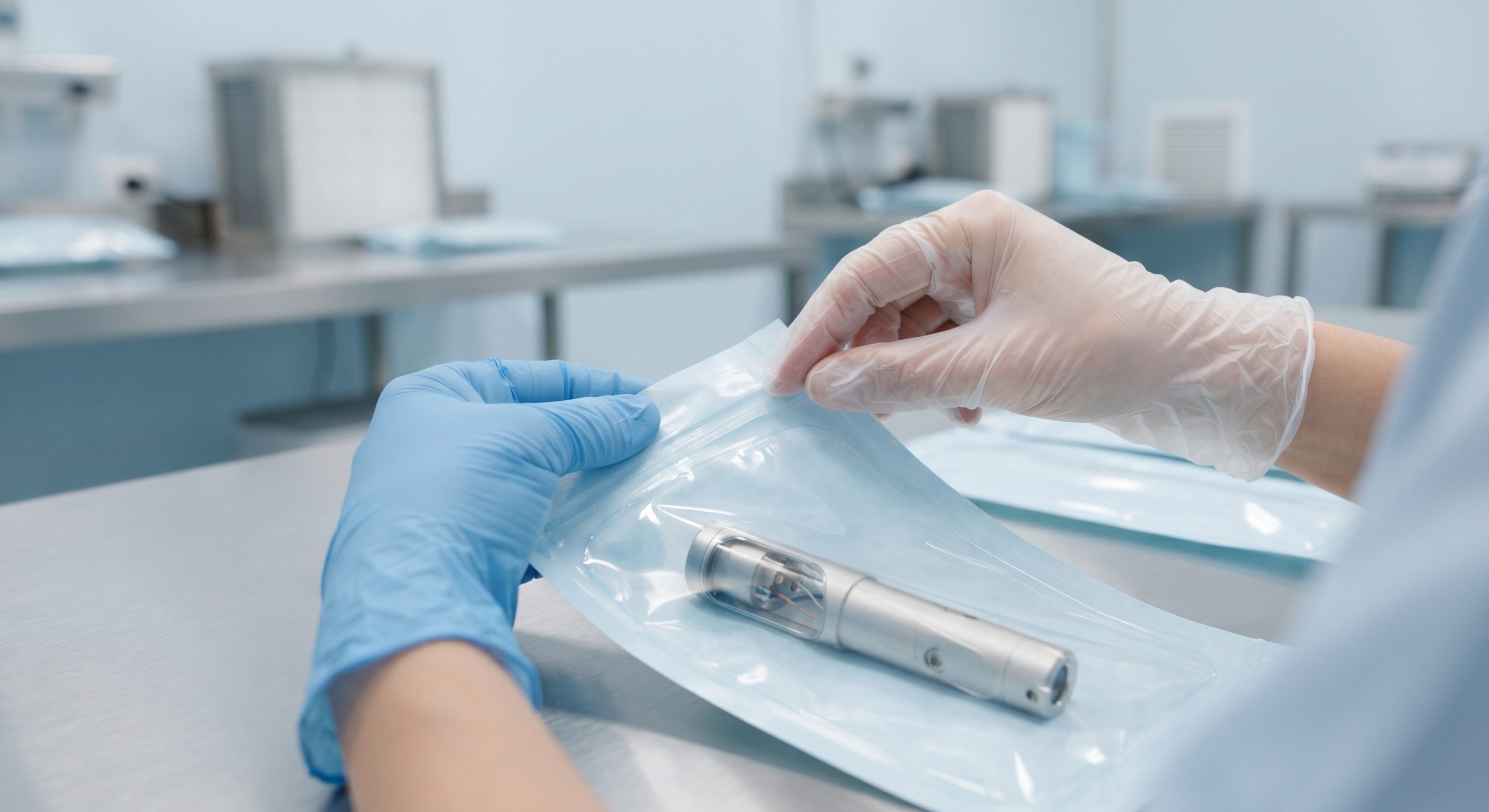
The sterile barrier system — typically Tyvek®/PET-PE pouches or thermoformed trays with breathable lids — must maintain sterility over a 5-year shelf life. ISO 11607-1 requires seal strength testing (ASTM F88, minimum 1.5 N/15mm), burst testing (ASTM F2054), and dye penetration testing (ASTM F1929) at validated process limits. Seal process validation must include lower and upper temperature/pressure/dwell time boundaries with ≥3 production runs demonstrating process capability (Cpk ≥1.33).
Packaging Integrity Testing: The Final Gate
Visual inspection under 2,000-3,000 lux illumination at 30-45 cm distance is insufficient alone. ISO 11607-2 requires 100% seal inspection for critical devices, supplemented by microbial ingress testing (ASTM F1608) and accelerated aging per ASTM F1980 (typically Q10=2.0 for 5-year equivalence at 55°C).
| Key Parameter | Technical Specification |
|---|---|
| Cleanroom Classification | ISO Class 5 (Grade A) — ≤3,520 particles ≥0.5μm/m³ |
| Airflow Velocity | 0.3-0.5 m/s unidirectional (ISO 14644-3) |
| HEPA Filtration Efficiency | H14 — ≥99.995% at MPPS |
| Viable Air Monitoring | ≤1 CFU/m³ — each shift |
| Surface Monitoring | ≤3 CFU/contact plate — daily |
| Personnel Glove Monitoring | ≤5 CFU/glove — each gowning session |
| Bioburden Limit | ≤100 CFU/device (ISO 11737-1) |
| Endotoxin Limit | ≤0.5 EU/mL (USP <161>) |
| Seal Strength | ≥1.5 N/15mm (ASTM F88) |
| Dye Penetration | Zero leakage (ASTM F1929) |
| SBS Shelf Life Validation | 5 years per ASTM F1980 (Q10=2.0, 55°C accelerated aging) |
| Regulatory Standards | ISO 13485:2016, ISO 11607-1/-2, EU MDR 2017/745, FDA 21 CFR 820 |
Critical Process Parameters and Acceptance Criteria
Environmental Monitoring Frequency
- Viable air sampling: ≤1 CFU/m³ (ISO Class 5) — performed each shift using settle plates and active air samplers
- Surface monitoring: ≤3 CFU/contact plate — daily at critical pack-out surfaces
- Personnel monitoring: ≤5 CFU/glove — each gowning session
Bioburden and Endotoxin Limits
- Bioburden: ≤100 CFU/device (ISO 11737-1) — monthly monitoring with alert level 50 CFU
- Endotoxin: ≤0.5 EU/mL (USP <161>) — batch release testing for mucosal-contact devices
Seal and Package Integrity
- Seal strength: ≥1.5 N/15mm (ASTM F88) — per lot sampling (n=5 minimum)
- Dye penetration: Zero leakage (ASTM F1929) — 100% for critical devices
Operator Training and Qualification for Zero-Defect Pack-Out
ISO 13485:2016 clause 6.2 requires documented competency matrices for all pack-out personnel. Training must cover gowning qualification, aseptic technique, seal inspection criteria, and deviation reporting. Annual requalification with practical assessments and written examinations (≥80% pass threshold) is mandatory. Microbial monitoring of personnel must demonstrate ≤5 CFU/glove consistently; failures trigger retraining and re-qualification.
Regulatory Compliance and Audit Readiness
Medical CE (EU MDR 2017/745) and FDA 21 CFR Part 820 both require validation of sterile packaging processes as special processes under ISO 13485 clause 7.5.6. The ISO 13485:2016 certification body will audit cleanroom validation reports, environmental monitoring trends, and SBS validation data during surveillance audits. Non-conformities in pack-out controls are among the top 10 most cited findings in Notified Body audits, frequently resulting in major non-conformities and certificate suspension.
Documentation Requirements
- Cleanroom validation reports (ISO 14644-1/-3) — renewed every 12 months
- SBS validation reports (ISO 11607-1/-2) — renewed every 3 years or upon material change
- Bioburden trending reports — reviewed quarterly with statistical process control (SPC) charts
- Operator qualification records — retained for ≥5 years
Conclusion: Building a Zero-Contamination Culture
Achieving zero contamination during medical part pack-out is not a single intervention but a systemic engineering and cultural commitment. For B2B buyers and clinic procurement managers sourcing aesthetic laser handpieces and consumables, verifying a supplier’s ISO 13485 certification, cleanroom validation reports, and SBS validation data is non-negotiable. Medical CE and FDA clearance provide the regulatory floor, but true zero-contamination performance requires continuous environmental monitoring, rigorous operator qualification, and validated sterile barrier systems. Clinics that demand this level of rigor from their device manufacturers protect their patients, their reputations, and their return on investment (ROI) — because in medical aesthetics, sterility is not optional; it is the foundation of trust.