
Blog
The Ultimate Clinic Guide to Due Diligence Checklist for North American OEM Distributors: Compliance, ROI, and Clinical Safety
2026年8月13日
Introduction: The High-Stakes Landscape of OEM Distribution in Medical Aesthetics
For the discerning clinic owner or med spa director, the decision to partner with an Original Equipment Manufacturer (OEM) distributor is one of the most critical business and clinical decisions you will make. In the rapidly evolving North American aesthetic device market, the difference between a profitable, safe investment and a regulatory nightmare often lies in the depth of your initial due diligence. This guide provides a comprehensive, technical checklist designed to navigate the complexities of sourcing high-powered aesthetic devices, ensuring alignment with FDA and Medical CE standards, and securing a robust Return on Investment (ROI). As the market matures, relying solely on a distributor’s marketing materials is insufficient; you must verify technical specifications, regulatory compliance, and supply chain integrity .

Phase 1: Regulatory Compliance and Legal Standing
The foundation of any due diligence process begins with a rigorous legal and regulatory audit. In the US, the FDA classifies many aesthetic lasers as Class II or III medical devices, requiring specific clearances. Your chosen OEM distributor must not only understand this landscape but also provide verifiable proof of compliance.
Essential Documentation to Request:
- FDA Clearance (510(k) or PMA): Verify the specific device model’s clearance. Do not accept general statements; request the actual FDA Summary of Safety and Effectiveness. This document outlines the cleared indications for use, which is non-negotiable for medical liability and insurance coverage.
- Medical CE Marking (Not just CE): For devices sold globally, ensure they hold a Medical CE Mark (Class IIa or IIb), not just a general CE mark for electronics. This indicates compliance with the strict European Medical Device Regulation (MDR) .
- Manufacturing Quality Systems: Insist on proof of ISO 13485 certification for the OEM manufacturer. This is the international standard for quality management systems in medical devices. It ensures consistent design, production, and post-market surveillance processes.
- Legal Entity Verification: Conduct a basic legal check. Verify the distributor’s business status, registration, and any history of litigation or liens. Compliance with U.S. sanctions and export controls is also critical, especially if the distributor handles sensitive technology .
Phase 2: Technical Specifications and Clinical Efficacy
Beyond paperwork, the core value of an aesthetic device lies in its technical performance. You must evaluate the hardware’s capability to deliver consistent, safe, and effective clinical outcomes. This is where you separate a medical-grade device from an inferior consumer-grade unit. The key performance indicators (KPIs) revolve around the physics of selective photothermolysis.
| Key Parameter | Technical Specification Requirement | Clinical Significance |
|---|---|---|
| Wavelength / Laser Type | Diode Laser (e.g., 755nm, 808nm, 1064nm) | Determines tissue penetration depth and target specificity for melanin and hemoglobin. |
| Energy Density (Fluence) | ≥ 20-40 J/cm² (Variable) | Higher fluence enhances treatment efficacy for hair removal and pigmented lesions. |
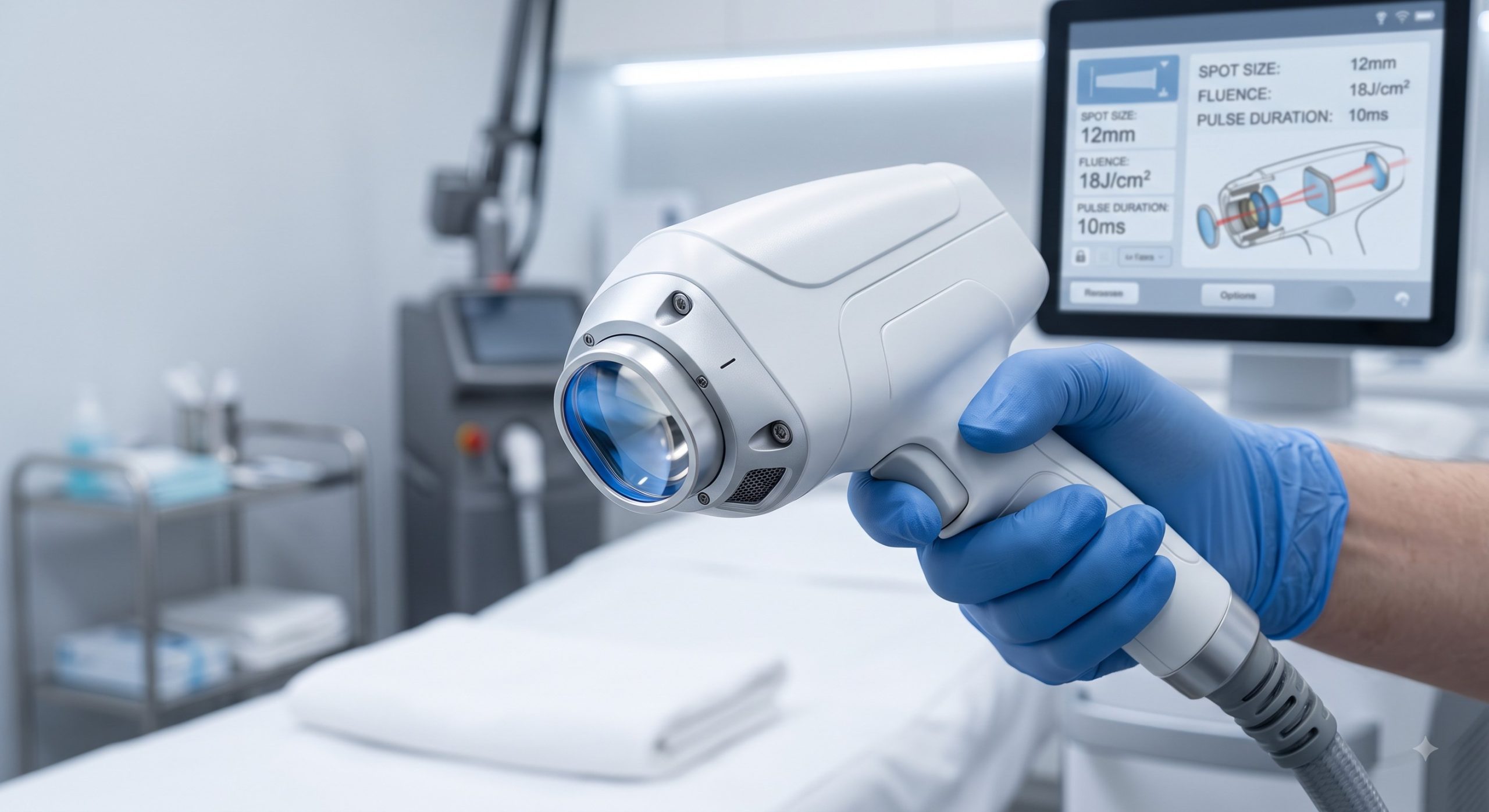
| Spot Size | ≥ 12×12 mm or larger | Larger spot sizes increase penetration depth and treatment speed, improving ROI. |
| Cooling System | Advanced Sapphire Contact / TEC Cooling | Protects epidermis, allows higher fluences, and ensures patient comfort and safety. |
| Regulatory Status | FDA 510(k) Cleared / Medical CE Mark | Validates clinical safety and efficacy for specific medical indications. |
| Quality Standard | ISO 13485 Certified Manufacturing | Ensures consistent quality management and regulatory compliance. |
Critical Technical Metrics to Audit:
- Laser Source and Wavelengths: Verify the type of laser or light source. For diode lasers, confirm the specific wavelengths (e.g., 755nm, 808nm, 1064nm). The 808nm wavelength is often cited for its deep penetration and affinity for melanin, making it a gold standard for hair reduction. Multi-wavelength platforms (755/808/1064nm) offer versatility in treating a broader range of Fitzpatrick skin types.
- Energy Density (Fluence) and Spot Size: Request the maximum Fluence (J/cm²). A higher fluence generally yields better clinical clearance rates, but it must be balanced with cooling. Spot Size is equally critical; larger spot sizes (e.g., 12x12mm or larger) allow for faster treatment sessions (higher throughput) and deeper energy penetration due to less scattering, directly impacting ROI.
- Pulse Width: This parameter dictates the duration the laser energy is delivered. For hair removal, it must be longer than the Thermal Relaxation Time (TRT) of the hair follicle but shorter than that of the surrounding tissue to achieve selective damage. The range is typically from milliseconds to hundreds of milliseconds.
- Epidermal Cooling Systems: Assess the cooling mechanism. Sapphire Contact Cooling or advanced TEC (Thermoelectric Cooling) systems are essential for patient safety and comfort, allowing for higher fluences without epidermal burns. Inquire about the cooling system’s durability and lifespan.
Phase 3: Operational Capability and Supply Chain Resilience
A technically superior device is useless if the supply chain falters. Your due diligence must assess the distributor’s operational backbone, service capabilities, and financial stability to ensure long-term support.
Supply Chain and Service Audit Points:
- Inventory Management: How does the distributor handle inventory? Do they stock critical components like handpieces or replacement laser bars in North America? Long lead times for parts can cripple a clinic’s schedule.
- Technical Support and Training: Evaluate the quality of their clinical training and field service engineers. Are they OEM-certified? Do they offer comprehensive training on parameter selection and safety protocols?
- Warranty and Service Level Agreements (SLAs): Scrutinize the warranty terms. Look for distributors offering comprehensive in-service warranties . Clarify what is covered (e.g., laser bars, handpieces, cooling system) and the response times for technical issues.
- Sub-Distributor Governance: If the distributor uses sub-distributors, demand clarity on who is responsible for servicing the device. This chain often creates grey areas for liability .
Phase 4: Financial Health and ROI Validation
The ultimate goal is profitability. A thorough financial due diligence not only secures your investment but also projects the long-term viability of the partnership.
Financial & ROI Checklist:
- Audited Financials: For significant capital investments, request audited annual accounts for the last 3-5 years. This indicates the distributor’s financial stability and staying power .
- Cost of Ownership (TCO): Analyze the Total Cost of Ownership. This includes the initial CapEx, but more importantly, the OpEx (consumables like handpieces, maintenance contracts, and repair costs). Evaluate the lifetime shot count of the handpiece and the cost per shot.
- Treatment Throughput: Calculate the potential revenue generation based on the device’s treatment speed (shots per second/pulse repetition rate) and spot size. A faster device increases patient throughput and accelerates ROI.
- Trade References: Request references from other clinics that have used the distributor’s devices. Ask about clinical results, device downtime, and the responsiveness of the distributor’s support team .
Conclusion: Making an Informed Strategic Decision
Conducting due diligence on a North American OEM distributor is not merely a procedural step; it is a strategic imperative that directly impacts your clinic’s reputation, patient safety, and financial success. By meticulously auditing regulatory compliance, technical specifications, operational capabilities, and financial health, you move from being a passive purchaser to an informed partner. This comprehensive checklist, grounded in technical rigor and business acumen, empowers you to select a distributor capable of delivering high-performing, safe, and profitable aesthetic solutions for the long term.