
Recurso
Medical CE & FDA Technical Compliance Register: Vacuum Packaging Validation Report for Rust Prevention
CLINICAL SAFETY POSITIONING
The Vacuum Packaging Validation Report for Rust Prevention establishes the critical process controls required to ensure that precision-engineered medical aesthetic devices—including laser handpieces, sapphire cooling tips, optical lenses, and electronic subassemblies—are protected from oxidation and corrosion during storage and transit. In the medical device OEM supply chain, rust formation on stainless steel or coated metallic components can compromise optical transmission, thermal dissipation, and electrical reliability. This validation report defines the vacuum packaging parameters, barrier material specifications, and acceptance criteria that guarantee a rust-free, clinically sterile condition upon arrival at the med spa or clinical end-user. The validation framework is aligned with ISO 9001:2015 and ISO 13485:2016 quality management principles, ensuring that every packaged component meets the highest standards of material integrity and patient safety.

TEMPERATURE MONITORING CAPABILITIES
While primarily a packaging validation protocol, the rust prevention strategy integrates environmental monitoring throughout the packaging lifecycle. Vacuum-sealed barrier bags are evaluated for oxygen transmission rate (OTR) and moisture vapor transmission rate (MVTR) under accelerated aging conditions. Real-time temperature and humidity data loggers accompany validation batches to confirm that the vacuum environment remains stable during simulated transport and warehouse storage. The validation protocol includes:
– Residual gas analysis to confirm vacuum level ≤ 5 kPa inside the sealed package.
– Humidity indicator cards calibrated to detect relative humidity above 40% RH, the threshold for accelerated rust nucleation.
– Desiccant performance verification to maintain internal humidity below 20% RH for a minimum of 24 months.
– Seal integrity testing via dye penetration and burst testing per ASTM F1929 and ASTM F1140.
These monitoring capabilities ensure that the vacuum packaging remains a reliable barrier against the primary causes of rust: oxygen, moisture, and galvanic corrosion catalysts.
PREMIUM COMPONENT ASSEMBLY
The vacuum packaging validation applies to the following premium component assemblies critical to aesthetic device performance:
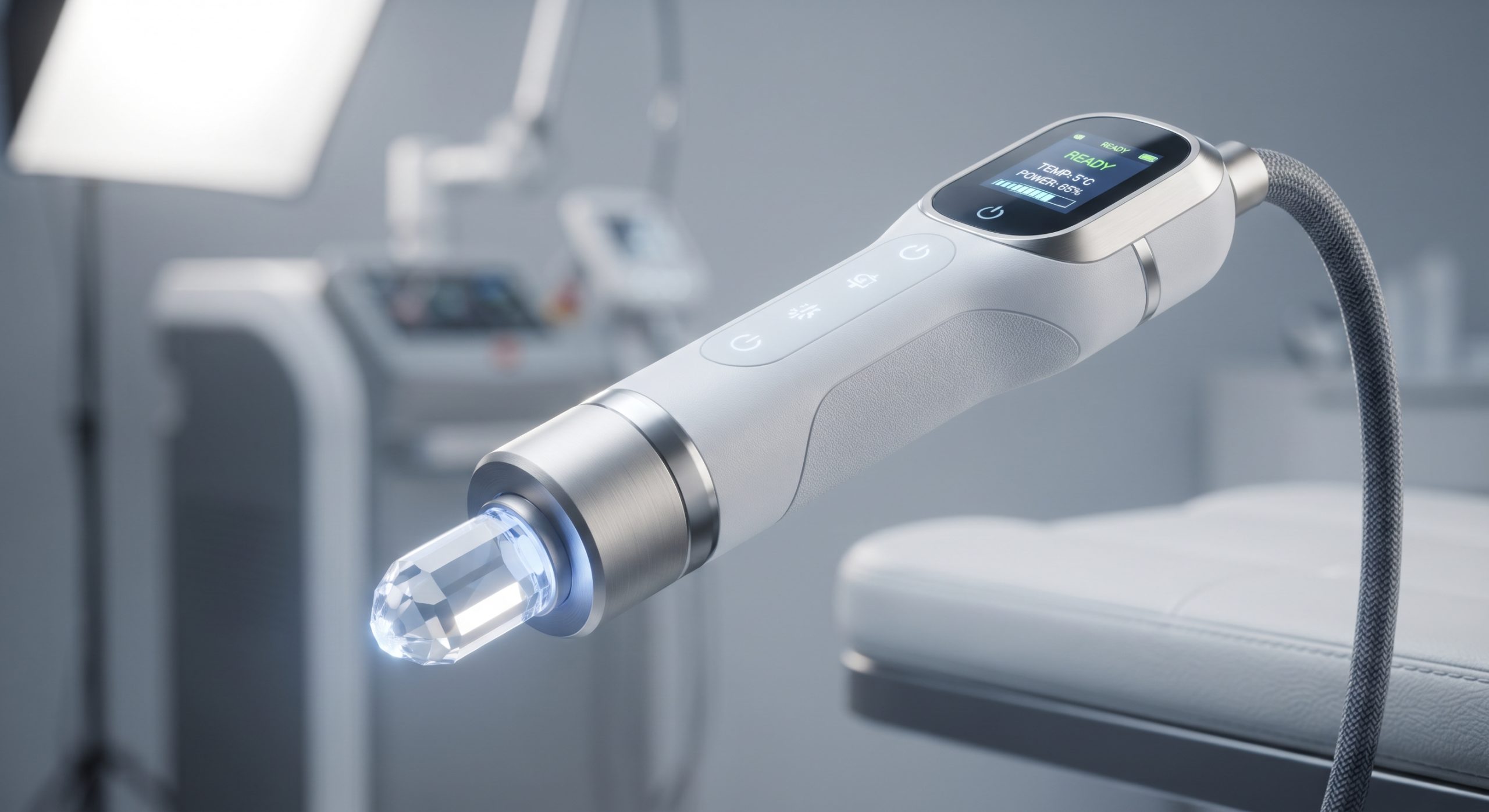
– Sapphire cooling tips and their metallic mounting rings.
– Diode laser bars and their copper or tungsten heat sinks.
– Optical lenses and dichroic mirrors with anti-reflective coatings.
– Handpiece chassis and connector pins.
– Electronic control board connectors and grounding hardware.
Each component assembly is pre-cleaned using a validated ultrasonic degreasing and passivation process. The passivation step—using citric or nitric acid per ASTM A967—restores the chromium oxide layer on stainless steel surfaces, providing a primary defense against rust. Components are then dried in a nitrogen-purged chamber before vacuum packaging to eliminate residual moisture. The validation confirms that this assembly sequence achieves a rust-free shelf life of at least 36 months under controlled storage conditions (15–30°C, <60% RH). DETAILED PARAMETERS The following parameter register defines the validated vacuum packaging and rust prevention specifications. These values are derived from stability studies, accelerated aging tests, and supplier qualification data. All parameters are subject to change control under the OEM's quality management system.
| Parameter | Specification |
|---|---|
| Vacuum Level | ≤ 5 kPa (absolute), verified by residual gas analysis |
| Barrier Material | Multi-layer PET/AL/PE or PET/AL/NY/PE, OTR ≤ 0.1 cc/m²/day, MVTR ≤ 0.1 g/m²/day |
| Seal Width | ≥ 8 mm, validated by burst test (ASTM F1140) and dye penetration (ASTM F1929) |
| Desiccant | Silica gel, 5–10 g per package, sized per ASTM D4990 |
| Humidity Indicator | Calibrated 30–40–50% RH spots, irreversible at >40% RH |
| Passivation Standard | ASTM A967 (citric or nitric acid), chromium oxide layer ≥ 1.5 nm |
| Shelf Life | 36 months at 15–30°C, <60% RH (accelerated aging per ASTM F1980) |
| Packaging Validation | ASTM D4169 (distribution), ISTA 3A (parcel), ISO 11607 (sterile barrier if applicable) |
| Certificate Documentation | CoC and CoA per batch, retained for 5 years |
MEDICAL CERTIFICATIONS
The Vacuum Packaging Validation Report for Rust Prevention is supported by a comprehensive certification matrix that ensures compliance with international medical device and packaging standards:
– ISO 13485:2016 – Medical devices quality management system.
– ISO 9001:2015 – Quality management systems requirements.
– ISO 11607-1 and ISO 11607-2 – Packaging for terminally sterilized medical devices (where applicable).
– ASTM D4169 – Standard practice for performance testing of shipping containers and systems.
– ASTM F1980 – Accelerated aging of sterile barrier systems.
– ISTA 3A – Packaging performance testing for parcel delivery.
– RoHS and REACH – Material compliance for electronic components.
– FDA 21 CFR Part 820 – Quality system regulation (for devices intended for U.S. market).
Each validation batch is accompanied by a Certificate of Conformance (CoC) and a Certificate of Analysis (CoA) documenting vacuum level, seal strength, residual humidity, and visual inspection results. These certifications are available for review during supplier audits and are integral to the OEM’s technical file.
CLINICAL ENVIRONMENT
The validated vacuum packaging directly supports the clinical environment by ensuring that critical aesthetic device components arrive free from rust, corrosion, and particulate contamination. In the med spa or dermatology clinic, rust on a handpiece connector or cooling tip can lead to electrical arcing, reduced cooling efficiency, or patient discomfort. By implementing this validation report, the OEM guarantees that:
– Handpieces and tips are ready for immediate clinical use upon unpacking.
– No additional cleaning or passivation is required by the clinic.
– Shelf life is clearly marked and supported by real-time stability data.
– Packaging disposal follows environmentally responsible guidelines (recyclable barrier films where possible).
This validation report thus serves as a foundational document for the safe, reliable, and compliant deployment of aesthetic devices in clinical practice.
📥 Download Technical Specification
Click the button below to view or download the full official PDF datasheet.