
BLOG
Updating Technical Construction Files for Design Revisions: Medical CE, FDA & ISO 13485 Compliance Blueprint
2026年9月9日
Introduction: The Critical Imperative of Technical Construction File Updates
For medical aesthetic device manufacturers and clinic operators, a Technical Construction File (TCF) is not merely a regulatory checkbox—it is the foundational clinical evidence portfolio that validates device safety, performance, and compliance. When introducing design revisions—whether to optical output, cooling mechanisms, or software algorithms—updating the TCF becomes a non-negotiable clinical governance requirement. Failure to synchronize your TCF with hardware modifications can result in Medical CE certification lapses, FDA audit findings, and ISO 13485 non-conformities that halt market access and erode clinic trust. This technical blueprint outlines a structured, data-driven protocol for TCF updates, integrating specific metrics like 755nm, 808nm, and 1064nm wavelengths, spot size variations, fluence ranges, and pulse width parameters to ensure every design revision is clinically substantiated and regulatorily robust.

Part 1: Regulatory Triggers – When Design Revisions Demand TCF Updates
Not every iterative change mandates a full TCF overhaul. However, design revisions that affect intended use, performance specifications, or safety risk profiles require immediate TCF updates under Medical Device Regulation (MDR) 2017/745 and FDA 510(k) guidance. Key triggers include:
- Optical Engine Modifications: Altering laser bar configurations or wavelength combinations (e.g., adding a 1064nm channel to an existing 808nm system) shifts tissue interaction dynamics.
- Cooling System Upgrades: Transitioning from traditional air cooling to Sapphire contact cooling or TEC (thermoelectric) assemblies changes epidermal protection efficacy and requires updated thermal safety calculations.
- Software/Firmware Updates: Changes to pulse duration algorithms, fluence delivery patterns, or spot size selection logic directly impact selective photothermolysis outcomes.
- Handpiece Redesign: Modifications to handpiece geometry, energy transmission optics, or shot count lifespan necessitate re-validation of output consistency and durability.
Clinically, these changes demand re-assessment of Maximum Permissible Exposure (MPE), Nominal Hazard Zone (NHZ), and thermal relaxation time matching for target chromophores. For example, increasing spot size from 10mm to 15mm reduces peak fluence density but enhances treatment speed, altering both efficacy and safety margins for Fitzpatrick Skin Types IV-VI.
Part 2: The Technical Dossier – Core Components of a Compliant TCF
A comprehensive TCF for any aesthetic laser device includes:
- Device Description & Intended Use: Clear articulation of indications (e.g., permanent hair reduction, vascular lesion clearance) and target patient demographics.
- Design & Manufacturing Information: Complete bill of materials, OEM component specifications (including laser diode brands and cooling pump models), and assembly drawings.
- Essential Requirements Checklist: Mapping to Annex I of MDR and IEC 60601-2-22 for laser safety.
- Risk Management File: Updated ISO 14971 hazard analysis, including FMEA for new failure modes introduced by the design revision.
- Clinical Evaluation Report (CER): Updated literature reviews and, where necessary, new clinical trial data or performance validation studies.
- Labeling & Instructions for Use (IFU): Reflecting new parameters, contraindications, and operator training requirements.
Each section must explicitly address how the design revision affects or maintains the device’s risk-benefit profile.
Part 3: Parametric Re-Validation – Generating Essential Technical Data
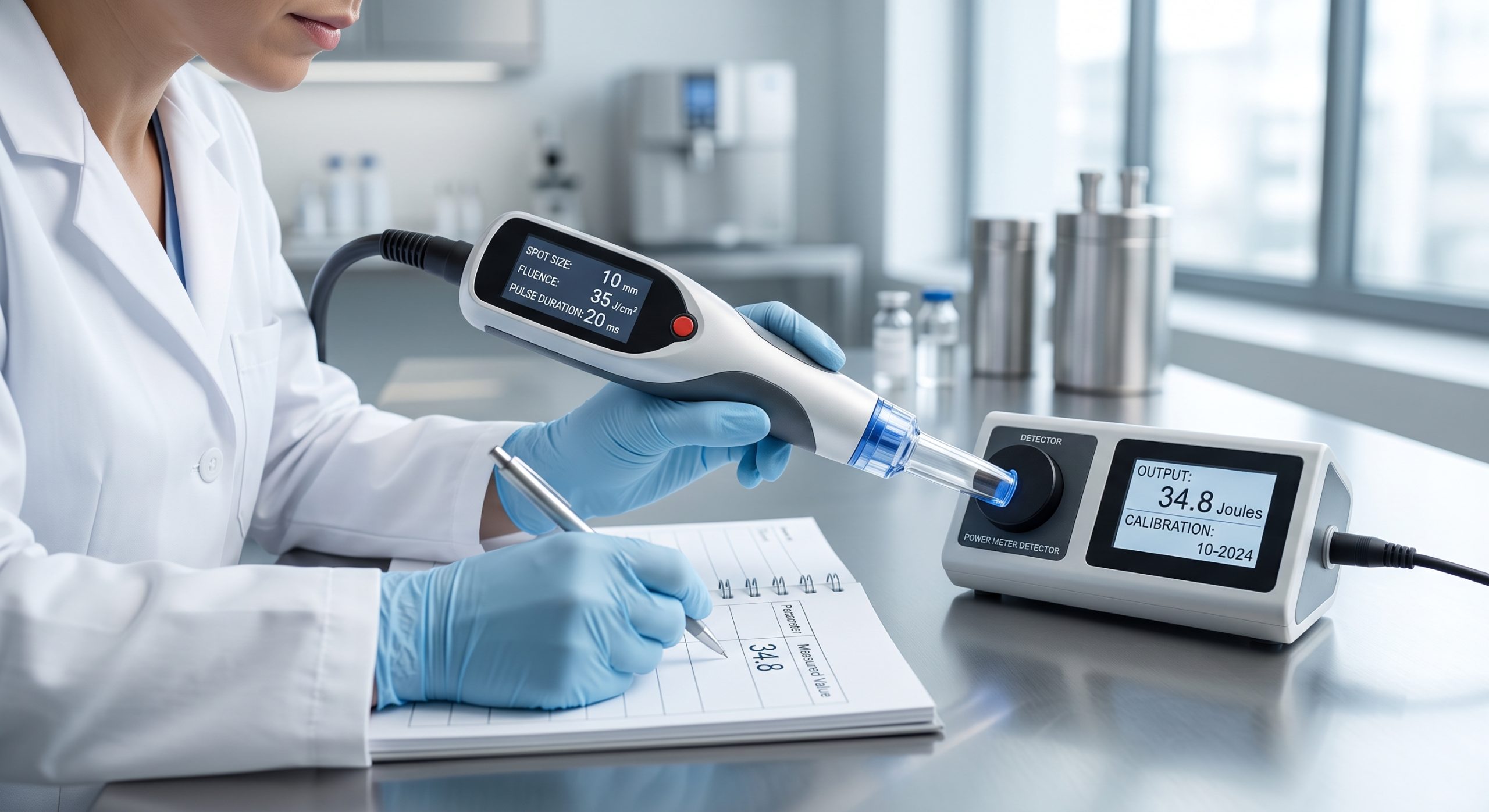
For design revisions involving optical output, the TCF update must include fresh test reports that quantify:
- Output Power & Energy Stability: Measured across a range of fluence settings (e.g., 5-40 J/cm²) and pulse widths (e.g., 5-400 ms), ensuring ±5% tolerance in line with manufacturer specifications.
- Beam Profile & Spot Size Integrity: Using beam profilers to confirm top-hat or Gaussian distribution and spot size accuracy to within ±0.5mm.
- Cooling System Performance: Documenting Sapphire tip temperature curves during continuous operation (e.g., maintaining 5°C surface temperature for epidermal protection).
- Pulse Repetition Rate & Frequency: Validating high-frequency modes (e.g., 1-10 Hz) for high-throughput clinics.
These metrics must be compared against baseline design input specifications and justified through clinical rationale. For instance, a change in pulse width from 10ms to 30ms for 1064nm wavelength alters thermal confinement in deeper chromophores, necessitating updated Fitzpatrick Skin Type guidance.
| Parameter Group | Pre-Revision Specification | Post-Revision Specification | Clinical Justification |
|---|---|---|---|
| Wavelength (Diode) | 808nm | 808nm + 755nm + 1064nm (selectable) | Expanded indications for melanin-rich and deeper vascular targets |
| Spot Size | 10mm x 10mm | 12mm x 12mm (large) / 8mm x 8mm (small) | Large spot increases speed; small spot enhances precision |
| Fluence (Energy Density) | 5-20 J/cm² | 5-40 J/cm² | Broader therapeutic range for diverse skin types and indications |
| Pulse Width | 10-100 ms | 5-400 ms | Short pulses for epidermal targets; long pulses for deep hair follicles |
| Cooling System | Air Cooling | Sapphire Contact Cooling (0-4°C) | Superior epidermal protection enables higher fluence with reduced pain |
| Output Energy Stability | ±10% | ±5% | Improved consistency ensures predictable clinical outcomes |
Part 4: Clinical Evidence & Performance Validation
Design revisions that alter fluence, pulse duration, or cooling mechanisms require clinical validation to confirm efficacy and safety are at least equivalent to the original design. This involves:
- In Vivo Studies: Conducting split-body or cohort trials with objective outcome measures such as hair count reduction at 3- and 6-months post-treatment, or pigment clearance via dermatoscopy.
- Subjectivity Assessments: Incorporating patient satisfaction scores and pain scores (e.g., Visual Analogue Scale) to evaluate comfort improvements from new cooling systems.
- Adverse Event Monitoring: Detailed documentation of any erythema, purpura, or hyperpigmentation incidents, stratified by Fitzpatrick Skin Type and treatment parameters.
For a design revision that introduces a multi-wavelength capability (e.g., adding 755nm for superficial pigments to an existing 808nm hair reduction device), the CER must provide evidence for each wavelength’s indication, drawing on both published literature and de novo test data.
Part 5: Compliance Documentation & Notified Body Submission Strategy
Once the technical and clinical data are consolidated, the updated TCF must be compiled in a regulatorily compliant format:
- Document Version Control: Clear traceability between design revision numbers, engineering change orders (ECOs), and TCF versions.
- Gap Analysis: A dedicated section summarizing how the design revision addresses previously identified residual risks or performance gaps.
- Notified Body Submission: For Medical CE certified devices, a change notification is required per MDR Article 120 and MDCG 2020-3. The submission must include the revised TCF, test reports, and a declaration of conformity for the affected modules.
- FDA 510(k) Considerations: If the design revision substantially changes intended use or performance characteristics, a new 510(k) submission may be required, referencing the updated TCF as part of the predicate device comparison.
Proactive engagement with regulatory consultants and testing laboratories (e.g., UL, TÜV SÜD) is recommended to streamline approval timelines.
Part 6: Real-World Impact – Clinical Outcomes and Business Continuity
Timely TCF updates for design revisions not only ensure regulatory compliance but also drive clinic profitability and patient safety. Clinics deploying devices with validated design revisions report:
- Superior Clinical Clearance: Optimized parameters lead to higher hair reduction rates (e.g., 85-90% at 6 months) and faster vascular lesion resolution.
- Enhanced Patient Experience: Advanced cooling systems reduce treatment pain by up to 60%, improving patient retention and referral rates.
- Operational Efficiency: Larger spot sizes and higher frequencies shorten session times, enabling clinics to increase daily patient throughput and return on investment.
Conversely, failure to update the TCF can result in regulatory holds, product recalls, or liability claims, all of which severely damage brand reputation and market share.
Conclusion: Strategic TCF Management as a Competitive Advantage
In the rapidly evolving medical aesthetic device landscape, design revisions are essential for maintaining clinical relevance and technological leadership. However, the technical pathway to market must be paved with meticulous TCF updates that reflect the highest standards of clinical evidence, engineering rigor, and regulatory compliance. By adhering to the structured framework outlined above—triggered by ISO 13485 processes, validated through parametric testing, and substantiated by clinical data—manufacturers and clinics can confidently navigate Medical CE and FDA requirements, ensuring their devices deliver safe, effective, and commercially viable outcomes. Ultimately, a robust TCF is not just a regulatory document; it is a strategic asset that underpins clinic success, patient trust, and industry innovation.